






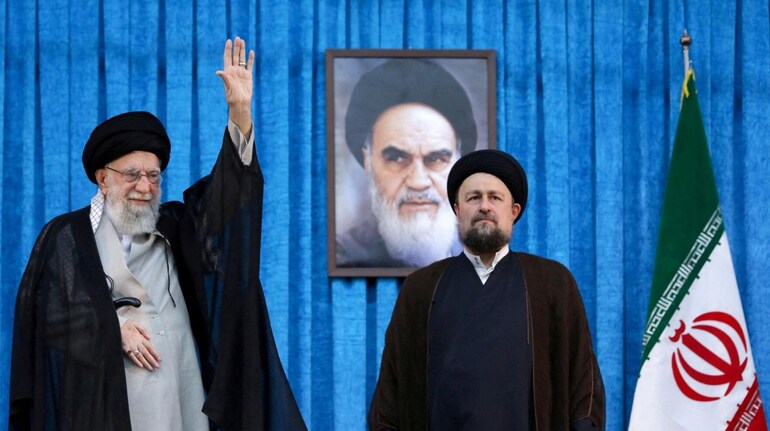

Following the death of Iran’s Supreme Leader Ayatollah Ali Khamenei on February 28, attention has turned to the complex process of choosing his successor. While the Assembly of Experts is constitutionally responsible for selecting the next Supreme Leader, several reports suggest that Hassan Khomeini, the grandson of the Islamic Republic’s founder Ayatollah Ruhollah Khomeini, has emerged as one of the leading figures in the succession debate.
According to Reuters and other international media reports, Hassan Khomeini is not only involved in discussions about the future leadership but is also widely viewed as a serious contender for the position himself. His name has gained traction at a time when Iran is facing significant political and military challenges.
Who is Hassan Khomeini?
Hassan Khomeini is the grandson of Ayatollah Ruhollah Khomeini, the architect of the 1979 Islamic Revolution and the founder of the modern Islamic Republic of Iran.
According to The Independent, Hassan Khomeini was among three senior clerics reportedly nominated by Ali Khamenei to the Assembly of Experts as possible successors in the event of his assassination.
He is often described as a relatively moderate cleric and is closely associated with reformist figures such as former Iranian presidents Mohammad Khatami and Hassan Rouhani.
One of his biggest sources of influence is his family legacy. As the grandson of the revolutionary leader who established the Islamic Republic, he carries significant symbolic authority and religious legitimacy during a period of uncertainty.
Hassan Khomeini currently serves as the custodian of his grandfather’s mausoleum in Tehran. Despite his influence in religious and political circles, he has never held a formal government office.
A cleric with reformist leanings
International media reports show that Hassan Khomeini has at times expressed moderate criticism of government institutions while maintaining loyalty to the Islamic Republic.
In the aftermath of the 2022 protests following the death of Mahsa Amini in the custody of Iran’s morality police, Hassan Khomeini called on authorities to explain the incident publicly. He demanded that officials “transparently and precisely account for what has happened” and questioned the “pretext of ‘guidance and education’” used to justify her detention.
He also criticized the Guardian Council in 2021 after it disqualified numerous reformist and moderate candidates from the presidential election. Highlighting the limited choice available to voters, he remarked, “You can’t pick someone for me and tell me to vote for them!”
In 2008, he was also seen as challenging the growing political influence of the Islamic Revolutionary Guard Corps (IRGC). He argued that those loyal to his grandfather’s legacy should follow the original principle that the military should remain separate from political affairs.
Another major episode came in 2016 when the Guardian Council barred him from running for the Assembly of Experts, citing insufficient religious credentials. Hassan Khomeini appealed the decision, noting that the council had ignored his scholarly work and the backing he had received from senior clerics.
Balancing reform and loyalty
Despite these instances of criticism, Hassan Khomeini has generally maintained loyalty to the Iranian political system.
He supported the government of former president Hassan Rouhani and backed the 2015 nuclear agreement with world powers.
During the intense unrest that gripped Iran between 2025 and 2026, he sided with the establishment and criticized protesters who chanted slogans against the Supreme Leader. He accused rioters of serving foreign interests.
He has also praised Ali Khamenei’s leadership, commending the Supreme Leader’s “wisdom and courage” in managing national crises. Hassan Khomeini also expressed support for Iran’s military actions against Israel.
Other contenders in the succession race
Hassan Khomeini is not the only influential figure being discussed as a potential successor.
One of the most prominent names is Mojtaba Khamenei, the son of the late Supreme Leader. Mojtaba is believed to have strong backing from the Islamic Revolutionary Guard Corps. However, his candidacy has also generated criticism because it could appear to establish a hereditary leadership system.
Another possible figure is Alireza Arafi, a senior cleric and deputy chairman of the Assembly of Experts. He is currently serving on a three-person interim leadership council.
Gholam-Hossein Mohseni-Eje’i, Iran’s hardline judiciary chief, is also a member of the interim council and is considered another influential candidate.
The legacy of Ayatollah Ruhollah Khomeini
Hassan Khomeini’s political relevance is closely tied to the legacy of his grandfather, Ayatollah Ruhollah Khomeini.
Ruhollah Khomeini led the 1979 Iranian Revolution, which overthrew the monarchy of Shah Mohammad Reza Pahlavi and established the Islamic Republic of Iran.
A senior Shia cleric, he served as Iran’s first Supreme Leader from 1979 until his death in 1989.
Khomeini became a prominent critic of the Shah during the early 1960s. After being arrested for opposing the monarch’s policies and reforms, he spent 15 years in exile in Turkey, Iraq and France. During this period, his speeches and sermons were secretly circulated inside Iran, helping fuel revolutionary sentiment.
He returned to Iran in February 1979 after the Shah fled the country. Millions of Iranians welcomed him back, and the monarchy collapsed within days.
Khomeini established the doctrine of velayat-e faqih, or “guardianship of the jurist”, which holds that Islamic scholars should rule the state.
His leadership shaped several defining moments in Iran’s modern history, including the 1979 hostage crisis when Iranian militants seized the US Embassy in Tehran and held 52 Americans for 444 days.
Another defining event was the Iran–Iraq war from 1980 to 1988. Khomeini eventually accepted a United Nations mediated ceasefire, famously describing the decision as “drinking a poisoned chalice”.
Ayatollah Ruhollah Khomeini died on June 3, 1989. His funeral drew an estimated 10 million mourners, making it one of the largest gatherings in history. He was succeeded as Supreme Leader by Ali Khamenei.
Now, decades later, the founder’s grandson has emerged as a possible candidate to lead the system his grandfather created.
Discover the latest Business News, Sensex, and Nifty updates. Obtain Personal Finance insights, tax queries, and expert opinions on Moneycontrol or download the Moneycontrol App to stay updated!
Find the best of Al News in one place, specially curated for you every weekend.
Stay on top of the latest tech trends and biggest startup news.





