







Tension between Washington and Tehran is increasingly visible across sea and land, with satellite imagery and military movements pointing to a widening zone of confrontation as US forces draw closer to Iran’s shores.
At sea, the United States has positioned one of its most formidable naval formations in the region. The USS Abraham Lincoln Carrier Strike Group is operating far out in the Arabian Sea, projecting American power deep into the Middle East. Iran has responded in kind, but closer to home. Satellite images show the Iranian Navy’s Shahid Bagheri drone carrier positioned about six kilometres off Bandar Abbas, near the strategically vital Strait of Hormuz. On land, meanwhile, Iran appears to be fortifying its most sensitive installations, signalling concern over the possibility of renewed strikes.
Commercial satellite imagery analysed by researchers at the Institute of Science and International Security reveals that Iran has intensified efforts to harden its nuclear infrastructure, reports India Today. According to American physicist and weapons expert David Albright and his team, Tehran is pushing key facilities deeper underground as US military pressure mounts.
This shift comes against the backdrop of last year’s brief but intense 12-day war, during which US forces struck Iran’s Fordow and Natanz nuclear sites with bunker-buster bombs, reportedly causing significant damage. That experience appears to have reshaped Iran’s defensive posture.
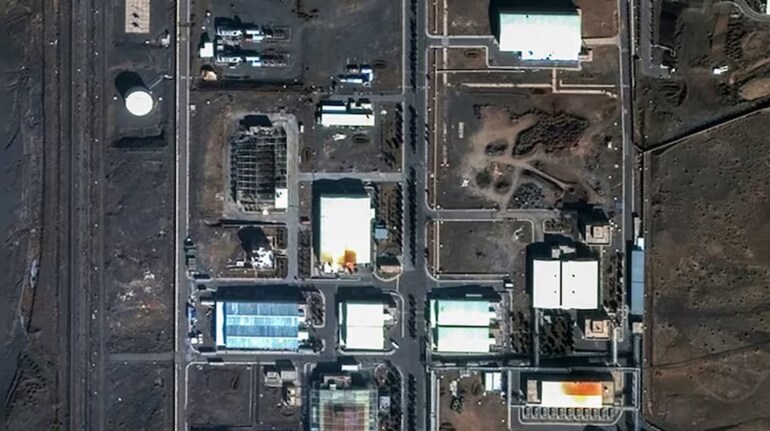
Recent satellite images, cited by India Today in its report, show fresh activity at one of Iran’s primary nuclear facilities inside the Esfahan nuclear complex. Tunnel entrances appear to have been further buried, with large piles of newly moved soil covering access points. Analysts have also identified dump trucks carrying soil along roads leading to the tunnel complex, suggesting continued backfilling operations aimed at sealing or reinforcing underground entrances, particularly the central access route.
The US attack on Fordow in June 2025 involved the use of 12 GBU-57 Massive Ordnance Penetrators, each weighing 30,000 pounds. These bombs targeted ventilation shafts connected to centrifuge cascade halls located at least 200 feet underground, underscoring Washington’s focus on Iran’s deeply buried nuclear capabilities.
Satellite imagery from December 2025 and January 2026 also shows reconstruction work at Esfahan following an Israeli air strike in June last year. The metal framework of a damaged structure has been repaired and a new roof rebuilt in stages beginning in early December. While most debris had been cleared earlier, images indicate that sections at either end of the annex and parts of potential lower-level structures inside the main building remain intact.
At sea, the picture is equally tense. Shortly after the USS Abraham Lincoln’s deployment to the Middle East, Iranian state-affiliated media reported that Tehran had moved “hundreds of fast, missile-launching and support vessels” closer to the American carrier group. Additional satellite imagery reviewed by India Today confirms the presence of the Shahid Bagheri drone carrier off Bandar Abbas, placing it in a critical maritime chokepoint.
Open-source researcher Ben Tzion, along with confirmation from the Institute for the Study of War, has highlighted the proximity of Iranian naval assets to US forces. Iranian media has also pointed to the deployment of fast attack craft, missile boats and support vessels operating near the American strike group in the Arabian Sea.
To further signal deterrence, the Islamic Revolutionary Guard Corps Navy is expected to hold a two-day live-fire exercise in the Strait of Hormuz on February 1 and 2, according to Western media reports. Iranian outlets have also speculated about a possible joint naval drill with China and Russia in the Sea of Oman and the Indian Ocean, although neither Moscow nor Beijing has confirmed such plans.
As the Institute for the Study of War has noted, these naval deployments are significant because Iran did not employ maritime forces during the June 2025 Israel-Iran conflict. This time, Tehran appears determined to show it is prepared on every front.
Discover the latest Business News, Sensex, and Nifty updates. Obtain Personal Finance insights, tax queries, and expert opinions on Moneycontrol or download the Moneycontrol App to stay updated!
Find the best of Al News in one place, specially curated for you every weekend.
Stay on top of the latest tech trends and biggest startup news.





