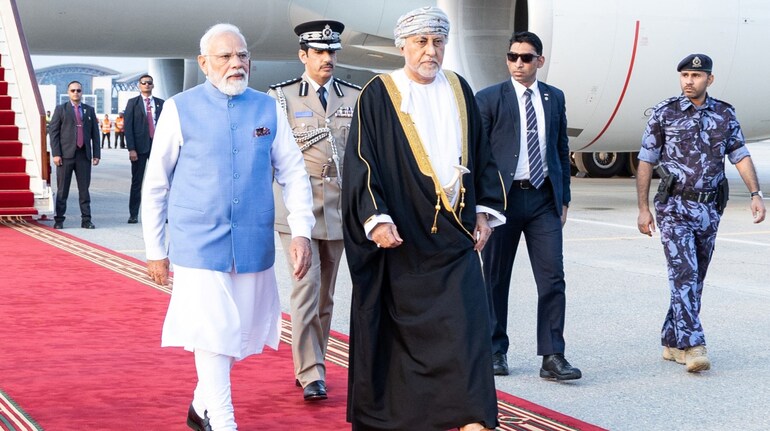
India’s decision to sign a Comprehensive Economic Partnership Agreement with Oman marks a carefully timed shift in New Delhi’s trade strategy. As global trade becomes more restrictive and major markets raise barriers, India is moving to secure dependable export destinations closer home. The agreement, signed on Thursday in Muscat during Prime Minister Narendra Modi’s visit, reflects an effort to reduce India’s exposure to punitive tariffs, particularly those imposed by the United States, while deepening economic ties with West Asia.
The India-Oman pact is the second major free trade agreement finalised by New Delhi in the past six months, after the deal with the United Kingdom in May. Together, these agreements signal a renewed push to diversify export markets and lower risks arising from geopolitical and trade tensions.
Why India-Oman CEPA comes at a critical moment
India’s exporters are currently facing steep trade barriers in the United States. Import tariffs on Indian goods stand at 50 percent, with negotiations yet to deliver any relief.
The US remains India’s largest export destination, making these tariffs particularly damaging. A portion of the duties is linked to India’s continued purchase of discounted Russian crude oil, which Washington says indirectly supports Moscow’s war effort in Ukraine.
The impact has been sharp in labour-intensive sectors such as textiles, auto components and metals, where even small cost disadvantages can affect competitiveness. Talks between India and the US on a broader trade agreement have stalled amid diplomatic strains, leaving exporters exposed.
Against this backdrop, India has accelerated efforts to conclude trade agreements with other partners. The Oman deal fits into this recalibration, aimed at spreading export risk and reducing dependence on any single market.
India already has 15 free trade agreements covering 26 countries, along with six preferential trade agreements, and is negotiating with over 50 other partners, trade analyst Ajay Srivastava told AP. Once these talks conclude, India is expected to have trade arrangements with most major global economies, with China being the key exception.
What signing of India-Oman CEPA signals
The agreement was signed by India’s Commerce and Industry Minister Piyush Goyal and Oman’s Minister of Commerce, Industry and Investment Promotion Qais bin Mohammed Al Yousef. The ceremony was attended by Modi and Oman’s head of state Sultan Haitham bin Tarik, underlining the political importance of the pact.
Beyond trade, the deal reflects a broader strategic alignment. Oman sits at the mouth of the Strait of Hormuz, a narrow but critical waterway through which a large share of global oil shipments pass. Stronger economic ties also support India’s long-term energy and maritime interests in the region.
Highlighting the broader impact, Modi said, “This (pact) will set a new pace of our trade, add new trust to our investments and open doors to new opportunities in many sectors.”
For Oman, the CEPA is equally significant. It is Muscat’s first bilateral trade agreement since its deal with the United States in 2006.
The agreement also comes as talks between India and the Gulf Cooperation Council as a bloc remain stalled. While a comprehensive GCC deal did not materialise, India now has trade agreements with two GCC members, the UAE and Oman.
What India-Oman CEPA includes
Under the CEPA, Oman will provide zero-duty access on more than 98 percent of its tariff lines. These concessions cover 99.38 percent of India’s exports to Oman by value.
Nearly 98 percent of Indian product categories will see immediate tariff elimination once the agreement takes effect. The benefits span major labour-intensive sectors.
Indian exports such as gems and jewellery, textiles, leather, footwear, sports goods, plastics, furniture, agricultural products, engineering goods, pharmaceuticals, medical devices and automobiles will enter Oman duty free. Earlier, many of these products faced import duties of around five percent, reducing price competitiveness.
India has also offered market access, agreeing to reduce or eliminate tariffs on 77.79 percent of its tariff lines, covering about 95 percent of imports from Oman by value.
Sensitive items such as dates, marbles and petrochemical products will be handled through tariff rate quotas rather than full duty elimination. India has also placed several products on an exclusion list, including dairy items, tea, coffee, rubber, tobacco, gold and silver bullion, jewellery, footwear, sports goods and metal scrap.
Officials say these safeguards are meant to balance trade liberalisation with domestic interests. The agreement is expected to come into force in the first quarter of 2026.
How India and Oman trade today
India and Oman currently record annual bilateral trade of over $10 billion. In the 2024–25 financial year, trade stood at around $10.5 billion, with Indian exports worth about $4 billion and imports at $6.54 billion.
Oman is India’s third largest export destination among GCC countries. Indian exports have grown steadily, with shipments of machinery and related parts doubling over five years.
Other major Indian exports include naphtha and petrol, aircraft, rice, iron and steel products, personal care items and ceramics.
Oman’s exports to India are dominated by crude oil, liquefied natural gas, fertilisers, petroleum coke and chemical inputs. These are critical for India’s energy and industrial needs and already attract relatively low tariffs.
Industry groups expect the CEPA to open new opportunities, especially for the gems and jewellery sector, which has been hit by tariff disruptions in the US. The deal could also help Indian exporters tap wider West Asian markets, where regulatory hurdles are often lower than in the European Union.
How CEPA strengthens services and mobility
The agreement goes beyond goods. Oman’s services imports are estimated at $12.52 billion, but India’s share is just over five percent.
Under the CEPA, Oman has offered commitments across sectors such as IT and computer services, professional services, research and development, education, health and audio-visual services.
Indian companies will be allowed 100 percent foreign direct investment in key service sectors through commercial presence. The pact also improves mobility for skilled professionals.
For the first time, Oman has made extensive commitments under Mode 4. The quota for intra-corporate transferees has risen from 20 percent to 50 percent, while the permitted stay for contractual service suppliers has increased from 90 days to two years, with an option for extension.
These changes apply to professionals in areas like accountancy, taxation, architecture and medical services.
What comes next for India’s trade push
The Oman CEPA fits into India’s wider trade strategy. Recent agreements with the UAE and Australia have already boosted bilateral trade.
In May, India and the UK finalised a long-delayed free trade deal covering products ranging from Scotch whisky to Indian food items.
Talks are ongoing with the European Union, New Zealand and Chile. While negotiations with the US remain difficult, recent diplomatic engagement suggests both sides are trying to stabilise ties.
Even as India pushes ahead, negotiators remain cautious about protecting farmers and small industries. The Oman agreement reflects that balance, opening markets while keeping sensitive sectors shielded.
Discover the latest Business News, Sensex, and Nifty updates. Obtain Personal Finance insights, tax queries, and expert opinions on Moneycontrol or download the Moneycontrol App to stay updated!
Find the best of Al News in one place, specially curated for you every weekend.
Stay on top of the latest tech trends and biggest startup news.