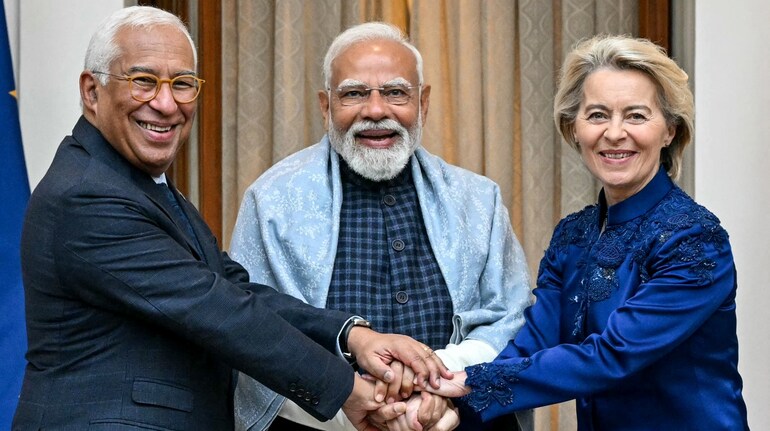

The India-EU Free Trade Agreement has opened a new economic front in South Asia, and it is one that has clearly rattled Pakistan and Bangladesh. Long accustomed to enjoying preferential access to European markets, exporters in both countries are now staring at a future where India, armed with duty-free entry and scale, is poised to undercut them in their most important overseas market.
For New Delhi, the deal is a strategic breakthrough that aligns trade with geopolitics. For Islamabad and Dhaka, it threatens to dismantle decades of hard-won advantage built on special trade regimes rather than competitiveness.
Why the India-EU FTA has caused panic in Pakistan and Bangladesh
The agreement between India and European Union grants Indian goods expanded, near-zero duty access to the European market, covering around 93 percent of exports. This directly hits Pakistan and Bangladesh where it hurts most: textiles and garments.
“India has now opened an economic front,” an office-bearer of a Pakistani trading association told Dawn, bluntly summing up the mood in Islamabad. The comment came in the aftermath of India’s military action during Operation Sindoor, reinforcing the sense that Pakistan is being squeezed on multiple fronts.
For decades, exporters in Pakistan and Bangladesh relied on preferential EU schemes to stay competitive. Pakistan benefited from GSP Plus status, while Bangladesh enjoyed duty-free, quota-free access under the Everything But Arms arrangement as a Least Developed Country.
How Europe became Pakistan and Bangladesh’s export lifeline
Under the EU-Pakistan Cooperation Agreement and the GSP Plus scheme, nearly 85 percent of Pakistani exports entered Europe duty-free. In 2024, the EU accounted for 12.4 percent of Pakistan’s total trade, with bilateral goods trade worth €12 billion, according to the European Commission. Textiles and clothing made up nearly 76 percent of EU imports from Pakistan.
Bangladesh’s dependence is even deeper. Europe is its largest trading partner, with total goods trade of €22.2 billion in 2024. Almost 94 percent of EU imports from Bangladesh were textiles. The country was the single biggest beneficiary of the EBA scheme, with €17.1 billion worth of exports enjoying preferential access in 2023.
This reliance now looks like a strategic weakness.
Why India now holds the upper hand
Unlike Pakistan and Bangladesh, India entered the EU market without preferential treatment. Indian goods were subject to standard WTO tariffs, around 12 percent on textiles and as high as 26 percent on seafood. Despite this handicap, EU–India trade grew by 90 percent over the past decade, reaching €120 billion in 2024.
Once the FTA is ratified, the EU will eliminate 90 percent of tariff lines and 91 percent in value terms. Labour-intensive Indian sectors such as textiles, garments, footwear, jewellery and leather stand to gain the most. According to Reuters, India currently holds just 3 percent of the EU’s $250 billion apparel market, which is dominated by China, Bangladesh and Vietnam. Industry forecasts now suggest Indian apparel exports to the EU could grow by 20 to 25 percent annually once the deal is operational.
Why Islamabad is alarmed
Pakistani exporters are openly worried about being priced out. Saquib Fayyaz Magoon of the Federation of Pakistan Chambers of Commerce and Industry warned Dawn that “once India secures zero-rated access under the EU deal, Pakistan’s advantage will vanish and our exports could suffer a severe blow.”
Drawing a parallel with Operation Sindoor, Magoon added, “Just as the armed forces secured victory on the battlefield, the business community now needs government support to win this economic war.” Faisal Arshad of the Hosiery Manufacturers and Exporters Association echoed the concern, warning that Indian exporters could aggressively undercut prices while Pakistan remains trapped within the limits of GSP Plus.
Bangladesh’s advantage is slipping away faster
For Bangladesh, the threat is more structural. The country lost its LDC status in November 2025 and will lose EBA benefits within three years. As India gains duty-free access, Bangladesh will be forced to pay tariffs unless it secures GSP Plus or a bilateral deal.
“The implications will be significant, particularly for apparel,” Mustafizur Rahman of the Centre for Policy Dialogue told The Daily Star. He warned that Bangladesh would become less competitive once India’s tariffs drop to zero. Factory owners have also cautioned that buyers will push prices down further or shift orders to India.
A structural shift Europe will not reverse
The India-EU FTA marks a decisive reset. Pakistan and Bangladesh built export models around preferential treatment. India is entering the market on scale, integration and competitiveness. Unless Islamabad and Dhaka rapidly adapt through diplomacy, diversification and industrial reform, their long-standing dominance in Europe’s textile market is set to steadily erode.
Discover the latest Business News, Sensex, and Nifty updates. Obtain Personal Finance insights, tax queries, and expert opinions on Moneycontrol or download the Moneycontrol App to stay updated!
Find the best of Al News in one place, specially curated for you every weekend.
Stay on top of the latest tech trends and biggest startup news.