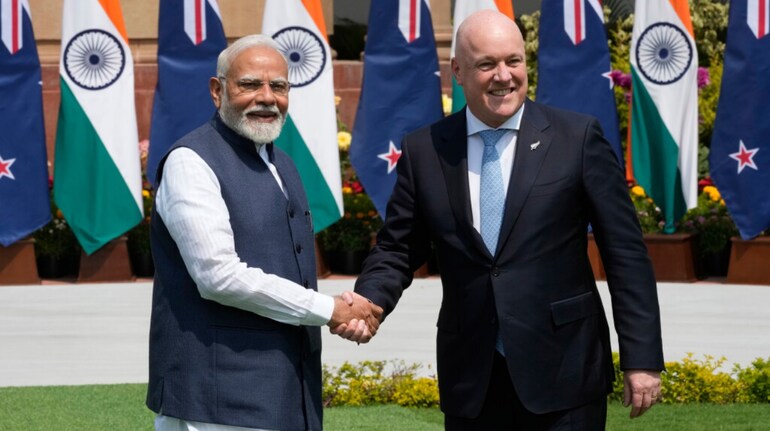
India and New Zealand have concluded negotiations on a comprehensive free trade agreement, a development New Delhi sees as strategically important at a time when global trade is becoming more fragmented and protectionist pressures are rising.
Announced on December 22, 2025, the agreement comes as Indian exporters face growing headwinds in traditional markets, particularly the United States, where higher tariffs have affected sectors such as textiles, auto components, metals and labour-intensive manufacturing. Against this backdrop, India has been seeking partners that offer market access without direct competition and provide long-term diversification opportunities.
From India’s standpoint, the deal with New Zealand fits squarely into this strategy.
Why the timing matters for India
For New Delhi, the agreement is less about immediate trade volumes and more about future positioning. New Zealand is a small but high-income economy with stable demand, strong regulatory standards and deep integration into global supply chains.
At the same time, India is pushing to expand its trade footprint beyond a narrow set of partners. Recent FTAs with the UAE, Australia and the United Kingdom reflect this shift, while talks with the European Union, Canada and Chile continue.
The New Zealand pact also carries symbolic weight. It opens doors in the Pacific region and reinforces India’s image as a credible, rules-based trade partner at a time when global commerce is increasingly shaped by tariffs, subsidies and strategic competition.
New Zealand Prime Minister Christopher Luxon captured this broader opportunity when he said, “India is the world’s most populous country and is the fastest-growing big economy, and that creates opportunities for jobs for Kiwis, exports and growth.” He added, “The gains are wide-ranging and significant.”
I’ve just spoken with India’s Prime Minister Narendra Modi following the conclusion of the NZ-India Free Trade Agreement. The FTA reduces or removes tariffs on 95% of our exports to India. It’s forecast that NZ exports to India could increase $1.1B to $1.3B per year over the… pic.twitter.com/FEat7BQWOI— Christopher Luxon (@chrisluxonmp) December 22, 2025
When the deal will take effect
Negotiations were completed over nine months, beginning with Luxon’s visit to India in March this year. The agreed text will now undergo legal scrubbing before formal signing.
India’s chief negotiator Petal Dhillon said a signing is expected in the first quarter of 2026, once that process is complete. New Zealand officials have indicated a similar timeline, though the agreement will still need to clear domestic approval processes in both countries.
In New Zealand, political resistance could pose challenges. Coalition partner New Zealand First has said it will oppose the pact. Party leader Winston Peters argued it “gives too much away, especially on immigration, and does not get enough in return for New Zealanders, including on dairy.”
What India gains on goods and exports
From India’s perspective, one of the most significant outcomes is full tariff elimination for Indian exports to New Zealand from day one.
This means Indian manufacturers and exporters will enjoy zero duty access across all product categories, boosting competitiveness for sectors such as textiles, apparel, engineering goods, leather, footwear, marine products and a wide range of manufactured items.
Indian officials believe this will help exporters diversify away from more volatile markets and offer consumers in New Zealand more competitively priced Indian goods.
New Zealand Trade Minister Todd McClay said the agreement would “deliver thousands of jobs and billions in additional exports,” but from India’s side, the immediate benefit lies in guaranteed access without tariff escalation risks.
How India balanced agriculture sensitivities
Agriculture was one of the most politically sensitive areas for India, and New Delhi has drawn clear red lines.
Dairy products such as milk, cream, whey, yoghurt and cheese are excluded from tariff liberalisation, along with select animal and vegetable products, including goat meat, onions and almonds. Indian officials have said these exclusions are essential to protect domestic farmers and rural livelihoods.
At the same time, India agreed to limited, carefully structured access in horticulture. New Zealand secured quota-based access for apples and kiwifruit, with volumes higher than current trade levels and expanding over time.
McClay highlighted the breakthrough, saying, “In a world-first New Zealand will have duty-free access for a large kiwifruit quota nearly four times our current exports with a 50 per cent tariff applying outside quota.” He added, “For the first time in an FTA, India has agreed preferential market access for apples and mānuka honey.”
From India’s perspective, the quota approach ensures imports remain manageable while meeting consumer demand for high-value products.
Why dairy is not entirely off the table
While consumer dairy products remain excluded, India has allowed targeted access for dairy ingredients meant for further processing and re-export.
“New Zealand exporters will enjoy duty-free access for dairy and other food ingredients for re-export through the FTA, opening the door to greater collaboration and processing,” McClay said.
Tariffs on bulk infant formula and dairy preparations will be phased out over seven years. Duties on peptones will also be eliminated over the same period, while tariffs on albumins will be halved within a quota.
Crucially for India, safeguards are built in. If India offers better dairy access to other countries in future, it has committed to consulting New Zealand, with a formal review scheduled one year after the agreement enters into force.
Services, fintech and digital trade
Services are a major focus for India. The agreement goes beyond India’s WTO commitments, particularly in financial services, digital payments and fintech.
McClay noted that “the FTA has broad services coverage and builds significantly on India’s WTO commitments,” while including a most favoured nation clause to ensure parity with future deals.
From India’s perspective, this supports the global expansion of Indian fintech firms and service providers, while also reinforcing regulatory cooperation.
Labour mobility and visas
The agreement includes a limited labour mobility component that India views as pragmatic rather than expansive.
New Zealand will create a pathway for an average of up to 1,667 skilled Indian workers annually through non-renewable three-year visas, targeting sectors such as healthcare, education, ICT and engineering.
“To better provide the skills to grow the New Zealand economy, the agreement establishes a process for up to an average of 1,667 skilled 3-year work visas per year,” McClay said.
India also secured an expansion of the working holiday scheme to 1,000 places annually, supporting youth mobility and people-to-people ties.
The long game for India
Beyond trade flows, India sees the agreement as a platform for deeper economic engagement. New Zealand has committed investments worth $20 billion in India over 15 years, according to India’s Trade Ministry.
While details remain sparse, officials describe the pledge as a foundation for collaboration in manufacturing, services and technology.
Commerce Secretary Rajesh Agarwal said both sides aim to double bilateral trade within five years.
Discover the latest Business News, Sensex, and Nifty updates. Obtain Personal Finance insights, tax queries, and expert opinions on Moneycontrol or download the Moneycontrol App to stay updated!
Find the best of Al News in one place, specially curated for you every weekend.
Stay on top of the latest tech trends and biggest startup news.