






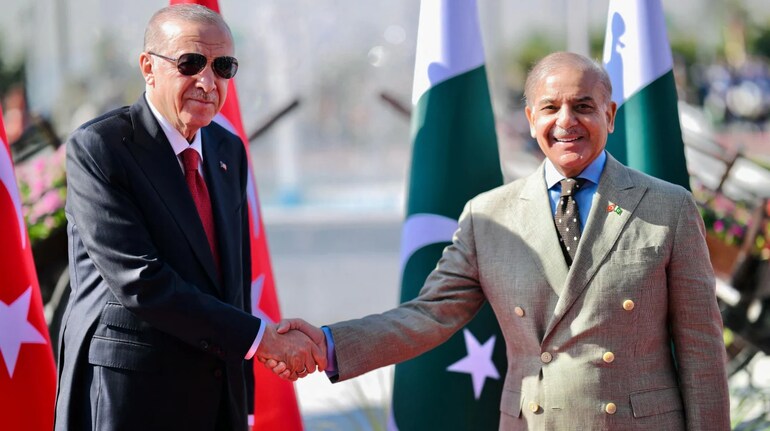
Turkey is pursuing a long-term, calibrated approach to dilute Saudi and Emirati dominance in the Middle East by exploiting regional fault lines rather than engaging in open confrontation, senior intelligence sources have told CNN-News18. Officials say Ankara’s strategy hinges on leveraging instability, ideological networks and selective partnerships, most notably with Pakistan, to gradually erode Gulf influence.
Leveraging regional instability
Intelligence assessments indicate that Turkey has quietly benefited from sustained instability around the Bab-el-Mandeb strait, a vital maritime chokepoint handling an estimated 12–15 per cent of global trade and nearly 30 per cent of Europe-bound container traffic. Any disruption in this corridor disproportionately undermines Saudi and Emirati port ambitions, particularly hubs such as Jebel Ali and Fujairah.
Officials note that Turkey has positioned itself diplomatically as a mediator rather than a combatant, enabling Ankara to gain strategic advantage without direct military involvement.
Sources stressed that Turkey does not directly back the Houthi movement in Yemen. Instead, Ankara has cultivated links with Muslim Brotherhood-aligned Yemeni factions, subtly weakening Saudi-supported political frameworks. Intelligence officials say this approach reflects Turkey’s earlier strategies in Libya and Sudan, where political Islamist groups were supported to dilute Gulf influence without deploying Turkish forces.
At the same time, Turkish media outlets and affiliated NGOs have amplified humanitarian narratives around Yemen. According to intelligence sources, this soft-power messaging has portrayed Saudi-UAE intervention as destructive, enhancing Ankara’s diplomatic leverage.
Pakistan emerges as a strategic force multiplier
A central pillar of Turkey’s regional strategy is its deepening alignment with Pakistan. Ankara has increasingly relied on Pakistan’s military and diplomatic standing in the Islamic world to internationalise Turkish positions, intelligence sources said. Joint statements at Organisation of Islamic Cooperation platforms, as well as on issues such as Gaza and Yemen, frequently reflect Turkish positions more closely than Gulf perspectives.
Pakistan’s armed forces have also become structurally integrated into Turkey’s defence ecosystem. Since 2018, defence deals worth an estimated $1.5–2 billion have been signed, covering MILGEM corvettes, Bayraktar TB-2 drones and helicopter engine collaborations. Intelligence officials note that Pakistani military officers are increasingly training in Turkey rather than in Gulf states, signalling a shift in long-term institutional alignment.
Reducing Pakistan’s dependence on Gulf leverage
Intelligence inputs further suggest that Turkey has encouraged Pakistan to reduce reliance on Gulf labour markets and remittance flows, which currently generate $30–35 billion annually from Saudi Arabia and the UAE. Ankara has also leveraged Pakistan’s clerical and religious networks to challenge Saudi Arabia’s claim to uncontested leadership of the Islamic world.
Officials said that whenever Riyadh or Abu Dhabi have sought to pressure Islamabad — through financial leverage, oil supplies or IMF signalling — Turkey has stepped in to cushion Pakistan, limiting its vulnerability to Gulf capitals.
In parallel, China-backed infrastructure projects, including Gwadar port, are gradually reducing Pakistan’s dependence on Gulf maritime routes. Turkey is seen as aligning with this emerging multipolar logistics framework, which over time weakens Gulf maritime centrality.
Implications for India’s trade and security
Intelligence agencies of India underline that the developments extend beyond a Middle East power contest. More than 60 per cent of India’s westbound trade transits the Red Sea–Suez corridor, making New Delhi vulnerable to instability linked to Yemen. Officials warn that higher insurance premiums, rerouting costs and energy price volatility could have indirect but significant economic consequences for India.
Additionally, Turkey’s backing provides Pakistan with strategic breathing space during periods of Gulf pressure. Intelligence officials caution that the growing Turkey–Pakistan ideological convergence also fuels narratives hostile to India, with potential spillover into South Asian discourse, including on Kashmir.
From New Delhi’s perspective, sources said, Ankara’s approach represents a slow-burning strategic challenge — one that reshapes regional power balances without overt confrontation, but carries long-term implications for trade, energy security and geopolitics.
Discover the latest Business News, Sensex, and Nifty updates. Obtain Personal Finance insights, tax queries, and expert opinions on Moneycontrol or download the Moneycontrol App to stay updated!
Find the best of Al News in one place, specially curated for you every weekend.
Stay on top of the latest tech trends and biggest startup news.




