






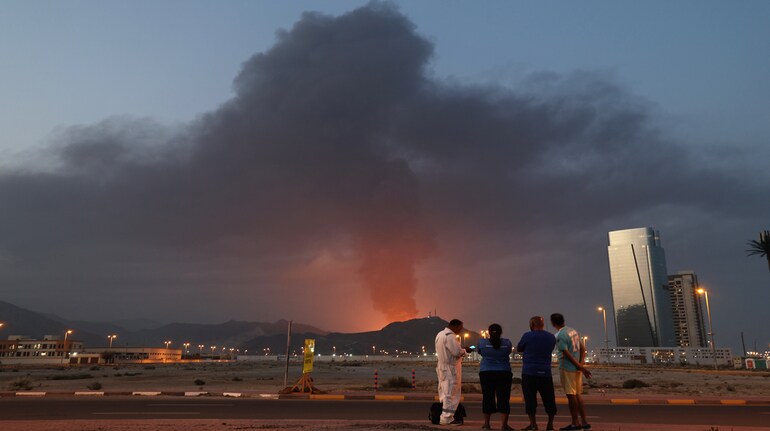
With United States and Israeli forces significantly degrading Iran’s missile stockpiles and launch systems during Operation Epic Fury, Tehran’s ability to unleash large-scale ballistic missile barrages has weakened. In response, it has pivoted to a new approach — fewer shots, more targets.
The Wall Street Journal, in an analysis, noted how Iran is turning to low-cost drone attacks across at least 11 countries in an effort to impose economic pressure on the US and its allies.
Iran’s escalating military campaign
Iran’s Islamic Revolutionary Guard Corps (IRGC) said on Friday that its aerospace forces had launched the 21st wave of Operation True Promise, deploying swarms of suicide drones and advanced Khayber missiles fitted with cluster warheads to saturate and bypass what it described as the “Zionist regime’s” multi-layered air defences. The IRGC said the coordinated assault was codenamed “Ya Mu’izz al-Mu’minin.”
Tehran has indicated that its retaliatory campaign will intensify in the coming days, with military officials vowing expanded strikes as air defence systems continue intercepting Israeli and US aircraft and drones across the country.
Lieutenant Colonel Ibrahim Zolfaghari, spokesperson for the Khatam al-Anbiya Central Headquarters, told Press TV that Israel has tried to conceal its military assets within civilian areas, but Iranian forces are continuing to locate and strike them.
“The cowardly military forces and facilities of the Zionist regime have hidden in civilian and public layers,” Zolfaghari said. “But the detection and striking of the aggressors will continue, and in the coming days the trend of attacks will become more intense and widespread.”
He added that Iranian air defences had intercepted and destroyed advanced enemy aircraft over several regions. According to Zolfaghari, the latest figures take the total number of enemy drones shot down since the US–Israeli operation began last Saturday to more than 75.
In New Delhi, Iranian Deputy Foreign Minister Saeed Khatibzadeh stated that Tehran has “no option” but to engage in what he described as a “heroic nationalist defence” against what he called an American and Israeli “invasion.” He vowed that the nation would resist to the “last bullet” and “last soldier.”
Where does Iran’s military capability stand?
Ballistic missiles:
Launch activity has dropped by around 90% since the conflict began. The US Pentagon reported an 86% decline in theatre ballistic missile launches as of mid-week, according to the WSJ.
Drones:
One-way attack drone launches have fallen by 83% overall, yet drones remain Iran’s primary tool for retaliation due to their relatively low cost and ability to evade certain air defence systems.
Air defences:
Iran’s air defence infrastructure has been “severely degraded,” enabling US and Israeli forces to achieve localised air superiority and strike deeper into Iranian territory, according to foreign media reports.
Regional and economic fallout
Iran has carried out attacks across 11 countries, including Turkey, Cyprus, Azerbaijan, and Gulf states such as the UAE and Bahrain.
The strikes have effectively disrupted traffic through the Strait of Hormuz, which carries around 20% of the world’s daily oil and liquefied natural gas (LNG) supply.
Drone attacks have hit Saudi oil installations and forced Qatar to pause gas exports, pushing US oil prices above $80 a barrel for the first time in over a year.
Six American troops were reportedly killed in a drone strike in Kuwait, while drones have also targeted high-rise buildings and hotels in Dubai and Bahrain.
What does the 'fewer shots, more targets' strategy mean?
Iran’s “Fewer Shots, More Targets” doctrine marks a tactical shift from heavy missile barrages to widening the conflict through sustained, low-cost drone operations across the Middle East.
According to the WSJ, this adjustment follows the destruction of much of Iran’s advanced ballistic missile stockpile by US and Israeli air strikes during the 2026 conflict.
By striking at least 11 countries in under a week — including Gulf states such as the UAE, Kuwait and Qatar — Tehran aims to inflict economic pain on US allies and unsettle global energy markets.
Officials appear to be attempting to generate a broader sense of risk to pressure Washington into reconsidering its military campaign before the US midterm elections.
The approach forces defending forces to deploy costly interceptors — such as $4 million Patriot missiles — against inexpensive drones priced between roughly $20,000 and $50,000, creating a significant economic imbalance for the US and its partners.
Attacks on key infrastructure such as Dubai International Airport and energy hubs like Saudi Arabia’s Ras Tanura refinery are designed to extend the conflict beyond Israel and amplify regional instability, according to foreign media reports.
Iran’s core tactics
Asymmetric endurance:
Iran is absorbing initial damage to its infrastructure while preserving the capacity to escalate once allied air defences are stretched.
Drone swarms:
The deployment of large numbers of Shahed-136 “kamikaze” drones aims to overwhelm radar systems and defensive layers.
Maritime pressure:
Closing or threatening the Strait of Hormuz is intended to disrupt global energy shipments and push oil prices higher.
Decentralised command:
Authority for conducting strikes has reportedly been distributed to prevent potential US–Israeli “decapitation” operations from paralysing Iran’s response.
US and allied response
The United States has deployed more than 50,000 troops, around 200 fighter aircraft and two aircraft carrier strike groups — USS Gerald R. Ford and USS Abraham Lincoln — to the region.
US Central Command (CENTCOM) said it has struck nearly 2,000 targets inside Iran using over 2,000 munitions within the first 100 hours of the operation.
NATO members and regional partners including Jordan, Saudi Arabia and the UAE have strengthened their ballistic missile defence systems to intercept continuing Iranian threats.
Discover the latest Business News, Sensex, and Nifty updates. Obtain Personal Finance insights, tax queries, and expert opinions on Moneycontrol or download the Moneycontrol App to stay updated!
Find the best of Al News in one place, specially curated for you every weekend.
Stay on top of the latest tech trends and biggest startup news.




