






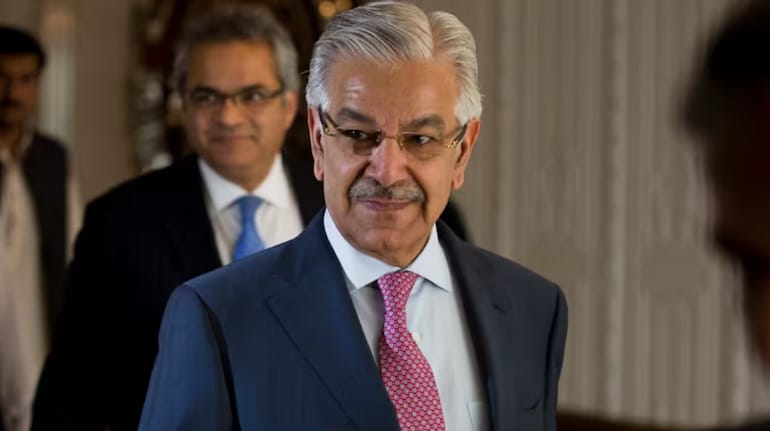

Pakistan’s Defence Minister Khawaja Asif has described the country’s political system as a 'hybrid government', calling the Army the most important national institution and denying that Pakistan is under military rule, even as questions persist over the expanding powers of Field Marshal Asim Munir.
In an interview with France 24, Asif rejected suggestions that Munir is the de facto ruler of Pakistan.
“Pakistan has a history of the (military) establishment controlling governments way back in the 1950s-60s. There were times when the establishment intervened and took over the reins of power. It is not happening now,” Asif said.
“It is a cooperation of national institutions. Pakistan Army or the armed forces are the most important national institution. They are rendering help to the elected government. I call it a hybrid government. There is absolutely no military rule in Pakistan. He is not my boss,” he added.
Why the question arose
The question posed to Asif reflects a growing global perception that Army Chief Asim Munir wields more influence than Prime Minister Shehbaz Sharif, particularly after Pakistan’s National Assembly passed the 27th Amendment last year.
The amendment granted sweeping powers to the Army Chief and elevated Munir to the position of Chief of Defence Forces, giving him control over the army, navy and air force. It amended Article 243 of Pakistan’s Constitution, which states that the Federal Government shall have control and command of the Armed Forces and that supreme command vests in the President.
Munir was also granted the rank of Field Marshal for life, along with legal immunity for acts carried out in uniform by him and other five-star generals.
Until now, Pakistan had at least theoretical avenues to hold senior military officials legally accountable for actions undertaken while in service.
A shifting civil-military balance
The military has long played a central role in Pakistan’s governance, directly ruling the country for extended periods since the 1950s. Even during civilian governments, the establishment has been widely seen as retaining decisive influence over security and foreign policy.
With the Army already controlling significant segments of the economy through military-run enterprises and now constitutionally empowered over defence and nuclear command structures, critics argue that Pakistan’s political system is evolving into a structure where civilian authority exists alongside, and sometimes beneath, institutional military dominance.
Asif, however, insisted in his remarks to France 24 that the current arrangement represents institutional cooperation rather than a takeover, framing the Army’s role as supportive of the elected government rather than superseding it.
Discover the latest Business News, Sensex, and Nifty updates. Obtain Personal Finance insights, tax queries, and expert opinions on Moneycontrol or download the Moneycontrol App to stay updated!
Find the best of Al News in one place, specially curated for you every weekend.
Stay on top of the latest tech trends and biggest startup news.





