






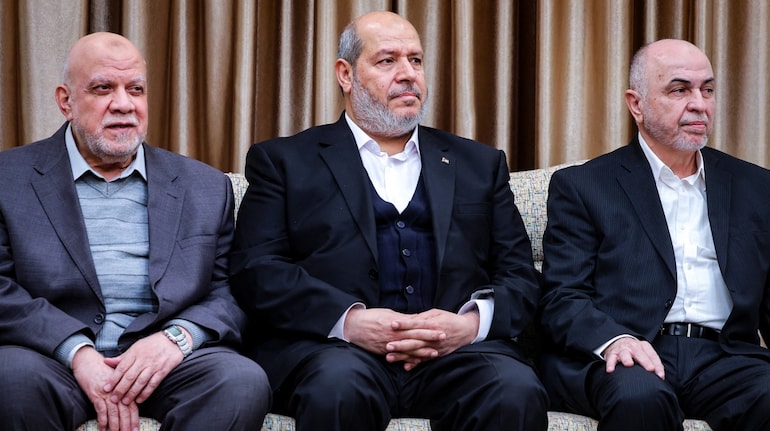

Hamas is expected to elect a new leader later this month, ending a period of collective leadership that followed the killing of its chief Hamas leader Yahya Sinwar, according to two sources within the group cited by Reuters.
The decision comes at a critical moment for Hamas, which has been severely weakened by nearly two years of war with Israel triggered by its October 7, 2023 attack. The group is under intense military pressure, faces growing criticism inside Gaza, and is confronting international demands to disarm.
Two frontrunners emerge
Sources told Reuters that Khalil Al-Hayya and Khaled Meshaal have emerged as leading contenders for the top post.
Both men are based in Qatar and currently sit on a five-member leadership council that has overseen Hamas since Sinwar’s death. Sinwar was one of the main architects of the October 7 attack on Israel. His predecessor, Ismail Haniyeh, was assassinated by Israel during a visit to Iran in 2024.
According to Reuters, the internal election process has already begun. The leader is chosen through a secret ballot by Hamas’ Shoura Council, a roughly 50-member body that includes representatives from Gaza, the Israeli-occupied West Bank, and Hamas members living in exile. A Hamas spokesperson declined to comment.
Deputy leader vote also expected
Sources said Hamas is also expected to elect a deputy leader to replace Saleh Al-Arouri, who was killed in an Israeli airstrike in Lebanon in 2024.
While some Hamas figures favour extending the current system of collective leadership, sources close to the group said there is strong determination to complete the leadership vote despite the risks involved.
A movement under pressure
Hamas is facing some of the most serious challenges since it was founded in 1987. Although large-scale fighting in Gaza eased following a US-brokered ceasefire in October, Israel still controls nearly half of the territory, sporadic attacks continue, and humanitarian conditions remain dire for Gaza’s roughly two million residents.
The group has also faced anger from within Gaza over the scale of destruction caused by the war. Gaza health authorities say more than 71,000 people have been killed. Hamas-led militants killed around 1,200 people and abducted 251 during the October 7 assault on Israel.
US President Donald Trump has proposed a ceasefire framework that calls for Hamas to disarm and for Gaza to be administered by a technocratic Palestinian authority under international oversight through a body known as the Board of Peace.
Hamas has rejected demands to disarm, saying the issue of armed resistance must be decided by all Palestinian factions. It has said it would be prepared to hand over its weapons to a future Palestinian state, a scenario Israel has ruled out. Hamas is designated as a terrorist organisation by the United States and other Western countries.
Both contenders have survived Israeli attempts
Both Meshaal and Hayya have previously been targeted by Israel.
Hayya, who was born in Gaza and currently serves as Hamas’ lead negotiator, was among leaders targeted in an Israeli airstrike in Qatar in September. Israeli Prime Minister Benjamin Netanyahu later apologised to Qatar’s emir during a call with Trump and pledged that Israel would not carry out similar attacks there again, the White House said at the time.
Meshaal led Hamas for nearly two decades. In 1997, Israeli agents attempted to assassinate him in Jordan by injecting him with poison, an incident that caused a major diplomatic crisis.
His ties with Iran weakened in 2012 after he distanced Hamas from Tehran’s ally, former Syrian President Bashar al-Assad, during the early phase of the Arab Spring.
Pragmatism versus alignment with Iran
Hamas watchers cited by Reuters describe Meshaal as belonging to a more pragmatic wing with stronger ties to Sunni Muslim countries, while Hayya is seen as closer to a faction that deepened relations with Iran.
Analyst Reham Owda said there were limited differences between the two men on the conflict with Israel but suggested Meshaal may have an edge.
He could “market (Hamas) internationally and help rebuild its capabilities,” Owda said.
Founded as the Palestinian branch of the Muslim Brotherhood, Hamas remains the principal rival to Fatah, the Palestinian national movement led by President Mahmoud Abbas.
While Hamas’ founding charter called for Israel’s destruction, its leaders have at times proposed a long-term truce in return for a Palestinian state on territories occupied by Israel in the 1967 war. Israel has repeatedly dismissed such offers as tactical manoeuvres rather than genuine concessions.
With the leadership vote approaching, Hamas faces a defining choice over how it navigates survival, legitimacy, and resistance in an increasingly hostile regional and international environment.
Discover the latest Business News, Sensex, and Nifty updates. Obtain Personal Finance insights, tax queries, and expert opinions on Moneycontrol or download the Moneycontrol App to stay updated!
Find the best of Al News in one place, specially curated for you every weekend.
Stay on top of the latest tech trends and biggest startup news.





