






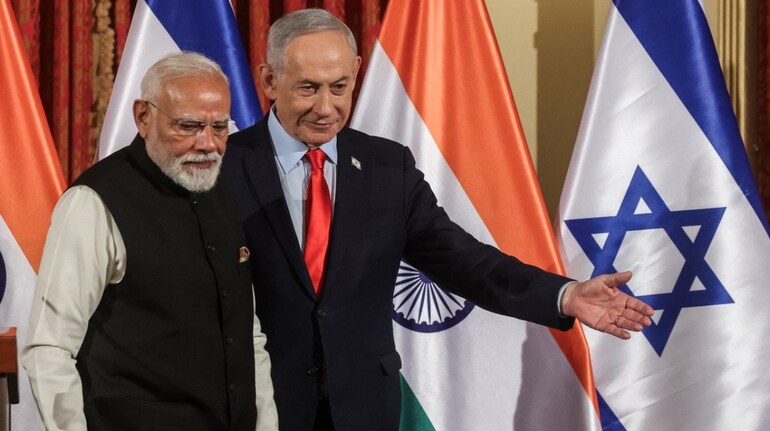

Prime Minister Narendra Modi’s two-day visit to Israel marked a clear inflection point in India–Israel relations, moving the partnership beyond symbolism into a more structured, outcome-driven phase. The visit culminated in the elevation of bilateral ties to a “special strategic partnership,” signalling New Delhi’s intent to anchor Israel as a long-term partner across defence, technology, trade, and security.
Modi’s visit, his second to Israel since 2017, unfolded against a backdrop of regional instability in West Asia and growing global competition in emerging technologies. The messaging from both sides focused on trust, strategic convergence, and future readiness.
A new strategic label with practical intent
Announcing the upgrade in ties, Modi said, “We decided to give time-tested India-Israel ties the status of special strategic partnership.” The joint statement described the relationship as being rooted in democratic values, humanitarian principles, and deep mutual trust.
The new status was backed by a broad set of agreements. India and Israel signed 16 agreements and made 11 key announcements covering trade, agriculture, energy, cyberspace, digital payments, and artificial intelligence. One of the central outcomes was an MoU on cooperation in AI, with both sides agreeing to deploy artificial intelligence for public welfare.
“We have decided to establish the Critical and Emerging Technologies Partnership. This will give new momentum to cooperation in areas such as AI, quantum, and critical minerals,” Modi said.
Defence, security and counter-terror alignment
Defence cooperation remained a core pillar of the visit. The two countries agreed to expand joint development and joint production of military hardware under technology transfer frameworks, reinforcing an already strong defence relationship.
Modi underlined the shared security outlook, declaring, “India and Israel stood shoulder-to-shoulder in opposing terrorism and its supporters, and we will continue to do so.”
“India and Israel are completely clear that there is no place for terrorism in the world,” he added.
Israeli Prime Minister Benjamin Netanyahu announced that both sides had agreed to hold a government-to-government meeting in India at the earliest opportunity.
Trade, FTA and worker mobility
Economic engagement featured prominently, with both sides committing to concluding a free trade agreement. “We will work to conclude a mutually beneficial free trade agreement,” Modi said.
The first round of FTA negotiations concluded on February 26. Israel’s ambassador to India, Reuven Azar, told NDTV that the deal could be finalised this year. Bilateral merchandise trade stood at $3.62 billion in FY 2024–25.
Israel also agreed to allow 50,000 additional Indian workers over the next five years, particularly in manufacturing sectors, strengthening people-to-people ties.
UPI, finance and digital connectivity
A major digital outcome was the signing of an MoU between NPCI International and MASAV to introduce India’s Unified Payments Interface in Israel.
“An agreement has been reached for the use of UPI in Israel,” Modi said, adding that both sides would explore linking UPI with Israel’s fast payment system to enable cross-border remittances and enhance financial connectivity.
The two countries also launched the India–Israel Financial Dialogue and agreed to deepen cybersecurity cooperation, including setting up an India–Israel Centre of Excellence in Cybersecurity in India.
West Asia and Gaza
Modi also backed US President Donald Trump’s Gaza peace initiative. “Humanity must never become a victim of conflict,” he said.
“The Gaza Peace Plan has opened a route to peace. India has supported such efforts. In future too, India will continue to cooperate and have dialogue with all nations,” Modi added, stressing that India’s security interests are closely tied to stability in West Asia.
Taken together, the visit repositioned India–Israel ties as a long-term strategic partnership shaped as much by future technologies as by shared security concerns.
Discover the latest Business News, Sensex, and Nifty updates. Obtain Personal Finance insights, tax queries, and expert opinions on Moneycontrol or download the Moneycontrol App to stay updated!
Find the best of Al News in one place, specially curated for you every weekend.
Stay on top of the latest tech trends and biggest startup news.





