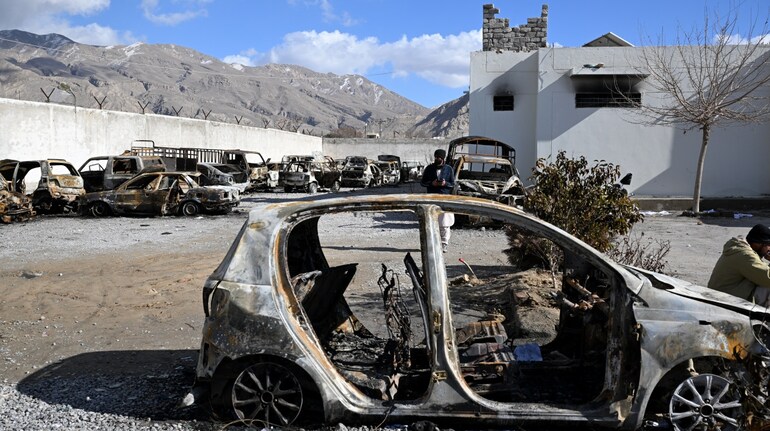

Train movement across Pakistan’s restive Balochistan province has once again ground to a halt, exposing the depth of the country’s internal security breakdown and the state’s inability to guarantee even basic civilian infrastructure.
According to CNN-News18, Pakistan Railways confirmed on Wednesday that all train services in Balochistan remain suspended indefinitely, after security agencies refused to grant clearance amid ongoing military operations and persistent militant violence.
The decision marks a humiliating reversal for the Pakistani government. Just a day earlier, the Railway Ministry had announced the resumption of the Jaffer Express between Quetta and Peshawar, only to retract the move hours later when security forces vetoed it, citing an inability to protect passengers.
Rail connectivity collapses under security threat
Services affected by the shutdown include the Jaffer Express, Bolan Mail connecting Quetta to Karachi, the Chaman local passenger train, and multiple intra-provincial routes. Officials admitted that passenger safety could not be assured, a rare but telling acknowledgement of the state’s loss of control in the mineral-rich but insurgency-hit province.
The rail paralysis has coincided with intensified counter-insurgency operations and armed skirmishes across several towns in Balochistan, as per intelligence inputs cited by CNN-News18. Compounding the crisis, mobile and cellular data services have remained suspended in multiple cities for a sixth consecutive day, effectively cutting off communication for millions of residents.
Insurgency escalates as Pakistan offers conflicting narratives
The security clampdown follows the Balochistan Liberation Army’s declaration of “Operation Herof 2.0", which the outfit claims is an ongoing campaign against Pakistan’s armed forces. The BLA said the operation began on January 31 with coordinated strikes on 12 locations across 10 cities, including Quetta and Gwadar, and alleged that 22 Pakistani security personnel were killed.
Pakistan’s military establishment has responded with a vastly different and unverifiable account. The Inter-Services Public Relations claimed that 216 BLA-linked militants were killed as forces concluded “Operation Radd-ul-Fitna-1" in Balochistan. No independent confirmation of casualty figures from either side has been possible, further fuelling doubts over the official narrative.
China pulls back, exposing Pakistan’s strategic vulnerability
Perhaps most damaging for Islamabad is the reported fallout with its closest strategic ally. In the aftermath of the attacks, China has suspended all ground operations in Gwadar and other parts of Balochistan, citing security concerns for Chinese personnel and projects linked to the China-Pakistan Economic Corridor.
The move underscores Beijing’s growing unease with Pakistan’s failure to stabilise Balochistan, a region critical to CPEC and China’s long-term regional ambitions.
No relief in sight
Intelligence sources told CNN-News18 that no security clearance has been issued so far for the resumption of train services, indicating that restrictions are likely to persist as military operations continue across the province.
For Pakistan, the indefinite suspension of rail services is not just a logistical disruption. It is a stark reminder of a deepening internal crisis, where insurgency, communication blackouts, and conflicting military claims have combined to paralyse civilian life and erode confidence in the state’s authority.
Discover the latest Business News, Sensex, and Nifty updates. Obtain Personal Finance insights, tax queries, and expert opinions on Moneycontrol or download the Moneycontrol App to stay updated!
Find the best of Al News in one place, specially curated for you every weekend.
Stay on top of the latest tech trends and biggest startup news.