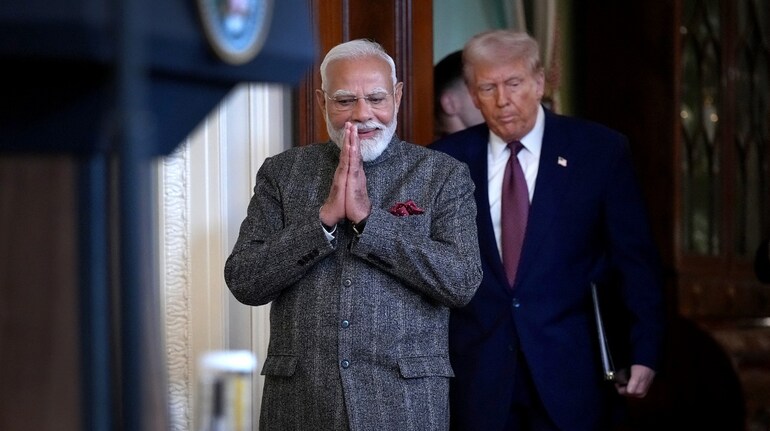

India’s newly announced trade deal with the United States has reshaped the global tariff landscape, placing New Delhi in a significantly stronger position compared to several major export economies. Following a phone call between Donald Trump and Narendra Modi, Washington confirmed that tariffs on Indian goods will be reduced to 18 percent from the earlier effective rate of 50 percent.
The previous levy included a 25 percent reciprocal tariff and an additional 25 percent punitive duty imposed over India’s imports of Russian crude oil. With the punitive component now withdrawn and the base tariff lowered, India has emerged far better placed than many competing economies exporting to the US market.
Announcing the decision on Truth Social, Trump said, “It was an honor to speak with Prime Minister Modi of India this morning. We spoke about many things, including trade, and ending the war with Russia and Ukraine. He agreed to stop buying Russian oil, and to buy much more from the United States and, potentially, Venezuela.”
He added, “Out of friendship and respect for Prime Minister Modi and, as per his request, effective immediately, we agreed to a trade deal between the United States and India, whereby the United States will charge a reduced reciprocal tariff, lowering it from 25 per cent to 18 per cent.”
India’s new tariff position
With the revised 18 percent tariff, India now enjoys a clear competitive edge over several major exporters. Countries such as Brazil face US duties of 50 percent, while Myanmar, Laos and Syria are each taxed at 40 percent. China continues to face a steep 37 percent tariff, and South Africa is subject to a 30 percent rate.
Closer to home, Canada and Mexico face tariffs of 25 percent each. Bangladesh and Vietnam remain in the 20 percent bracket, while Malaysia, Cambodia, Thailand and Pakistan are levied at 19 percent. In contrast, only a handful of advanced economies such as the European Union, Japan, South Korea and Switzerland enjoy lower tariffs of 15 percent, while the United Kingdom stands at 10 percent.
Nations that have the lowest tariff agreement with the US include the United Kingdom (10 per cent), the European Union (15 per cent), Switzerland (15 per cent), Japan (15 per cent) and South Korea (15 per cent).
Modi welcomes tariff relief
Prime Minister Modi welcomed the development, calling it a boost for Indian manufacturing and exporters.
“Wonderful to speak with my dear friend President Trump today. Delighted that Made in India products will now have a reduced tariff of 18 per cent. Big thanks to President Trump on behalf of the 1.4 billion people of India for this wonderful announcement,” Modi said in a post on X.
He added that closer cooperation between the two countries would unlock new opportunities, noting that when large economies and the world’s biggest democracies work together, it benefits their people.
Reactions from India
Senior members of the Indian government have described the agreement as a major opening for Indian businesses. Commerce and Industry Minister Piyush Goyal said the deal would create new opportunities for farmers, MSMEs, entrepreneurs and skilled workers, while strengthening the Make in India initiative.
External Affairs Minister S Jaishankar, who is currently in the US, said the agreement would deepen economic ties. “This will create more jobs, spur growth and promote innovation in both economies. It will strengthen ‘Make in India’ endeavors and encourage trusted technology ties,” Jaishankar said.
A clear advantage for Indian exporters
For Indian exporters, the tariff reset comes as a major relief. Sectors such as textiles, garments, seafood, chemicals, engineering goods and gems and jewellery are expected to benefit the most, particularly as many of these industries operate on thin margins where even small tariff changes can determine competitiveness.
Compared to Asian rivals such as China, Bangladesh and Pakistan, India now enjoys a meaningful cost advantage in the US market. Analysts say the new tariff regime could help Indian exporters regain market share and attract greater investment into manufacturing.
While the finer details of the trade arrangement are yet to be formalised, the immediate outcome is clear. In the global tariff hierarchy, India has moved decisively upward, emerging better placed than most competing economies in access to the US market.
List of countries with new tariff rates
| Country | Tariff rates |
|---|---|
| Brazil | 50 |
| Syria | 41 |
| Laos | 40 |
| Myanmar | 40 |
| Canada | 35 |
| Iraq | 35 |
| Serbia | 35 |
| Algeria | 30 |
| Bosnia and Herzegovina | 30 |
| Libya | 30 |
| South Africa | 30 |
| Mexico | 25 |
| Brunei | 25 |
| Kazakhstan | 25 |
| Moldova | 25 |
| Tunisia | 25 |
| Bangladesh | 20 |
| Sri Lanka | 20 |
| Taiwan | 20 |
| Vietnam | 20 |
| Cambodia | 19 |
| Indonesia | 19 |
| Malaysia | 19 |
| Pakistan | 19 |
| Philippines | 19 |
| Thailand | 19 |
| Nicaragua | 18 |
| India | 18 |
| Afghanistan | 15 |
| Angola | 15 |
| Bolivia | 15 |
| Botswana | 15 |
| Cameroon | 15 |
| Chad | 15 |
| Costa Rica | 15 |
| Côte d'Ivoire | 15 |
| Nauru | 15 |
| New Zealand | 15 |
| Nigeria | 15 |
| North Macedonia | 15 |
| Norway | 15 |
| Papua New Guinea | 15 |
| South Korea | 15 |
| Trinidad and Tobago | 15 |
| Turkey | 15 |
| Uganda | 15 |
| Vanuatu | 15 |
| Venezuela | 15 |
| Zambia | 15 |
| Zimbabwe | 15 |
| European Union | 15 |
| Japan | 15 |
| United Kingdom | 10 |
| Switzerland | 15 |
Discover the latest Business News, Sensex, and Nifty updates. Obtain Personal Finance insights, tax queries, and expert opinions on Moneycontrol or download the Moneycontrol App to stay updated!
Find the best of Al News in one place, specially curated for you every weekend.
Stay on top of the latest tech trends and biggest startup news.