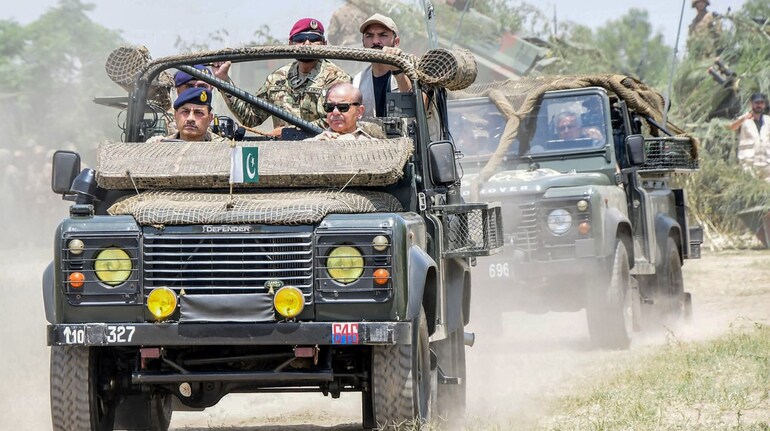
Pakistan has opened yet another front in its long and bloody history of miscalculations. On the night of October 9, Pakistani fighter jets bombed Kabul and other Afghan cities in unprecedented airstrikes that signal a new flashpoint in South Asia. The targets, Pakistan claims, were hideouts of the Tehreek-e-Taliban Pakistan (TTP).
But the timing of the attack, coinciding with Afghan Foreign Minister Maulavi Amir Khan Muttaqi’s visit to New Delhi, exposes the desperation of a cornered state. Field Marshal Asim Munir now faces a tetra-crisis of his own making: twin external threats from India and Afghanistan, and twin insurgencies raging in Balochistan and Khyber-Pakhtunkhwa. Pakistan’s generals are running out of enemies to blame.
The Kabul strikes: A dangerous escalation
The October 9 strikes marked the first time Pakistan directly bombed the Afghan capital. They were aimed at TTP chief Mufti Noor Wali Mehsud, the most dangerous adversary the Pakistan Army has faced in decades. Under Mehsud’s leadership, the TTP has united warring factions, imposed a code of conduct, and launched devastating attacks on Pakistani security forces. Over 900 Pakistani soldiers have been killed this year alone, the bloodiest toll since 2009. Just two days before the airstrikes, the TTP ambushed a convoy in Khyber-Pakhtunkhwa’s Orakzai District, killing 17 soldiers, including a Lt Colonel and a Major.
Pakistan accuses the Taliban regime of sheltering the TTP in Afghanistan’s Khost and Paktika provinces. Yet the irony is unmistakable: the same Taliban that Pakistan nurtured for decades has now turned into a nightmare next door.
A country surrounded by fire
Field Marshal Asim Munir’s troubles are not limited to Afghanistan. To the east, India remains an ever-present threat, especially after the Pahalgam terror attack and India’s retaliatory Operation Sindoor. To the west, relations with Kabul have collapsed, with the Taliban openly defying Pakistan’s diktats. Inside its borders, Pakistan faces two full-blown insurgencies -- one in Balochistan, the other in Khyber-Pakhtunkhwa -- both fuelled by anger against Islamabad’s heavy-handed military control.
Munir’s army is overstretched, fighting on multiple fronts with dwindling resources. Each front exposes Pakistan’s decaying state structure, collapsing economy, and loss of control over territories it once dominated through fear.
The American gamble: History repeats itself
Despite the chaos, Munir is once again turning to the United States -- Pakistan’s oldest enabler. Washington, eyeing a return to Afghanistan through the strategic Bagram airbase, sees Pakistan as a potential partner. In return for access and cooperation, Munir is bargaining for advanced weaponry and funds. The US has reportedly agreed to supply Pakistan with upgraded AMRAAM air-to-air missiles for its F-16s.
The playbook is old. In the 1980s, General Zia used the Afghan war to buy F-16s. In the 2000s, General Musharraf exploited the “War on Terror” for American aid and arms. Now, Munir is dangling rare earth deals, mining rights, and the Pasni port as leverage to bring the US back to the region, and keep his army’s privileges intact.
The Afghan blowback: Pakistan’s monster turns on itself
For decades, Pakistan’s military elite believed in “strategic depth,” controlling Afghanistan to secure its western flank against India. That fantasy has collapsed. The Taliban, once Pakistan’s proxy, now refuses to take orders from Rawalpindi. The TTP, born from Pakistan’s own policies, is slaughtering its soldiers. And Afghanistan’s patience with Pakistan’s aggression is wearing thin.
Taliban officials have already hinted at retaliation after the latest airstrikes. The last time Pakistan bombed Afghan soil, in December 2024, at least 46 civilians were killed. This time, the strikes on Kabul itself mark a dangerous turning point that could ignite open conflict between the two countries.
A nation in strategic freefall
Munir’s so-called “Af-Pak Great Game” has spiralled into chaos. The army that once boasted of playing Washington, Beijing, and the Taliban simultaneously is now trapped by its own duplicity. Every move to project strength only exposes weakness. Pakistan’s internal insurgencies, collapsing economy, and diplomatic isolation have stripped away its old power games.
From GHQ Rawalpindi, Munir may still pretend to control events. But the truth is clear: Pakistan is fighting four wars at once — against India, Afghanistan, the TTP, and the Baloch rebels. The generals who once used terror as strategy are now facing the consequences of their own deceit.
Discover the latest Business News, Sensex, and Nifty updates. Obtain Personal Finance insights, tax queries, and expert opinions on Moneycontrol or download the Moneycontrol App to stay updated!
Find the best of Al News in one place, specially curated for you every weekend.
Stay on top of the latest tech trends and biggest startup news.