






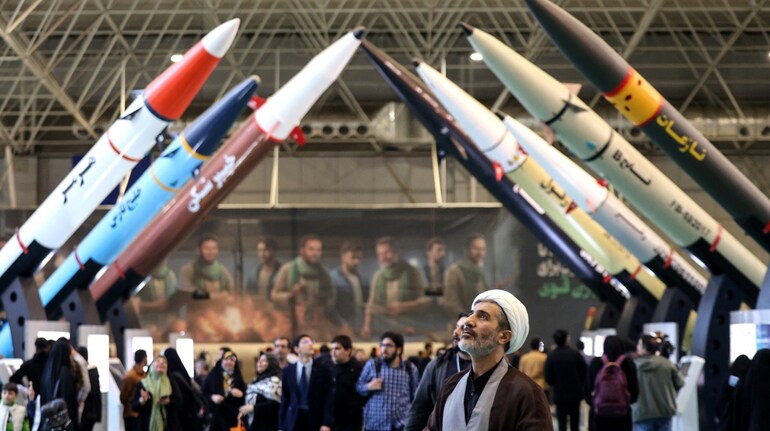

Tensions between Iran and the United States have sharply escalated after strong warnings from both sides, raising fears of a wider regional conflict. At the centre of the standoff is Iran’s missile capability and its clear message that it will not back down on uranium enrichment or military deterrence.
Iran’s Foreign Minister Abbas Araghchi has rejected any suggestion that Tehran could abandon uranium enrichment during negotiations with Washington. He also dismissed the US military buildup in the region, saying it “does not scare us.”
The remarks came after US President Donald Trump warned that a “massive armada” was “moving quickly, with great power, enthusiasm, and purpose” toward Iran.
Iran’s warning: US bases will be targeted
Araghchi made Iran’s position explicit in an interview with Al Jazeera.
“It would not be possible to attack American soil, but we will target their bases in the region,” he said.
“We will not attack neighbouring countries; rather, we will target US bases stationed in them. There is a big difference between the two,” he added.
He also warned that Iran was ready “with their fingers on the trigger” to “immediately and powerfully respond” to any aggression.
The message was clear. If the US attacks Iran, the response will not be symbolic. It will be directed at American military infrastructure spread across the Middle East.
Why US takes Iran’s missile threat seriously
While Iran’s direct missile attack on Israel last year involved nearly 500 missiles that caused limited damage, US defence planners do not dismiss Tehran’s capabilities.
According to the Wall Street Journal, Iran possesses around 2,000 midrange ballistic missiles capable of striking targets across the region. It also has a large number of short-range missiles that can hit US bases in the Gulf.
Behnam Ben Taleblu, senior director of the Iran Program at the Foundation for Defence of Democracies, explained why missiles matter so much to Tehran.
“In the absence of any meaningful air force and air defences and with decimated allies and nuclear capabilities, Iran's ballistic missiles now constitute the backbone of Iran's deterrence,” he told the Washington Post.
“They are like a Swiss Army knife for the regime for coercion, defence and punishment all at once.”
Iran’s key missiles and what they can reach
Khorramshahr
Iran’s most powerful liquid-fuelled missile carries an ultra-heavy warhead and has a range of up to 2,000 kilometres. This places Israel, large parts of the Middle East, and even southeastern Europe within reach.
US bases it can hit include Al Udeid Air Base in Qatar, US Naval Support Activity in Bahrain, and facilities in Kuwait, Iraq, Syria, the UAE, and Saudi Arabia.
Sejjil
The solid-fuel Sejjil missile also has a range of about 2,000 kilometres. It is capable of striking Israel and deep into the region.
Targets include Al Udeid in Qatar, US facilities in Bahrain, Camp Arifjan and Ali Al Salem in Kuwait, Al Asad Air Base in Iraq, and US assets in the UAE, Saudi Arabia, Jordan, and Turkey.
Emad and Ghadr-1
With ranges of around 1,700 kilometres, these missiles can reach key US bases across the Gulf and beyond.
They cover Al Udeid in Qatar, US bases in Bahrain, Kuwait, Iraq, the UAE, Turkey’s Incirlik Air Base, and sites in Jordan and Syria.
Fattah-1, Haj Qasem, and Kheibar Shekan
Developed largely by the Islamic Revolutionary Guard Corps, these missiles have ranges of about 1,400 kilometres.
They can hit US bases in Qatar, Bahrain, Kuwait, the UAE, Jordan, and Syria.
Dezful
With a shorter range of around 1,000 kilometres, the Dezful missile still covers most US infrastructure in the Gulf.
Potential targets include Al Udeid in Qatar, Ain al Assad in Iraq, Camp Arifjan and Ali Al Salem in Kuwait, US Naval Support Activity in Bahrain, Al Dhafra in the UAE, and eastern Saudi Arabia.
The strategic reality
The reality is that most US bases in the Gulf fall within range of at least one type of Iranian ballistic missile. This is why Washington treats Tehran’s warnings seriously, even as it deploys more forces to the region.
The missile threat is unfolding against a tense domestic backdrop in Iran. The US military buildup follows Iran’s violent crackdown on anti-government protests that erupted in late December over economic grievances.
Iranian authorities claim 3,117 people were killed, publishing a list of 2,986 names they say include security forces and bystanders. The US-based Human Rights Activists News Agency says it has verified 6,961 deaths, mostly protesters, with thousands more cases under review.
As diplomacy struggles and rhetoric hardens, Iran’s missile arsenal remains its strongest message to Washington. Any conflict, Tehran is signalling, would not stay confined to Iran alone.
Discover the latest Business News, Sensex, and Nifty updates. Obtain Personal Finance insights, tax queries, and expert opinions on Moneycontrol or download the Moneycontrol App to stay updated!
Find the best of Al News in one place, specially curated for you every weekend.
Stay on top of the latest tech trends and biggest startup news.





