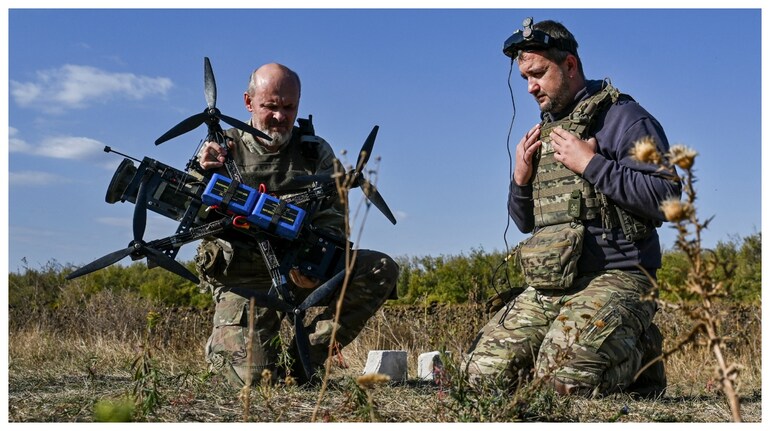
Deep beneath a concrete bridge in eastern Ukraine, a buzzing quadcopter crept silently toward its target: a sleeping Russian soldier wrapped in a red blanket. The drone hovered just feet away, guided not by radio but by a cable — a thin strand of fibre-optic wire spooling out behind it, impervious to electronic interference. The strike that followed was one of many now shaping a rapidly evolving warfront, where Ukraine is deploying a new class of tethered drones to outmanoeuvre Russia’s superior jamming systems, the Wall Street Journal reported.
As both sides ramp up their use of drones, fibre-optic guidance has emerged as a critical response to the digital arms race. With Russian electronic-warfare systems increasingly neutralizing traditional first-person-view (FPV) drones, Ukraine is turning to fibre-linked models capable of flying into buildings, manoeuvring around concrete walls, and waiting silently for the perfect ambush — all without losing signal.
A wired solution to a wireless problem
Ukraine’s FPV drones have been the backbone of its battlefield innovation since 2023, compensating for dwindling artillery supplies. But most of these drones rely on radio frequencies — now a liability across the 600-mile front, where Russian jammers and signal interceptors dominate the airwaves. In dense cities and forests, they often fail to even lift off.
Fiber-optic drones sidestep that vulnerability. From the outside, they look like standard quadcopters. But strapped to their frame is a spool containing up to 20 kilometres of high-speed internet-grade cable. This cable, unwound mid-flight, forms a direct, unjammable link between pilot and drone.
“It’s a lifeline,” said the lead pilot of the Dovbush Hornets, a Ukrainian drone unit named after a legendary outlaw. “Without these, we’d be grounded.”
Ironically, it was Russia that pioneered the use of fibre-optic drones during its offensive in Kursk last fall. But Ukraine has quickly caught up — and in some regions, surpassed its rival in tactical use and volume.
Precision ambushes in the shadows
From abandoned schools to metal pipes and ravines, Ukrainian units are using fibre-optic drones to reach enemy fighters who believe they are safely hidden from aerial attacks. In one mission, the Hornets flew a drone inside a garage and waited until a Russian tank rolled in. In another, the drone hovered in a tunnel beneath a city street before striking.
Michael Kofman, a defence expert at the Carnegie Endowment for International Peace, called the drones a logical evolution. “You can park this drone on the ground and simply wait for a vehicle to come. It’s a shift from swarm attacks to surgical strikes.”
But the technology is far from perfect. The cables are fragile, easily broken by wind, trees, or tanks that unknowingly drive over them. Pedestrians have been asked to reroute their steps to avoid severing an ongoing mission. Drones often carry lighter payloads because the cable-spool assembly eats up nearly half their lifting capacity.
And after detonation, the cable remains — leaving behind tangled webs across the Ukrainian countryside. Some troops report tripping on the wires during foot patrols; one soldier photographed a bird’s nest made from discarded fibre strands.
A race to mass-produce — and to disrupt
Ukraine’s drone industry is now racing to meet military demand. Sparrow Avia, a Kyiv-area drone manufacturer, produces 12,000 fibre-optic drones a month — double the cost of standard FPV drones — and is aiming for 20,000 by year’s end. The factory is also experimenting with green cables to help drones blend in during summer operations.
Yet the supply chain remains precarious. Most fibre-optic cable is sourced from China, a point of strategic vulnerability. “If China stops deliveries, all fibre-optic flights in Ukraine will instantly stop,” said Nikolai, Sparrow Avia’s director.
To disrupt Russian capabilities, Ukraine has twice struck Russia’s only known fibre-optic cable plant in Saransk this year, though Moscow has not acknowledged the damage.
The next stage: Self-guided drones
Despite their current value, fibre-optic drones are a stopgap solution. Military experts believe the future lies in AI-guided quadcopters that require neither cable nor radio. These autonomous drones would switch frequencies, lock onto targets themselves, and navigate jamming zones with algorithmic precision.
“Soon, auto-guidance systems will be the future,” said Lt. Andriy Kasianenko of the Achilles Drone Regiment. Until then, fibre-optic drones will continue weaving through ruins and trenches, their trailing cables carpeting the front line like glistening spiderwebs — a visible sign of an invisible arms race still playing out above the battlefield.
Discover the latest Business News, Sensex, and Nifty updates. Obtain Personal Finance insights, tax queries, and expert opinions on Moneycontrol or download the Moneycontrol App to stay updated!
Find the best of Al News in one place, specially curated for you every weekend.
Stay on top of the latest tech trends and biggest startup news.