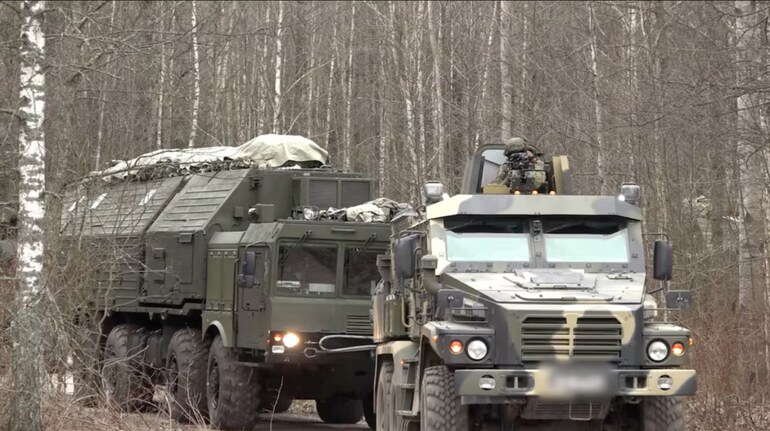

Russia has confirmed the use of an Oreshnik missile in an overnight strike on Ukraine, drawing renewed attention to a weapon that has so far remained largely experimental. The launch marks only the second known use of the missile in the war, according to Moscow, and comes amid rising tensions over long-range attacks and Western support for Kyiv.
A rarely used missile
The Oreshnik, a name that translates as Hazel Tree, belongs to a class of intermediate-range hypersonic ballistic missiles. Russia first fired it at Ukraine in November 2024, but that earlier launch was described by Ukrainian sources as a test, since the missile carried dummy warheads and caused only limited damage.
If the latest strike involved live explosive payloads, it would represent the first time the Oreshnik has been used with full destructive intent. Russian officials said the target was Ukrainian critical infrastructure, though there was no immediate independent confirmation of the scale of damage.
Design and capabilities
What sets the Oreshnik apart, analysts say, is its ability to deploy multiple warheads that can hit different targets at the same time. This feature is more commonly associated with intercontinental ballistic missiles rather than weapons of intermediate range.
The missile is derived from the RS-26 Rubezh, a system initially designed by Russia as an intercontinental weapon. Like many Russian missile platforms, the Oreshnik can theoretically carry either nuclear or conventional warheads. There was, however, no indication that the latest strike had any nuclear element.
During the November 2024 launch, Ukraine said the missile took roughly 15 minutes to reach its target after being fired from southern Russia, travelling at speeds estimated at around 13,600 kilometres per hour.
Claims and skepticism
President Vladimir Putin has previously argued that the Oreshnik is impossible to intercept and that even a conventional version has destructive power comparable to that of a nuclear weapon. Western experts have pushed back on those assertions.
In December 2024, a U.S. official described the missile as not a “game-changer” on the battlefield, characterising it instead as experimental and suggesting that Russia likely had only a limited number available at the time.
Despite that assessment, Russia has since moved the Oreshnik into serial production and has also supplied the system to its ally Belarus.
Why now?
Russia’s military said the missile launch was retaliation for what it claimed was an attempted Ukrainian drone strike late last year on one of Putin’s residences in Novgorod. Ukraine denied the allegation, saying no such attack had occurred.
Putin had earlier warned that continued Ukrainian use of long-range Western weapons could prompt Oreshnik strikes, including against what he called “decision-making centres” in Kyiv. Until now, those threats had not been carried out.
Wider implications
The latest strike hit Ukraine’s western Lviv region, close to the border with NATO member Poland. Ukraine’s foreign minister described the launch as a “global threat” requiring an international response.
The escalation comes as U.S. President Donald Trump continues efforts to push Moscow and Kyiv toward a peace agreement, nearly three years after Russia began its full-scale invasion of Ukraine in February 2022.
(With inputs from Reuters)Discover the latest Business News, Sensex, and Nifty updates. Obtain Personal Finance insights, tax queries, and expert opinions on Moneycontrol or download the Moneycontrol App to stay updated!
Find the best of Al News in one place, specially curated for you every weekend.
Stay on top of the latest tech trends and biggest startup news.