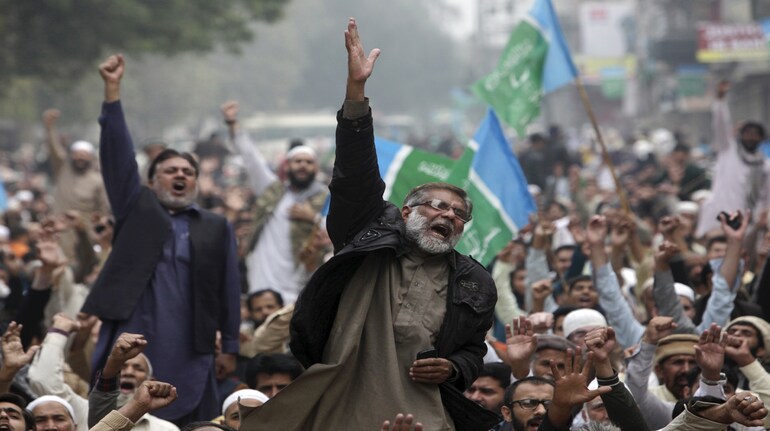
Bangladesh risks sliding into Pakistan’s strategic orbit in ways that could pose serious security challenges for India’s eastern security flank and the North-East, former Indian diplomat Veena Sikri has warned, citing the growing influence of Islamist groups, alleged ISI involvement and the re-emergence of Pakistan-backed terror networks.
Speaking with Moneycontrol, Sikri said Pakistan’s objective was to regain the kind of command and control it exercised over Bangladesh before 1971, when it was East Pakistan.
“That is the objective of Pakistan, definitely,” Sikri said. “They want to bring Bangladesh to the pre-1971 level, when they had command and control.”
She alleged that Pakistan acted as a conduit in the political transition in Dhaka, enabling Jamaat-e-Islami to consolidate its influence within the country’s power structure.
“In Bangladesh, the Jamaat-e-Islami is in charge,” Sikri said. “They have got Mohammed Yunus as their spokesperson, as their mouthpiece.”
Pakistan’s growing footprint in Bangladesh
Sikri said the developments over the past 18 months pointed to a deliberate attempt to embed Pakistan’s influence across Bangladesh’s military and security institutions — a trend she warned had direct implications for India’s eastern borders and the North-East.
“Whether it is embedding Pakistan army officers with the Bangladesh army, whether it is removing visa restrictions, trade restrictions and cargo inspection — everything has been removed,” she said.
She cautioned that such steps could allow hostile elements greater operational freedom close to India’s border regions.
“This has very serious implications for India, particularly for the eastern flank and the North-East,” Sikri said.
Terror groups ‘back in Bangladesh’
The former diplomat also raised concerns over the reported presence of Pakistan-backed militant organisations in Bangladesh.
“Even the Pakistan state-sponsored terrorist groups like Lashkar-e-Taiba and Jaish-e-Mohammed — they are all back. They say so themselves,” Sikri said.
She linked these developments to Pakistan’s broader regional strategy, warning that India could increasingly face pressure from the east.
“Asim Munir has already said the next attack on India will be from the East,” Sikri said, referring to remarks attributed to the Pakistan Army chief.
‘Not what the people want’
Despite these developments, Sikri said the direction being pushed by Islamist groups and external actors did not reflect popular sentiment in Bangladesh.
“This is what Pakistan wants at the state level,” she said. “But are the people of Bangladesh in favour of this? I don’t think so.”
She said Jamaat-e-Islami had failed to gain the mass support it expected.
“People are religious, yes. But nobody wants Sharia law. Nobody wants a caliphate. Nobody wants Jamaat-e-Islami to come to power,” Sikri said.
Sikri warned that continued political exclusion, violence and instability in Bangladesh would not only deepen internal crises but also complicate India’s security calculus along its eastern frontier.
“It’s not good for India to have an unstable Bangladesh,” she said. “And it’s not good for Bangladesh either.”
She emphasised that without inclusive and credible elections, the situation could worsen, increasing risks for both countries and the wider region.
Implications for India
The former diplomat said India had shown “strategic restraint” so far but cautioned that prolonged instability in Bangladesh was not in New Delhi’s interest.
“It’s not good for India to have an unstable Bangladesh,” Sikri said. “And it’s not good for Bangladesh either.”
She stressed that credible and inclusive elections were essential to preventing further deterioration.
“You cannot keep out 35–40% of the population and expect stability,” Sikri said, warning that political exclusion would only deepen violence and insecurity.
Sikri concluded that if extremist influence and external interference continued unchecked, Bangladesh could increasingly resemble Pakistan’s political and security trajectory — significantly complicating India’s regional security calculus.
Discover the latest Business News, Sensex, and Nifty updates. Obtain Personal Finance insights, tax queries, and expert opinions on Moneycontrol or download the Moneycontrol App to stay updated!
Find the best of Al News in one place, specially curated for you every weekend.
Stay on top of the latest tech trends and biggest startup news.