






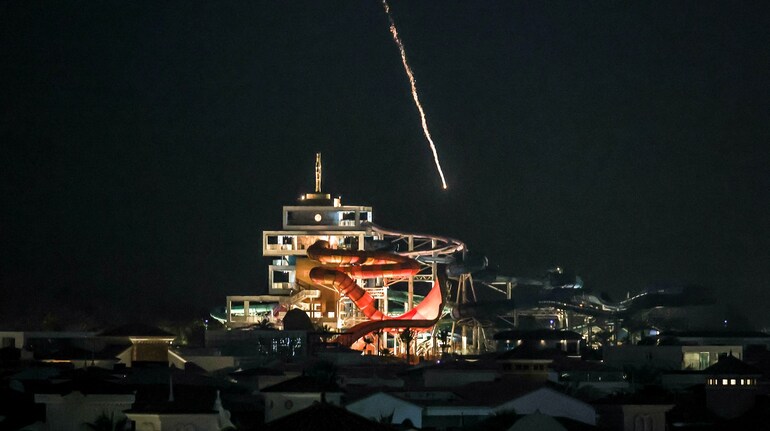

Iran’s latest missile and drone barrage across the Gulf has triggered a deeper debate about the region’s long-standing security architecture. For decades, Gulf states have hosted American military bases under a strategic understanding. The United States provides security guarantees and deterrence, while the host countries offer basing rights that allow Washington to project power across the Middle East. But the recent wave of Iranian strikes has raised uncomfortable questions about whether that arrangement still protects Gulf states or instead makes them targets. In a widely circulated analysis, geopolitical commentator Shanaka Anslem Perera argues that the attacks have exposed a fundamental flaw in the region’s security model.
A sentence that changed the conversation
Perera argues that the most important signal from the Gulf did not come from casualty figures or interception statistics.
“The most important sentence from the Gulf this weekend was not the UAE Defense Ministry announcing it had intercepted 132 of 137 Iranian ballistic missiles and 195 of 209 drones. It was not the confirmation of three dead and 58 injured. It was a single line buried in the UAE Foreign Ministry statement: the UAE voices its firm rejection of the use of the territories of countries in the region as arenas for settling scores or expanding the scope of conflict.”
According to Perera, the wording carried a deeper message about the region’s growing unease.
“Read that again. That sentence is not addressed to Iran. It is addressed to everyone. It is addressed to the United States.”
The most important sentence from the Gulf this weekend was not the UAE Defense Ministry announcing it had intercepted 132 of 137 Iranian ballistic missiles and 195 of 209 drones. It was not the confirmation of three dead and 58 injured. It was a single line buried in the UAE… https://t.co/88VuAffuaWpic.twitter.com/u6uuzZTFa8— Shanaka Anslem Perera ⚡ (@shanaka86) March 1, 2026
The Gulf’s long-standing security bargain
For decades, Gulf monarchies have operated under what Perera describes as a “grand bargain.”
“The grand bargain of the Gulf has operated on a simple formula for decades. Host American military bases. Receive a security umbrella. Prosper under the perception of invulnerability. Build the tallest buildings, the busiest airports, the most expensive hotels, on the understanding that the American presence deters anyone from attacking you.”
But the recent missile barrage, he argues, challenges that logic.
“That bargain just failed in real time on the most expensive real estate on earth.”
Iran’s strikes were not directed at the UAE because of bilateral tensions, Perera writes. They were aimed at military infrastructure tied to US operations.
“Iran did not fire 137 ballistic missiles at the UAE because it has a dispute with the UAE. It fired them because the UAE hosts Al Dhafra Air Base, where the US Air Force’s 380th Expeditionary Wing operates reconnaissance, refueling, and combat support aircraft.”
He also points to the role of US missile defence deployments.
“Because the THAAD missile defense system deployed on Emirati soil exists to protect American force projection, not Emirati shopping malls.”
A pattern across the Gulf
Perera highlights a pattern that emerged during the attacks. Countries hosting US military infrastructure were targeted, while one country that does not host American bases was not.
“The proof of concept is sitting right there in the data. Al Jazeera confirmed that the only GCC country Iran did not strike was Oman. Oman has no American bases. Oman served as mediator between Iran and the United States.”
“Oman was spared. Every country that hosted US military infrastructure was hit. The correlation is perfect and the lesson is devastating.”
The limits of air defence
The UAE’s missile defence system performed effectively, intercepting the vast majority of incoming threats. However, Perera argues that even a very high interception rate still carries risks when economic stability depends on absolute security.
“A 96 percent intercept rate against ballistic missiles is among the highest ever recorded in live combat.”
Yet the remaining few strikes still had visible consequences.
“Fourteen drones landed within the country. Debris fell across Saadiyat Island, Khalifa City, Bani Yas, and Mohamed bin Zayed City. A Pakistani worker died in Abu Dhabi. Fires broke out at Jebel Ali Port and on the facade of the Burj Al Arab.”
He adds that even limited disruption can shake confidence in a system built on the perception of safety.
“When your economic model depends on absolute safety, 96 percent is not enough.”
A strategic rethink underway
The UAE’s official response included language asserting its right to respond to the attacks. But Perera believes the more significant reaction will take place at the strategic level.
“The UAE Foreign Ministry added that it retains its full and legitimate right to respond. But the response that matters most is not military. It is strategic.”
The central question facing Gulf capitals now, he argues, concerns whether hosting American bases enhances security or increases vulnerability.
“The question the UAE is now asking itself, and that every Gulf capital is asking alongside it, is whether the grand bargain still holds.”
“Whether hosting American bases provides net security or net risk. Whether the umbrella protects you or paints a target on you.”
A turning point for the region
Dubai and other Gulf hubs built their economic success by positioning themselves as neutral commercial crossroads.
“Dubai did not build itself into the crossroads of global commerce by taking sides. It built itself by being the place where all sides could do business.”
But that position becomes harder to maintain when military infrastructure tied to external conflicts is located within national borders.
“That positioning is now incompatible with hosting the infrastructure of someone else’s war.”
Perera argues that the UAE’s statement signals the beginning of a larger conversation across the region.
“That single sentence about rejecting the use of Gulf territories as arenas for settling scores is not a complaint. It is the beginning of a renegotiation.”
If Gulf states eventually conclude that the presence of US military bases increases the risk of being drawn into conflicts, he warns, the consequences could reshape the regional order.
“And if the Gulf states conclude that American bases create more risk than they prevent, the security architecture of the Middle East that has held since 1991 will have to be rebuilt from scratch.”
Discover the latest Business News, Sensex, and Nifty updates. Obtain Personal Finance insights, tax queries, and expert opinions on Moneycontrol or download the Moneycontrol App to stay updated!
Find the best of Al News in one place, specially curated for you every weekend.
Stay on top of the latest tech trends and biggest startup news.





