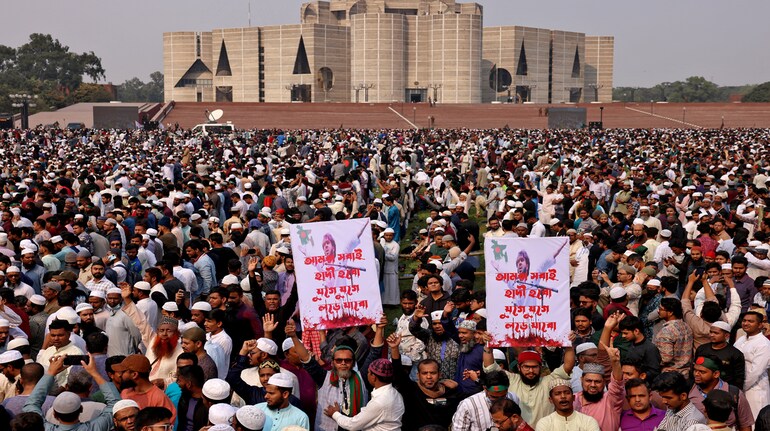
The escalating unrest in Bangladesh following the death of student leader Sharif Osman Hadi is being viewed by top intelligence sources as a carefully timed and premeditated move towards a hardline anti-India posture, News18 has reported. While the interim administration has portrayed the violence as a spontaneous outpouring of grief, ground-level intelligence assessments suggest a far more deliberate strategy at play.
Sources indicate to News18 that the turmoil is not simply the result of a power vacuum but a case of “controlled chaos” being used to reshape Bangladesh’s political narrative and its ties with New Delhi. The failure to adequately protect diplomatic missions — including stone-pelting at the Indian Assistant High Commission in Chattogram and the siege of the High Commission in Dhaka — is being attributed to a lack of political will rather than any shortage of security capability.
Intelligence inputs suggest that Jamaat-e-Islami-aligned student groups and street networks were mobilised with precision soon after the incident. Despite having the manpower to intervene, police stations in several parts of Dhaka remained largely inactive. Officers were reportedly instructed to avoid immediate arrests to prevent “escalation”, a hesitation that allowed attackers time to disperse and evade action.
Sources said this administrative paralysis feeds a larger narrative, as firm police action risked being labelled “pro-India suppression”. Such a perception, they add, would have bolstered radical claims that the unrest was triggered by an Indian-backed conspiracy. The resulting blame shift towards India has served to weaken the Awami League’s remaining influence and marginalise institutions seen as loyal to former prime minister Sheikh Hasina.
By allowing radical elements to dominate the streets and fuel anti-Hindu sentiment, the interim government has effectively redirected domestic political discourse towards a so-called “revolutionary” legitimacy that is inherently hostile to India, sources said.
For interim leader Muhammad Yunus, this managed instability appears to serve twin objectives, intelligence officials assess. At home, it sidelines traditional political rivals ahead of the proposed February elections. Internationally, it enables him to project himself to Western capitals as a neutral and indispensable stabilising force, positioned as the last barrier against a complete radical takeover.
However, sources cautioned that this strategy hinges on the steady amplification of anti-India rhetoric, transforming a tragic domestic incident into a wider regional flashpoint and putting decades of India-Bangladesh security cooperation at risk.
Discover the latest Business News, Sensex, and Nifty updates. Obtain Personal Finance insights, tax queries, and expert opinions on Moneycontrol or download the Moneycontrol App to stay updated!
Find the best of Al News in one place, specially curated for you every weekend.
Stay on top of the latest tech trends and biggest startup news.