






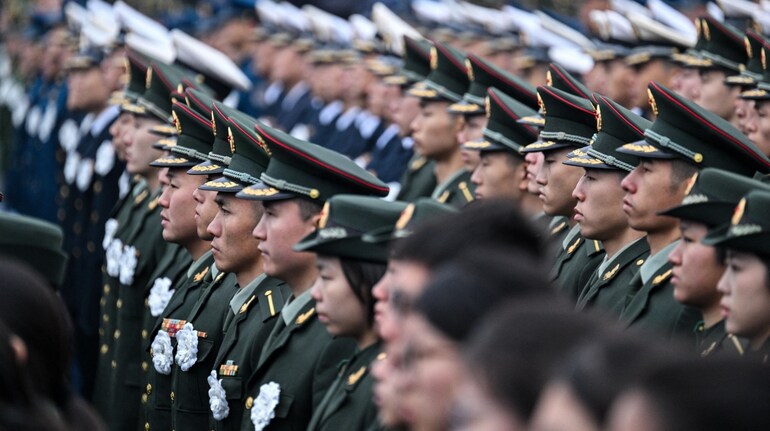
A new assessment by researchers at the Center for Strategic and International Studies puts numbers on something analysts have been tracking anecdotally for years. Since 2022, close to 100 senior officers in China’s armed forces, mostly generals and lieutenant generals, have been removed, sidelined, detained or simply stopped appearing in public. Some were pushed out after retirement, which is unusual in a system that normally leaves former commanders alone.
The study argues that this is not a narrow anti-corruption drive but a sweeping clean out of the upper layers of the People’s Liberation Army. Roughly half of the military’s senior leadership has been affected, including commanders of theatre commands, heads of key departments and officers once tipped as future leaders, the New York Times reported.
Who fell, and why it stands out
Among those removed were officers with direct operational relevance to Taiwan. One had commanded forces positioned opposite the island. Another was credited with modernising training across the PLA. A third had served as a long-time military aide to Xi Jinping himself.
What makes this striking is that some of these officers rose under Xi’s patronage. That undercuts the simple explanation that this is only about rooting out rivals from earlier political eras. Instead, analysts see a pattern of relentless tightening, where loyalty is constantly re tested and past favour offers no protection.
Why replacing them is not easy
Promoting new commanders in the Chinese system is slow by design. Senior officers usually need three to five years at their current rank before being considered for the next step. By clearing out so many people at once, the purge has narrowed the pool of candidates who have both the operational experience and the personal trust Xi demands.
As M Taylor Fravel of MIT notes in the study, Xi wants a military that is both loyal and competent. The problem is that purges solve the loyalty question in the short term while making the competence problem harder over time.
What this means for Taiwan right now
In the near term, the study suggests that China would struggle to run a large, complex military campaign, especially one involving joint operations across air, sea and missile forces. Vacancies at the top create command bottlenecks. Even below the level of an invasion, there are signs that China’s military exercises around Taiwan in 2025 were simplified, delayed or scaled back.
This does not mean Beijing has abandoned pressure on Taiwan. It does mean that the internal churn inside the PLA imposes real constraints on how far and how fast it can go.
The ripple effect inside the ranks
The damage does not stop with the officers who disappear. In the PLA, careers are built in clusters. When a senior commander falls, dozens of colonels and majors tied to that person come under suspicion. Promotions slow. Investigations spread. People become cautious.
Former CIA analyst John Culver describes this as a multi-year shock. Even if the purge stopped tomorrow, its effects would continue to ripple through the system for two or three years as officers wait to see who is safe to follow and which careers are now liabilities.
Modernisation versus command paralysis
China’s long term military modernisation does not appear to have stalled. Shipbuilding, missile production and new platforms continue. But modern hardware still needs experienced commanders to use it well. The study points to signs that leadership gaps may already be affecting planning and execution, particularly in complex exercises.
Xi has tried to patch some holes by appointing new commanders to the Eastern and Central Theater Commands. What remains unresolved is the leadership of the Central Military Commission itself, the body that ultimately controls the armed forces. There is no clear signal yet on when or how those positions will be filled.
The bigger picture
Seen together, the findings paint a picture of a military that looks formidable from the outside but is under strain at the top. Xi’s drive to enforce discipline and loyalty has reshaped the PLA faster and more brutally than many expected. The question now is whether that reshaping leaves China more capable, or more brittle, at a moment when regional tensions are already high.
Discover the latest Business News, Sensex, and Nifty updates. Obtain Personal Finance insights, tax queries, and expert opinions on Moneycontrol or download the Moneycontrol App to stay updated!
Find the best of Al News in one place, specially curated for you every weekend.
Stay on top of the latest tech trends and biggest startup news.




