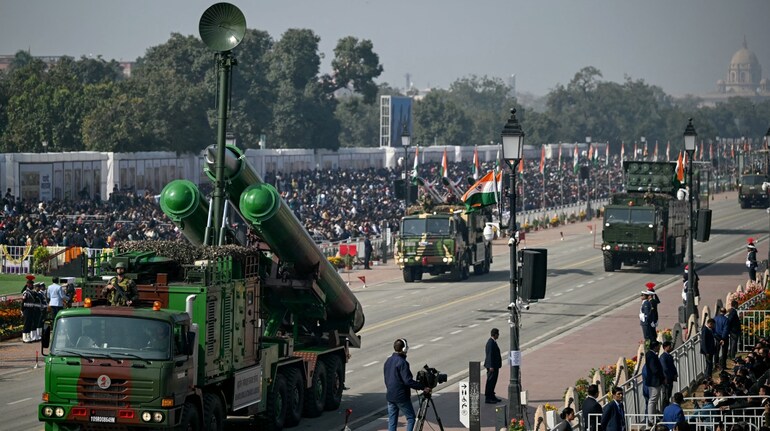

India’s defence budget for 2026–27 reflects a decisive shift from incremental preparedness to sustained military strengthening. In a year shaped by the success of Operation Sindoor and rising volatility along India’s borders with Pakistan, China and Bangladesh, the government has opted for a robust double-digit increase in defence spending.
The scale and structure of the hike signal that New Delhi is not only responding to immediate threats but also investing in long-term deterrence and strategic autonomy. By sharply raising capital outlay, prioritising high-value platforms and easing customs duties for defence manufacturing, the Budget reinforces India’s intent to build a modern, self-reliant military capable of handling multi-front challenges.
Defence outlay sees sharp rise
The government has set aside Rs 7,84,678 crore as total defence outlay for 2026–27, up from Rs 6,81,210 crore in the previous financial year. This marks a year-on-year increase of more than Rs 1 lakh crore and represents one of the strongest growth rates in recent years.
Excluding pensions, defence spending has risen to around Rs 5.9 lakh crore from Rs 4.9 lakh crore in FY26 (Budget Estimates), marking a growth of around 19 percent year-on-year. This underlines the focus on operational capability rather than recurring costs alone. Over the past decade, India’s defence budget has nearly doubled, rising from Rs 3.52 lakh crore in 2016–17 to over Rs 7.8 lakh crore today.
The defence spending in the Budget has reversed its recent decline as a share of GDP, rising to just under 2 per cent in 2026-27. The allocation accounts for 1.997 per cent of GDP, up from 1.91 per cent of GDP in 2025-26.
Capital expenditure takes priority
A defining feature of Budget 2026 is the emphasis on capital expenditure. The total capital outlay for defence has been pegged at Rs 2,19,306 crore, up sharply from Rs 1,80,000 crore in the Budget Estimates for 2025–26 and Rs 1,86,454 crore at the revised estimate stage.
Capital expenditure now accounts for roughly 28 per cent of total defence spending, a steady rise from about 26 per cent in the previous year. This shift highlights a structural transformation in India’s military planning, with greater emphasis on platforms, weapons and technology rather than manpower-heavy expenditure.
The long-term trend is even more revealing. Defence capital outlay has increased from Rs 86,357 crore in 2016-17 to more than Rs 2.2 lakh crore in FY27, reflecting a deliberate move towards modernisation and future-ready forces.
Where the money is going
Under capital expenditure, the government has earmarked Rs 63,733 crore for aircraft and aero engines, reflecting the priority given to air power amid evolving threats from both western and northern fronts. The naval fleet has been allocated Rs 25,023 crore, reinforcing India’s focus on maritime security in the Indian Ocean Region and the Bay of Bengal.
Higher allocations have also been made for missiles, artillery systems, armoured vehicles, drones and surveillance platforms. Air defence systems remain a major focus following lessons from recent conflicts and Operation Sindoor, which underscored the importance of layered defence against missiles, drones and precision strikes.
Revenue spending and pensions
Revenue expenditure for defence has been set at Rs 5,53,668 crore, which includes Rs 1,71,338 crore for pensions. While pensions remain a significant component, the rising share of capital expenditure indicates a conscious effort to balance welfare obligations with force modernisation.
Operation Sindoor and strategic lessons
The Budget comes in the aftermath of Operation Sindoor, which demonstrated India’s ability to conduct precise, coordinated and intelligence-driven military action. The operation validated investments made over the past decade in surveillance, joint operations and indigenous platforms.
Budget 2026 reflects these lessons by prioritising next-generation capabilities, network-centric warfare systems and electronic warfare assets. The focus has shifted towards rapid response, integration across services and technological superiority.
Aatmanirbhar Bharat gets a boost
A major highlight of the Budget is the support extended to domestic defence manufacturing. Finance Minister Nirmala Sitharaman announced exemptions on basic customs duty for components and parts required for the manufacture of civilian, training and other aircraft.
She also proposed waiving basic customs duty on raw materials imported for manufacturing aircraft parts used in maintenance, repair and overhaul activities by defence sector units. These measures are expected to significantly benefit the defence aerospace industry and reduce dependence on imported components.
The customs relief aligns with the Aatmanirbhar Bharat push, encouraging Indian companies to scale up production, invest in research and become part of global supply chains.
Responding to a volatile neighbourhood
India’s security environment remains challenging. Pakistan continues to rely on asymmetric threats and external military support. China’s sustained military build-up along the Line of Actual Control has forced India to maintain high troop levels and infrastructure readiness. Developments in Bangladesh have added new dimensions to eastern border security.
In this context, the defence budget is designed to sustain readiness across multiple fronts simultaneously, covering land, air, sea, cyber and space domains.
The bigger strategic message
The double-digit hike in defence spending sends a clear message of deterrence and resolve. It reassures the armed forces of sustained political backing, signals seriousness to adversaries and reinforces India’s emergence as a credible military power.
By combining higher capital expenditure, operational readiness and domestic manufacturing support, Budget 2026 strengthens India’s defence posture today while laying the foundation for long-term strategic autonomy in an increasingly uncertain regional landscape.
Discover the latest Business News, Sensex, and Nifty updates. Obtain Personal Finance insights, tax queries, and expert opinions on Moneycontrol or download the Moneycontrol App to stay updated!
Find the best of Al News in one place, specially curated for you every weekend.
Stay on top of the latest tech trends and biggest startup news.