






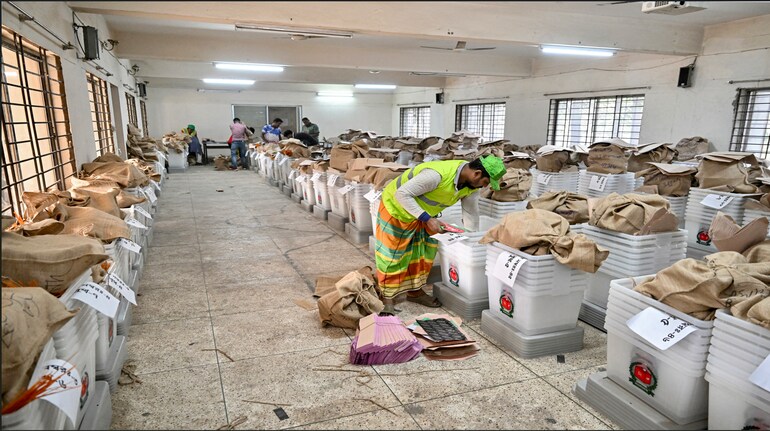

Bangladesh will vote on February 12 in its 13th general election, the first since former Prime Minister Sheikh Hasina was removed from office in August 2024 following a deadly crackdown on student-led protests that left an estimated 1,400 people dead.
The election is seen as a critical test of the country’s democratic transition under interim leader Muhammad Yunus, who has sought to reassure voters that power will be handed over to the elected government.
The election is set to witness a keen contest between the Bangladesh Nationalist Party (BNP) and the Jamaat-led alliance, a battle that is likely to significantly shape the South Asian nation’s political trajectory in the post–Sheikh Hasina era.
The Hasina factor
Sheikh Hasina’s Awami League has been barred from contesting the election. Hasina, currently in exile in New Delhi, has said the ban leaves millions of her supporters without representation and could lead to voter boycotts.
The opposition Bangladesh Nationalist Party (BNP) has made her extradition a major campaign issue, arguing that India’s decision to host her undermines Bangladesh’s judicial process.
Mirza Fakhrul Islam Alamgir, the BNP secretary general, told The Week, “Sheikh Hasina created this crisis by dismantling democratic institutions and centralising power. In the long run, she will not remain relevant in politics.”
While some Awami League supporters have indicated they may abstain, analysts say a large-scale boycott appears unlikely. Surveys suggest many former Awami League voters are shifting toward the BNP, with a significant portion also backing Jamaat-e-Islami.
What are the main issues?
Who are the key parties and candidates?
Bangladesh Nationalist Party (BNP)
The centre-right BNP leads a 10-party alliance and is headed by Tarique Rahman, son of former Prime Minister Khaleda Zia. Rahman returned from exile in London in late 2024. The BNP campaigns on Bangladeshi nationalism and governance reforms.
Jamaat-e-Islami (JIB)
Led by Shafiqur Rahman, Jamaat heads an 11-party bloc that includes the student-formed National Citizen Party (NCP). The Supreme Court restored Jamaat’s registration in June 2025, allowing it to contest after years of restrictions.
The party is fielding one Hindu candidate, Krishna Nandi, in a bid to broaden support. Political analysts say the outcome could shape Bangladesh’s foreign policy direction, including ties with India, Pakistan, China, the United States and Turkey.
Other parties
The Islami Andolan Bangladesh and the Jatiya Party are contesting independently.
What do opinion polls suggest?
A December 2025 survey by the International Republican Institute placed the BNP at 33% support and Jamaat-e-Islami at 29%, indicating a closely fought race.
When will results be announced?
Unofficial trends are expected to emerge early the next morning. However, officials have cautioned that counting may take longer due to the high number of candidates and the inclusion of both parliamentary ballots and referendum ballots on the July National Charter.
What time do polls open in Bangladesh?
Voting will begin at 7:30am (01:30 GMT) and continue until 4:30pm (10:30 GMT). Ballots will be cast at 42,761 polling stations across 64 districts to elect representatives for 300 parliamentary constituencies, according to the Election Commission of Bangladesh (ECB).
How does voting work in Bangladesh?
As of October 31, 2025, Bangladesh has 127,711,793 registered voters aged 18 and above, with postal ballots introduced for the first time to allow nearly 15 million overseas workers to vote. The country has a unicameral parliament, the 350-member Jatiyo Shangsad, comprising 300 directly elected seats and 50 reserved for women.
Members are chosen through a first-past-the-post system, where voters select one candidate per constituency and the highest vote-getter wins. The 50 women’s seats are distributed proportionally among parties based on their performance in the 300 elected constituencies.
A party needs at least 151 seats to form a government on its own, while the party with the next highest tally becomes the official opposition.
Discover the latest Business News, Sensex, and Nifty updates. Obtain Personal Finance insights, tax queries, and expert opinions on Moneycontrol or download the Moneycontrol App to stay updated!
Find the best of Al News in one place, specially curated for you every weekend.
Stay on top of the latest tech trends and biggest startup news.





