






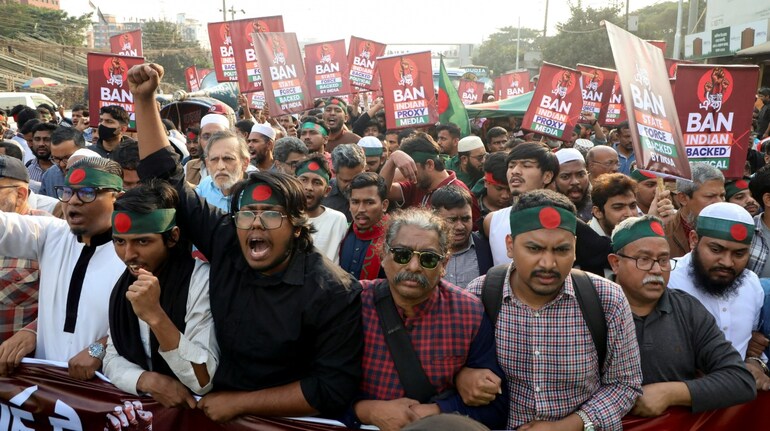
Anti-India sentiment in Bangladesh has once again spilled onto the streets, this time in a volatile mix of political opportunism, extremist mobilisation and a visible collapse of law and order. From violent protests outside India’s High Commission in Dhaka to the lynching of a Hindu man over blasphemy allegations, recent events have raised serious alarm in New Delhi about Bangladesh’s internal trajectory and its growing hostility towards India.
What makes this phase particularly dangerous is not just the rhetoric, but the brazenness with which threats are being issued against Indian diplomats, coupled with the Bangladeshi state’s inability or unwillingness to rein them in. The death of anti-India youth leader Sharif Osman Hadi, the lynching of Dipu Chandra Das, and open calls to storm the Indian High Commission have exposed how extremist narratives are being weaponised under the watch of Muhammad Yunus-led interim administration. Behind this unrest lies a deeper realignment, one that increasingly pulls Dhaka closer to China and Pakistan, while positioning India as a convenient enemy for domestic mobilisation.
The death of Sharif Osman Hadi and how it ignited protests
The immediate trigger for the latest wave of anti-India protests was the death of Sharif Osman Hadi, a prominent youth leader linked to the Inqilab Mancha platform. Hadi had been shot in Bangladesh earlier and later died in Singapore while undergoing treatment. His death quickly became fodder for conspiracy theories in Dhaka.
Sections of Bangladesh’s political ecosystem alleged that Hadi’s attackers had fled to India and were being sheltered by New Delhi. These claims were amplified without evidence, fuelling anger against India and turning grief into a political weapon.
India’s Ministry of External Affairs firmly rejected these allegations, calling them a “false narrative sought to be created by extremist elements regarding certain recent events in Bangladesh.” Despite the clarification, the narrative continued to gain traction, aided by student leaders and fringe political actors who used Hadi’s death to whip up anti-India sentiment.
Mob violence and the lynching of Dipu Chandra Das
As protests intensified, Bangladesh witnessed another disturbing incident that underlined the deteriorating security environment. Dipu Chandra Das, a Hindu man, was lynched by a mob over allegations of blasphemy amid the unrest.
The killing sparked international condemnation and highlighted the growing vulnerability of minorities in Bangladesh during periods of political chaos. While the interim government later condemned the lynching, the damage was already done. For India, the incident reinforced concerns that extremist mobilisation is increasingly spilling into communal violence, with minorities paying the price.
The episode also exposed the hollowness of Dhaka’s claims of stability, as mobs operated with impunity even as tensions with India escalated.
Threats against India’s High Commission in Dhaka
The situation took a sharply dangerous turn when protesters marched towards the Indian High Commission in Dhaka. Though stopped barely a kilometre short, the rhetoric used during the protest shocked Indian officials.
Mosaddeq Ali Ibn, a leader of the so-called July uprising and a Dhaka University student leader, issued an explicit threat. “If they (India) continue to act this way (summon Bangladesh HC), we will retaliate. Everyone will have axes in their hands. Not even a single brick will be spared here. We will uproot India’s High Commissioner to Bangladesh from Bangladesh and banish him,” he said.
Moments later, Rashid Pradhan, another student leader, escalated the threat further. “We stopped here this time. Next time, we will enter the Indian High Commission in Dhaka,” he announced.
These statements were made in close proximity to the diplomatic mission, despite prior intelligence inputs. India’s Visa Application Centre in Dhaka had already shut operations citing “ongoing security concern,” yet Bangladeshi authorities failed to prevent the march from reaching such a sensitive zone.
India summons Bangladesh’s envoy as tensions spike
Amid this, India summoned Bangladesh High Commissioner Riaz Hamidullah to South Block to lodge a strong protest over the deteriorating security situation and threats to Indian diplomats.
New Delhi conveyed deep concern over the failure of Bangladeshi authorities to ensure the safety of India’s mission and personnel. The summoning was a clear signal that India views the situation not as routine protest politics, but as a serious diplomatic and security breach.
Instead of de-escalating, the summoning itself became another rallying point for anti-India voices in Bangladesh.
Open calls to target India and the Northeast
The rhetoric soon crossed another red line when National Citizen Party leader Hasnat Abdullah openly threatened India’s territorial integrity. Referring to India’s northeastern states, he said Bangladesh could “sever the seven sisters.”
Even after India raised objections, Abdullah doubled down. “I heard Bangladesh High Commissioner was summoned by India and asked to explain why we said what we said. For giving refuge to murderer Sheikh Hasina, India’s High Commissioner to Bangladesh should be kicked out (of Bangladesh),” he told a public gathering.
Such statements would normally invite swift legal action. Instead, they were allowed to circulate freely, reinforcing the perception that extremist rhetoric has political backing.
Yunus and the collapse of law and order
At the heart of India’s concern is the failure of Muhammad Yunus led interim administration to maintain law and order or curb extremist mobilisation. Yunus, once projected internationally as a figure of peace and reform, has been unable to assert control over the streets or rein in radical voices.
Bangladeshi academician Arifa Rehman Ruma described the situation bluntly. “Hasnat Abdullah publicly said the Indian High Commissioner should be kicked out, a statement no responsible politician should ever make. Extremist and violent figures like Hasnat and his supporters are now the only real power backing Md Yunus,” she said.
For New Delhi, this suggests that Yunus is either unwilling or incapable of confronting the forces driving Bangladesh towards instability and confrontation with India.
The Sheikh Hasina extradition demand
Another fault line fuelling anger is Bangladesh’s renewed demand for the extradition of former Prime Minister Sheikh Hasina, who is currently in India. Extremist groups and political actors have used Hasina’s presence in India to portray New Delhi as interfering in Bangladesh’s internal affairs.
This narrative ignores India’s long-standing role in supporting Bangladesh’s stability. Instead, it paints India as an adversary sheltering enemies of the state, further legitimising hostility in the eyes of protestors.
China, Pakistan and the deeper strategic shift
Behind the street level unrest lies a broader strategic recalibration. Bangladesh’s increasing closeness to China and Pakistan has sharpened India’s anxieties.
China has expanded its economic and political footprint in Bangladesh, while Pakistan’s ISI has found renewed space to influence anti India narratives. Analysts in New Delhi see echoes of Pakistan’s playbook, where civilian unrest, extremist rhetoric and deniability are used to apply pressure without overt state action.
The growing alignment with Islamabad and Beijing provides ideological and logistical encouragement to groups seeking to position India as Bangladesh’s primary enemy.
Why this phase is more dangerous than before
A Parliamentary Standing Committee on External Affairs has warned that the evolving political situation in Bangladesh now represents India’s most serious strategic challenge since the 1971 war. The assessment reflects growing concern in New Delhi over political instability in Dhaka, the return of Islamist forces, and the expanding influence of China and Pakistan in India’s immediate neighbourhood.
What sets this surge of anti-India sentiment apart is the convergence of multiple factors. Political instability, extremist mobilisation, minority targeting, diplomatic threats and foreign influence are all reinforcing one another.
India is no longer dealing with isolated protests, but with a sustained narrative that portrays it as hostile, illegitimate and fair game for intimidation. For New Delhi, the message is clear. Bangladesh under its current trajectory is not just unstable, but increasingly hostile, emboldened by Yunus’ weakness and backed by actors who benefit from pushing India into a corner.
Discover the latest Business News, Sensex, and Nifty updates. Obtain Personal Finance insights, tax queries, and expert opinions on Moneycontrol or download the Moneycontrol App to stay updated!
Find the best of Al News in one place, specially curated for you every weekend.
Stay on top of the latest tech trends and biggest startup news.




