






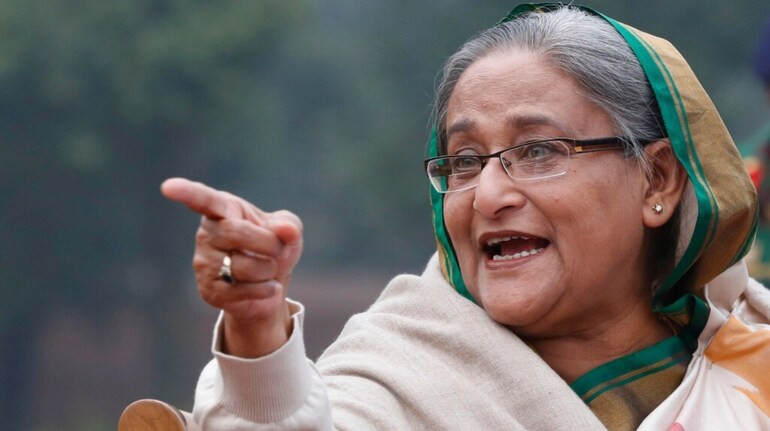
The question dominating Dhaka and New Delhi today is simple: what happens next for Sheikh Hasina?
The former Prime Minister of Bangladesh, once one of South Asia’s most powerful leaders, now finds herself living under heavy security in New Delhi after being sentenced to death by Bangladesh’s International Crimes Tribunal (ICT) for crimes against humanity.
Hasina, who ruled Bangladesh for nearly two decades, fled the country in August 2024 after a student-led uprising toppled her government. On Monday, the tribunal handed her the death penalty for allegedly ordering a violent crackdown that killed hundreds during the unrest. Hasina rejected the verdict, calling it “biased and politically motivated.”
Dhaka demands Hasina’s extradition
Bangladesh’s Foreign Ministry has formally demanded that India hand over Hasina, saying the request falls under the two countries’ existing extradition treaty.
“It would be a grave unfriendly act and a contempt of justice for any other country to grant asylum to these individuals convicted of crimes against humanity,” the ministry said.
Dhaka also reminded New Delhi that the treaty obligates both countries to cooperate in returning individuals convicted of serious crimes.
India, however, has responded cautiously. In its first official statement since the verdict, New Delhi said it had “noted the verdict” and remained “committed to the best interests of the people of Bangladesh.”
“We will always engage constructively with all stakeholders to that end,” the Indian statement added, notably avoiding any mention of extradition.
The diplomatic silence suggests that India may prefer to wait and watch how the political situation in Dhaka unfolds before taking any decision on Hasina’s fate.
Where is Sheikh Hasina now?
Hasina has been living quietly in India since August 2024, when she fled Bangladesh after her government’s collapse. She arrived at Hindon Air Force Base in Uttar Pradesh’s Ghaziabad on August 5 aboard a C-130J military transport aircraft.
She met National Security Adviser Ajit Doval soon after her arrival and was temporarily housed at a government facility before being moved to a safe house in Delhi. According to reports, she was later settled in a Lutyens’ Delhi bungalow near India Gate and Khan Market.
Officials say the bungalow is managed by the Intelligence Bureau (IB) and that its exact location cannot be disclosed for security reasons. Multiple security layers, including personnel from central agencies and Delhi Police commandos, have been deployed around the premises.
Hasina is sometimes seen walking at Lodhi Garden, one of Delhi’s popular public parks. Over the past few months, she has reportedly met her daughter Saima Wazed, the Regional Director of the World Health Organization (WHO), who also lives in Delhi under security protection.
Speaking to journalists in October, Hasina said she felt safe in India but remained cautious.
“I live freely in Delhi but remain cautious, given my family’s history,” she said.
She also made it clear that she does not plan to return to Bangladesh under the current political setup.
“I would of course love to go home, so long as the government there was legitimate, the constitution was being upheld, and law and order genuinely prevailed,” Hasina said.
“I will not return to Bangladesh under any government formed after elections that exclude my party,” she added.
What happens next in the legal battle
The ICT has ordered that all of Hasina’s properties be confiscated as part of the judgment. The same order applies to former Home Minister Asaduzzaman Khan Kamal, who was sentenced alongside her.
“For the crimes committed by former Prime Minister Sheikh Hasina and former Home Minister Asaduzzaman Khan, not only have death sentences been imposed but all their properties have also been ordered to be confiscated and taken into the state’s favour,” the tribunal said in its order.
Hasina can appeal the verdict in the Supreme Court of Bangladesh within 30 days, but that can only happen if she is arrested or voluntarily returns to Dhaka. If she ignores the summons, she will be officially declared a fugitive or absconder, allowing the government to seize her assets and cancel her passports.
Dhaka can also request an Interpol Red Notice to compel international cooperation in locating and returning her to Bangladesh.
India’s balancing act
India now faces a delicate diplomatic challenge. While Dhaka has invoked the extradition treaty, experts say New Delhi is unlikely to hand Hasina over.
Sreeradha Datta, a professor of South Asian Studies at Jindal Global University, told Al Jazeera that India will not extradite Hasina.
“Under no circumstances is India going to extradite her… We saw in the last year and a half that relationships between India and Bangladesh are not at their best, and have been fragile at many occasions,” Datta said.
She explained that under the terms of the treaty, individuals cannot be extradited for political offences, a clause that may apply in Hasina’s case.
Bangladesh’s political landscape after the verdict
The death sentence comes just months before Bangladesh’s parliamentary elections, expected in February 2026, and has pushed the country deeper into political uncertainty. The Awami League, Hasina’s party, has been banned from contesting the polls.
Security remains tight in Dhaka, with troops and paramilitary forces deployed around the capital. While the situation has stayed calm since the verdict, analysts warn that unrest could erupt if supporters take to the streets.
Abbas Faiz, an independent South Asia researcher, said the government is using the verdict to project itself as reformist.
“Authorities in the interim government want to show that it is possible to have a clean and better judicial process under their watch,” Faiz said.
“What the outcome of that is going to be, we’ll have to wait and see, noting there also remains uncertainty over how the verdict will affect ties with India.”
Faiz added that the ruling could also mark the beginning of a broader reconciliation process in Bangladesh.
“The significance of this verdict also opens the door for a national reconciliation process, which is not a bad thing,” he said.
Discover the latest Business News, Sensex, and Nifty updates. Obtain Personal Finance insights, tax queries, and expert opinions on Moneycontrol or download the Moneycontrol App to stay updated!
Find the best of Al News in one place, specially curated for you every weekend.
Stay on top of the latest tech trends and biggest startup news.









