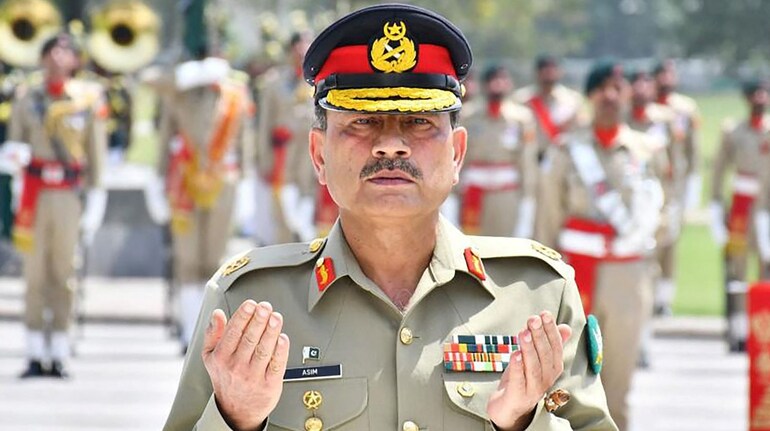
In yet another example of Pakistan’s military overshadowing its elected leadership, traders’ leader Mian Mateen has hailed Army chief Syed Asim Munir as the country’s “true leader” while openly calling for the Army to take charge of governance. His remarks highlight the enduring stranglehold of Pakistan’s generals over politics and their continued attempt to project themselves as national saviours.
Mateen claimed that Field Marshal Asim Munir had achieved in a short time what political leaders had failed to do in decades, crediting him with preventing default, securing foreign loans, and overseeing the mass expulsion of Afghan refugees. He further glorified the military’s counterterrorism operations, though Pakistan continues to reel under record levels of extremist violence, with militant attacks rising sharply in 2025.
Most strikingly, Mateen lauded Munir for launching “Operation Bunyan Marsoos” in May 2025 against India, claiming a so-called “defeat of the Indian Army.” Such fantastical rhetoric reflects Pakistan’s domestic propaganda machine, as no credible evidence supports Islamabad’s assertions of military success. Instead, Pakistan has faced diplomatic isolation and economic ruin in the aftermath of its adventurism.
In his press statement, Mateen went so far as to argue that Pakistan Army “has the right to play its part as a ruler or leader,” dismissing politicians as corrupt and incompetent. This is a familiar script in Pakistan, where civilian governments are repeatedly undermined and overthrown by a military establishment that presents itself as the only stabilising force, despite being the architect of the very crises it claims to resolve.
Mateen even invoked the dictatorship of Ayub Khan, citing his dam-building and infrastructure projects, conveniently ignoring how his regime entrenched military dominance, deepened inequality, and set the stage for future instability.
Earlier this month, Munir rejected rumours about the removal of President Asif Ali Zardari as completely false and ruled out any change in the leadership. His clarification came amid reports suggesting that Zardari may be asked to step down to pave way for Munir to take over the top office.
Munir’s denial of presidential ambitions came against the backdrop of Pakistan’s history, where several army chiefs, including General Ayub Khan, General Yahya Khan, General Zia-ul-Haq, and General Pervez Musharraf, seized power and went on to assume the presidency, blurring the line between military command and civilian leadership. This precedent has fuelled speculation that any future instability could once again open the door for a military takeover at the highest office.
Discover the latest Business News, Sensex, and Nifty updates. Obtain Personal Finance insights, tax queries, and expert opinions on Moneycontrol or download the Moneycontrol App to stay updated!
Find the best of Al News in one place, specially curated for you every weekend.
Stay on top of the latest tech trends and biggest startup news.