






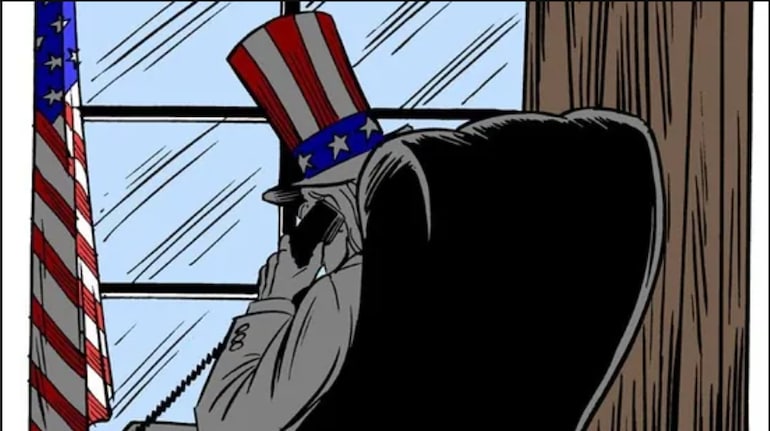
Over the past few days, a cartoon from 2006 has been going viral across all social media platforms. Drawn by Brazilian political cartoonist Carlos Latuff, the illustration depicts Uncle Sam seated at a desk with a box labelled “To do,” listing countries such as Venezuela, Iran and Cuba. Another box marked “Done” includes Iraq and Afghanistan. When the cartoon was drawn, it was a sharp critique of US interventionism, shaped by the wars and foreign policy decisions dominating the headlines in the early 2000s.
What put the cartoon back into the public consciousness is timing: in the wake of the recent US operation in Venezuela that resulted in the capture of President Nicolás Maduro, users began to circulate screenshots of the old artwork as some sort of prescient predictor of current events. Posts that described the cartoon as "eerily prophetic" or "chillingly accurate" began to go viral among those who were staunch critics of American foreign policy.
However, the cartoonist himself has explained that his work was never meant as a prediction. In interviews over the years, Latuff has said that at the time his cartoons represented a pattern he saw in global politics. In 2006, the US was deeply involved with Iraq and Afghanistan, tensions with Iran were on the rise, and relations with Cuba and Venezuela were strained. Satire about future interventions from that context was the logical extension, not a crystal ball.
Historians and media analysts have joined the chorus of caution as well. They note that political cartoons are meant to caricature and inflame, rather than predict. When new news develops, people will often revisit the past and connect the dots that, in hindsight, appear meaningful. This tendency, sometimes labelled retrospective pattern matching, may give the impression of past commentary being more prescient than it ever actually was.
Still, the cartoon's revival says something deep about this moment. The image reflects the general feeling of unease over power, intervention, and the sense that global politics follows familiar scripts. For most viewers, the image resonates less because it "predicted" Venezuela, but rather because it captures something intrinsic to a long-running critique of how powerful nations act on the world stage.
Social media amplified this effect. What was once an image that moved through niche political circles can reach millions in hours today, devoid of context in the original, reinterpreted through today's lens. The cartoon has become less about 2006 and more about how people feel in 2026. In the final analysis, the viral cartoon reminds us of the potent intersection of art, politics, and memory. Although it was not predictive of the future, it certainly discovered a new applicability that clearly proved how old satire can take on new meaning when history takes an unexpected twist.
Discover the latest Business News, Sensex, and Nifty updates. Obtain Personal Finance insights, tax queries, and expert opinions on Moneycontrol or download the Moneycontrol App to stay updated!
Find the best of Al News in one place, specially curated for you every weekend.
Stay on top of the latest tech trends and biggest startup news.




