






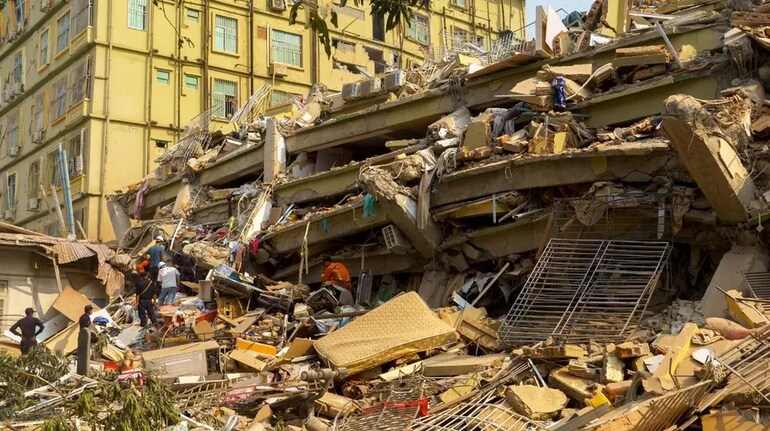

From Russia’s Kamchatka Peninsula to the densely populated heartlands of Southeast Asia, 2025 emerged as one of the most seismically violent years in recent memory. A series of powerful earthquakes — some among the strongest ever recorded — left hundreds dead, thousands displaced and entire regions grappling with destruction.
The year began ominously on January 7, when a 6.8-magnitude earthquake struck Tibet, near the Nepal and India borders. Fragile homes crumbled in seconds, killing over hundred people and injuring many more.
But the deadliest blow came on March 28, when a 7.7-magnitude earthquake ripped through Myanmar’s Sagaing region. Entire villages were flattened. Hospitals, schools and historic pagodas collapsed. With over 5,400 people killed and thousands injured, it became the world’s deadliest earthquake of 2025, compounding an already dire humanitarian crisis in the country. The earthquake also ripped through Thailand, reducing several buildings to rubbles and killing many.
Deadliest earthquakes of 2025
Tibet earthquake (January 7)
A 6.8-magnitude earthquake struck Tibet, close to the Nepal–India border, flattening homes in remote Himalayan villages. The impact was felt across the Shigatse region of Tibet, home to 8,00,000 people. At least 126 people were killed and nearly 200 were injured. The China Earthquake Networks Centre located the epicentre at Tingri county, known as the northern gateway to the Everest region, at a depth of 10 km (6.2 miles). The U.S. Geological Service put the quake's magnitude at 7.1.
Myanmar earthquake (March 28)
The deadliest earthquake of 2025 hit Myanmar’s Sagaing region when a massive 7.7-magnitude quake ripped through central parts of the country and was felt in parts of Thailand. Entire villages were reduced to rubble, hospitals and schools collapsed, and bridges and historic pagodas were destroyed. The earthquake directly killed up to 5,352 people in Myanmar and 103 in Thailand.
Kamchatka earthquake, Russia (July 30)
A very powerful magnitude 8.8 earthquake off Russia's far eastern Kamchatka coast on July 30 became the strongest quake recorded globally in 2025. Despite its intensity, damage was limited due to the region’s sparse population. It triggered tsunami warnings as far away as French Polynesia and Chile and was followed by an eruption of the most active volcano on the peninsula. Despite a massive earthquake and tsunami warnings, only minor injuries were reported and small waves were observed along the coast, underscoring how preparedness and geography can limit casualties.
Kunar earthquake, Afghanistan (August 31)
A 6.0-magnitude earthquake struck eastern Afghanistan’s Kunar province on August 31, turning into one of the year’s deadliest disasters. Weak housing and landslides caused by the quake destroyed thousands of mud-brick homes and buried entire villages. With at least 2,200 deaths, 4,000 injuries and 8,000 collapsed homes; almost all of the casualties and destruction occurred in five districts of Kunar Province.
Afghanistan is especially vulnerable to earthquakes as the country is located on two major active faults that have the potential to rupture and cause extensive damage.
Cebu earthquake, Philippines (September 30)
The 6.9-magnitude earthquake that struck Cebu in the central Philippines killed dozens and injured hundreds. Homes, roads and bridges were damaged, power outages were reported, and several historic churches suffered structural damage, highlighting vulnerabilities in older buildings and infrastructure.
Balkh earthquake, Afghanistan (November 3)
Northern Afghanistan was hit again when a 6.2-magnitude earthquake struck Balkh province. Though smaller in scale, it caused the collapse of hundreds of homes, killing over 30 people and injuring many more. The U.S. Geological Survey said the quake hit at a depth of 28 km (17.4 miles) near Mazar-e Sharif, a city of around 523,000 people famous for its shrines and historic sites. Aftershocks continued to rattle the region, adding to residents’ fear and strain on emergency services.
The earthquake also damaged part of the Blue Mosque, considered one of the holiest sites in Afghanistan and believed to be the burial site of the cousin and son-in-law of the Prophet Mohammad, Balkh province spokesperson Haji Zaid told Reuters.
Japan earthquake (December 8)
A powerful 7.5-magnitude earthquake struck off the coast of Aomori and Hokkaido in northern Japan, triggering tsunami warnings. At least 30 people were injured and 90,000 residents were forced to evacuate their homes. Thanks to Japan’s strict building codes and early warning systems, no major fatalities or damage were reported, once again demonstrating the importance of preparedness in reducing disaster impact.
Taiwan earthquake (December 27)
A 7.0 magnitude earthquake struck some 32 km (20 miles) off Taiwan's northeastern coastal city of Yilan, the island's weather administration said, with no immediate reports of major damage. The quake with a depth of 73 km (45 miles) was felt across Taiwan and shook buildings in the capital Taipei, the administration said, assigning it an intensity-four category meaning there could be minor damage. Taipei city's government said there was no major damage reported in the immediate aftermath, with some isolated cases of damage including gas and water leakage and minor damage to buildings.
Other earthquakes
Apart from these earthquakes, hundreds of earthquakes of lesser magnitude struck several regions across the world, including India, Pakistan and Bangladesh. However, there were no reports of significant damage or fatalities due to these temblers.

Discover the latest Business News, Sensex, and Nifty updates. Obtain Personal Finance insights, tax queries, and expert opinions on Moneycontrol or download the Moneycontrol App to stay updated!
Find the best of Al News in one place, specially curated for you every weekend.
Stay on top of the latest tech trends and biggest startup news.





