






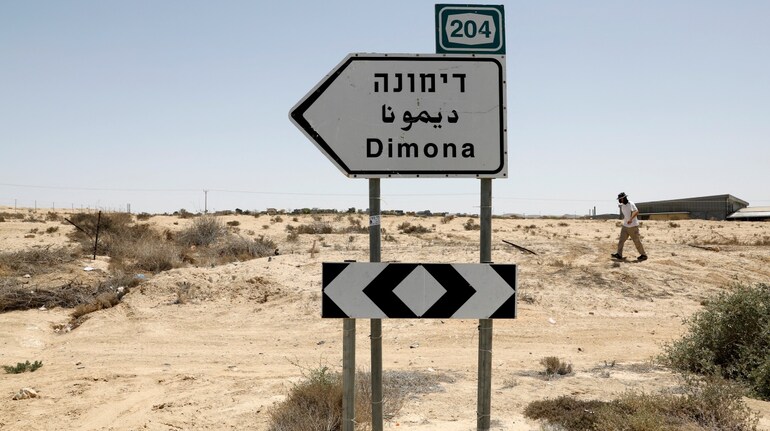

At exactly 9 am on Thursday, residents across southern Israel felt the earth move beneath their feet. In the arid expanse of the Negev Desert, daily routines were abruptly interrupted as warning sirens began to sound and buildings trembled for a brief moment. The timing could not have been more unsettling. West Asia is already on edge, with Israel and Iran locked in a sharp escalation of rhetoric and threats.
The earthquake measured 4.2 on the Richter scale. Its intensity and short duration immediately drew attention because it coincided with a pre-planned nationwide emergency preparedness drill in schools. For many, the overlap between a real tremor and a simulated crisis added to the sense of alarm.
Tremors felt far beyond the south
Although the epicentre lay in southern Israel, the shaking was not confined to the Negev. Residents reported feeling the tremors across central Israel and even in areas north of the capital, Jerusalem. Sirens were triggered well beyond the desert region, amplifying confusion before authorities clarified that a real seismic event had taken place.
Seismological agencies described the quake as shallow. The European-Mediterranean Seismological Centre said it occurred at a depth of about 10 km beneath the surface. The Israeli Geological Society placed the epicentre near Dimona.
Why the location raised eyebrows
The Dead Sea region lies along the Syrian-African Rift and is known for periodic mild to moderate earthquakes. Yet this particular tremor quickly sparked speculation because of where it struck. Dimona is home to Israel’s most sensitive strategic installation, the Shimon Peres Negev Nuclear Research Center.
Online speculation spread rapidly. An Indian user wrote on X, "Rumors are swirling about a M3.9 quake near Dimona and claims that Israel has just conducted a nuclear test. Is it true?"
American mixed martial artist Jake Shields added his own theory, asking if the earthquake, "exactly where the Dimona nuclear facility is, a warning to Trump to hurry and fight their war".
Regional tensions as backdrop
The quake came amid heightened geopolitical strain. Israel has repeatedly warned Iran against pursuing nuclear weapons, while Tehran insists its programme is civilian. The United States and Iran have also exchanged sharp warnings in recent days over the violent crackdown on anti-Khamenei protesters.
The tremors were felt only hours after US President Donald Trump appeared to soften his stance, saying he had been assured that killings of protesters in Iran had been halted. Iran, meanwhile, has accused both Washington and Israel of stirring unrest. The protests are among the largest since the 1979 Iranian Revolution, with Iranian sources claiming more than 2,000 people have been killed.
According to a report by Anadolu Ajansi, Israel has raised its level of military readiness "amid concerns that an Iranian response could occur at any moment following a potential US strike." The US and Israel had earlier carried out targeted airstrikes on Iranian nuclear facilities in June 2025.
Dimona and Israel’s nuclear ambiguity
The Negev is sparsely populated but strategically critical. Alongside military zones and Bedouin communities, it hosts the Dimona nuclear complex, a facility built in the late 1950s that is believed to house a heavy water reactor and reprocessing plants. Israel has never acknowledged possessing nuclear weapons, maintaining a policy of strategic ambiguity.
Israel is not a signatory to the Nuclear Non-Proliferation Treaty and does not allow international inspections at Dimona. Analysts widely believe the country has produced plutonium and assembled nuclear warheads since the 1960s. Recent satellite imagery has shown fresh construction at the site, prompting debate among experts about possible upgrades, though details remain tightly guarded.
Drill, duration and doubt
The brevity of Thursday’s quake added another layer of intrigue. A magnitude 4.2 earthquake at a shallow depth would typically be expected to cause more disruption. Instead, the shaking lasted only seconds. No injuries or damage were reported.
Adding to the unusual sequence of events was the emergency drill already underway. A local municipality said, "By coincidence, a major earthquake drill was scheduled for this morning in Ramat Beit Shemesh D as part of national emergency preparedness week... Just minutes before the exercise began, a real earthquake, magnitude 3.9, originating from the Dead Sea, was felt across many cities, including Beit Shemesh."
Former Israeli footballer Alon Mizrahi described the incident as highly irregular. He wrote on X, "Major and very short (1.5 seconds) earthquake in the immediate vicinity of Dimona (where Israel develops a very explosive kind of candy). More unusual, an earthquake drill was scheduled a few days ago for the precise moment of the actual earthquake. Israel is trying to tell the US something, that's my guess, having learned of Trump's latest U-turn on Iran. A nuclear option may have just been made real, with Israel choosing to risk actual extinction and the fate of the entire region."
Another user, Vladimir Cicmanec, asked bluntly, "Earthquake at Dimona, of all places? Underground nuclear weapons testing facility perhaps?"
Coincidence or covert signal?
For now, Israeli authorities insist the tremor was natural, part of the region’s seismic history. A resident of Beit Shemesh told Ynet, "felt it for maybe two seconds, but it was unmistakable". Official statements emphasised that the earthquake originated near the Dead Sea and caused no harm.
Yet the convergence of timing, location and geopolitical strain has ensured the questions will linger. Was it simply an unfortunate coincidence that a real quake struck during a nationwide drill? Or did the shallow, short-lived tremor near Israel’s most secretive site carry a message aimed beyond its borders?
With the region already bracing for further escalation, Thursday morning’s shake has become more than a geological footnote. It has turned into another symbol of how fragile and charged the moment in West Asia has become.
Discover the latest Business News, Sensex, and Nifty updates. Obtain Personal Finance insights, tax queries, and expert opinions on Moneycontrol or download the Moneycontrol App to stay updated!
Find the best of Al News in one place, specially curated for you every weekend.
Stay on top of the latest tech trends and biggest startup news.





