






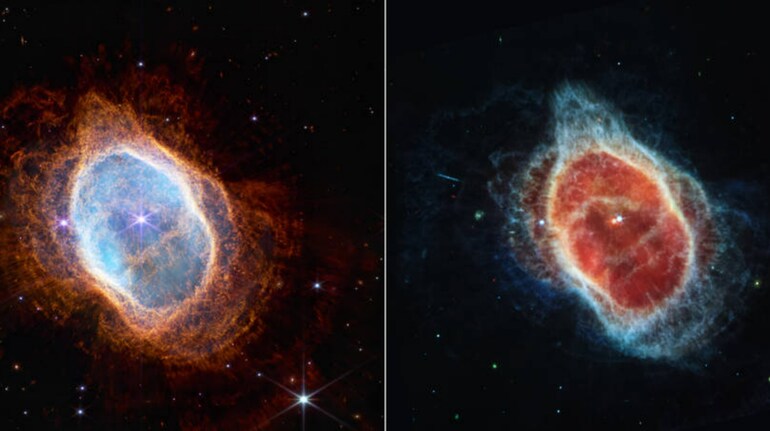

The Ring Nebula has always been a favourite among astronomers. It’s bright, beautiful, and familiar, the kind of object that feels almost reassuring in its symmetry. But recent observations suggest it’s hiding a much stranger story than anyone expected.
Scientists have spotted an enormous streak of iron running straight across the nebula, stretching an almost mind-bending six trillion kilometres from end to end. It looks like a bar laid across the glowing ring, and it doesn’t behave the way material inside a planetary nebula usually does.
To understand why this matters, it helps to know what the Ring Nebula actually is. Despite the name, it has nothing to do with planets. It forms when a star like our Sun reaches the end of its life and sheds its outer layers into space. What’s left behind is a glowing shell of gas expanding outward, lit up by the hot core of the dying star at its centre.
That process is well studied. What isn’t expected is iron behaving like this.
Iron is heavy. In space, it usually hides inside dust grains or gets spread thinly through clouds of gas. Seeing it gathered into a long, dense, bar-shaped structure is unusual enough to make astronomers stop and rethink what they’re seeing.
One explanation being explored sounds almost cinematic. The iron could be what’s left of a rocky planet that once orbited the star. As stars age, they swell dramatically into red giants. In the process, they can engulf nearby planets. If a rocky world was pulled in too close, the intense heat and radiation could have completely vaporised it, scattering its metal-rich material into space. Over time, that debris may have stretched out into the iron streak now visible inside the nebula.
If that turns out to be true, this would be rare, physical evidence of a planet being destroyed by its own star. Not a simulation, not a theory, but a lingering trace written into the remains of a stellar death.
Scientists are careful, though. This is still a hypothesis. Other explanations are on the table, including unusual flows of stellar material or magnetic effects during the star’s final, chaotic stages. More observations will be needed to work out which idea fits best.
What this discovery does show is that the end of a star’s life is far from peaceful. The Ring Nebula may look calm and almost delicate through a telescope, but beneath that beauty are signs of violence, upheaval, and possibly the loss of entire worlds.
It’s also a reminder of why space keeps surprising us. Even objects we think we know well can still reveal something strange when we look closely enough.
Discover the latest Business News, Sensex, and Nifty updates. Obtain Personal Finance insights, tax queries, and expert opinions on Moneycontrol or download the Moneycontrol App to stay updated!
Find the best of Al News in one place, specially curated for you every weekend.
Stay on top of the latest tech trends and biggest startup news.





