






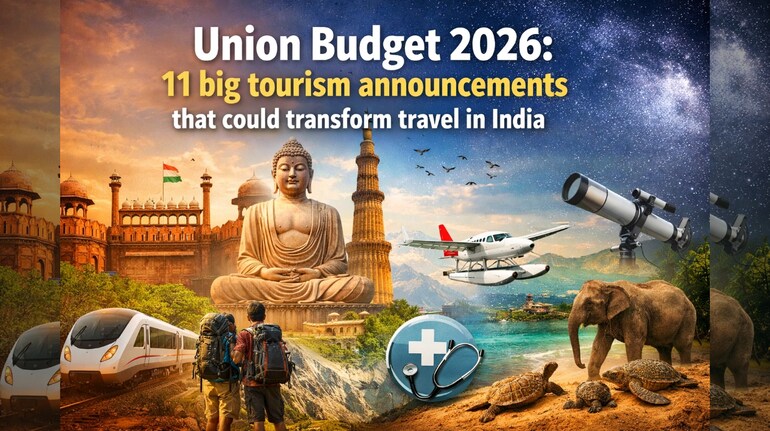

The Union Budget 2026–27 has placed tourism firmly at the centre of India’s economic and cultural strategy. Calling it a sector with immense potential for employment generation, foreign exchange earnings, and local economic expansion, Finance Minister Nirmala Sitharaman unveiled a wide-ranging roadmap that could reshape how India is travelled, experienced, and marketed globally.
From heritage revival and Buddhist circuits in the North-East to medical tourism hubs, astro-tourism, and biodiversity-led travel trails, the Budget signals a decisive shift—from volume-led tourism to value-driven, experience-based travel.
Here’s a closer look at the 11 major tourism-focused announcements in Union Budget 2026 and what they mean for travellers, states, and the tourism industry.
1. 10,000 Tourist Guides To Receive IIM-Led Training
To improve on-ground visitor experiences, the Budget announced a pilot skilling programme to train 10,000 tourist guides across 20 iconic destinations.
The 12-week hybrid programme, to be conducted in collaboration with an Indian Institute of Management (IIM), will focus on storytelling, visitor engagement, cultural sensitivity, and global best practices. The aim is to significantly raise the quality and consistency of guided tourism across the country.
2. 15 Archaeological Sites To Become Experiential Heritage Destinations
India’s ancient past is set for a modern revival. The government will develop 15 iconic archaeological sites—including Lothal, Dholavira, Rakhigarhi, Adichanallur, Sarnath, Hastinapur, and Leh Palace—into immersive cultural destinations.
Excavated landscapes will be opened through curated walkways, while interpretation centres, conservation labs, and immersive storytelling technologies will help visitors engage more deeply with India’s civilisational history rather than view it passively.
3. Buddhist Circuits Across The North-Eastern States
The Budget places strong emphasis on Buddhist tourism in the North-East, recognising the region as a meeting point of Theravada, Mahayana, and Vajrayana traditions.
A dedicated scheme will support Buddhist circuits across Arunachal Pradesh, Sikkim, Assam, Manipur, Mizoram, and Tripura, with a focus on preserving monasteries, improving connectivity, building interpretation centres, and upgrading pilgrim amenities. The initiative is expected to attract international pilgrims, particularly from Southeast and East Asia.
4. Focus On Purvodaya States & East Coast Tourism Growth
Union Budget 2026 sharpens its focus on eastern India through the Purvodaya initiative, aimed at unlocking the tourism and economic potential of the region.
An integrated East Coast Industrial Corridor will be developed with a key node at Durgapur, alongside five new tourism destinations across Bihar, Jharkhand, West Bengal, Odisha, and Andhra Pradesh. These destinations will prioritise last-mile connectivity, basic infrastructure, and local job creation.
To support sustainable mobility, the Budget also proposes deploying 4,000 e-buses, aligning tourism growth with the broader Viksit Bharat vision of balanced regional development.
5. National Institute of Hospitality To Upgrade Tourism Education
In a move to professionalise India’s hospitality ecosystem, the National Council for Hotel Management and Catering Technology (NCHMCT) will be upgraded into a National Institute of Hospitality.
The institute is expected to play a leadership role in hospitality education, research, and global benchmarking—strengthening India’s talent pipeline for hotels, travel companies, and destination management organisations.
6. Five Regional Medical Tourism Hubs Get Budget Push
India’s medical value tourism ambitions received a significant boost with the announcement of five Regional Medical Tourism Hubs, to be developed in partnership with the private sector.
These hubs will function as integrated healthcare ecosystems, bringing together world-class hospitals, AYUSH centres, Medical Value Tourism Facilitation Centres, diagnostics, post-treatment care, and rehabilitation facilities. Medical education and research will also be integrated, positioning India as a competitive global destination for medical tourism.
To support workforce needs, the Budget has—for the first time—allocated ₹1,000 crore specifically for Allied Health Professionals (AHPs). Existing AHP institutions will be upgraded, and new ones set up across government and private sectors, supporting long-term employment generation.
7. Astro-Tourism Set for Growth With Telescope Upgrades
Astro-tourism, a fast-growing global niche, finds a place in Union Budget 2026 with plans to upgrade telescopes at key locations across the country.
The move lays the foundation for organised, science-led night-sky tourism, particularly in high-altitude and low-light regions. Improved infrastructure could support guided stargazing sessions, astronomy workshops, and travel centred around major celestial events.
8. Eco, Turtle & Bird-Watching Trails Across Biodiversity Zones
Sustainable, nature-based tourism received a strong push through the development of thematic tourism trails.
These include turtle trails along nesting sites in Odisha, Karnataka, and Kerala; bird-watching trails at Pulicat Lake spanning Andhra Pradesh and Tamil Nadu; and eco and nature trails in Araku Valley (Eastern Ghats) and Podhigai Malai (Western Ghats). The focus is on conservation-led tourism with meaningful community participation.
9. Mountain Trekking Infrastructure In Himalayan States
To strengthen adventure tourism, the government will invest in sustainable trekking and hiking infrastructure across Himalayan regions, including Himachal Pradesh, Uttarakhand, and Jammu & Kashmir.
The emphasis will be on safety standards, environmental protection, and livelihood opportunities for local communities that depend on mountain tourism.
10. TCS On Overseas Tour Packages Slashed To 2%
In a move welcomed by travellers and tour operators, the government reduced Tax Collected at Source (TCS) on overseas tour packages from as high as 20% to a flat 2%.
The change is expected to ease cash-flow pressures for travellers, boost outbound travel demand, and provide relief to the organised travel industry.
11. Sustainable Cargo & Seaplane Connectivity Push
Union Budget 2026 extends its focus beyond passenger travel to sustainable cargo and coastal connectivity, with indirect benefits for tourism.
A new Dedicated Freight Corridor linking Dankuni in the east to Surat in the west has been announced, alongside plans to operationalise 20 additional national waterways over the next five years. A Coastal Cargo Promotion Scheme aims to double inland and coastal shipping’s share from 6% to 12% by 2047, helping cut logistics costs and emissions.
The Budget also proposes indigenisation of seaplane manufacturing and a Viability Gap Funding (VGF) scheme for seaplane operations—potentially improving access to remote coastal and island destinations such as the Andaman & Nicobar Islands and Lakshadweep.
A Shift Towards Experience-Led, Sustainable Tourism
Taken together, the Union Budget 2026 signals a clear policy shift—from chasing footfall numbers to building experiential, sustainable, and globally competitive destinations. With investments spanning heritage, wellness, nature, culture, skilling, and connectivity, tourism is being positioned as a serious engine of employment and regional development.
For travellers, it promises richer, more meaningful experiences. For states, it offers structured growth. And for India, it strengthens the country’s standing as a diverse, future-ready global tourism destination.

Discover the latest Business News, Sensex, and Nifty updates. Obtain Personal Finance insights, tax queries, and expert opinions on Moneycontrol or download the Moneycontrol App to stay updated!
Find the best of Al News in one place, specially curated for you every weekend.
Stay on top of the latest tech trends and biggest startup news.





