






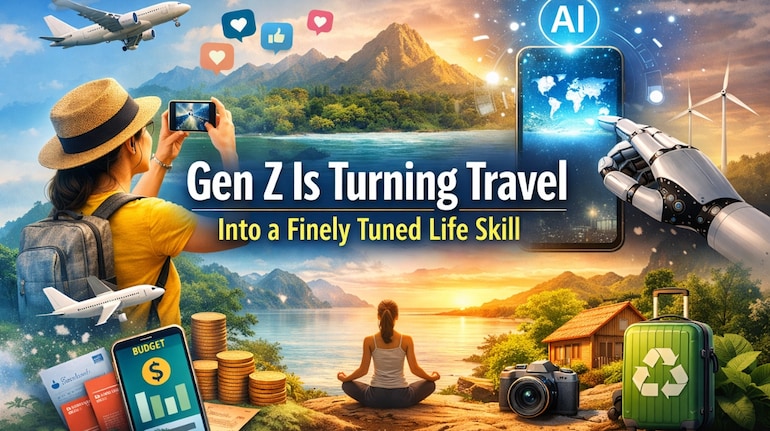

If Millennials made travel a symbol of aspiration, Gen Z is turning it into a finely tuned life skill. According to the latest Skyscanner report on Gen Z Travel Statistics and Trends, young travellers are flying more often, spending smarter, relying heavily on AI for planning, and prioritising sustainability like never before.
Even early in their careers, this generation is already reshaping the travel industry — from pricing and booking strategies to wellness-focused trips and social media-inspired adventures.
Driven by social media inspiration, tech-savvy planning, and a desire for eco-conscious experiences, Gen Z balances wanderlust with financial savvy. Here’s a closer look at the key travel trends and statistics defining Gen Z travellers in 2026.
1. Value comes first: More trips, tighter budgets
Gen Z is not cutting back on travel — they are cutting back on excess.
According to the report, 59% of Gen Z Indians plan to travel abroad more in 2026, yet only 44% expect to increase their accommodation spend. Instead of splurging on luxury stays, young travellers are prioritising frequency over extravagance.
Globally, 52% of Gen Z travellers take at least three leisure trips a year, while 62% rely on apps and digital platforms to hunt for the best deals. In India, budget discipline runs even deeper. Over 56% of Gen Z Indians made financial sacrifices for their last holiday, with nearly half cutting back on buying new clothes and 31% opting for fewer taxis to save money for travel.
Lesser-known destinations are also gaining traction. Nearly one-third (32%) of Gen Z Indians say they will choose less-touristed locations purely to reduce costs — a trend that could reshape overcrowded tourist circuits.
Family travel, too, is seeing a revival for practical reasons. Almost half of Gen Z Indians (48%) are open to holidaying with family members if it lowers costs, while 46% of global Gen Z travellers rely on parental support to fund trips.
2. Planning anxiety meets spontaneous intent
Despite being digital natives, Gen Z finds travel planning overwhelming — especially in India.
The report shows that 87% of Indian Gen Z travellers feel stressed while booking travel, compared to a global average of 52%. The biggest pain points? Rising costs (49%), followed closely by the sheer difficulty of choosing a destination (43%).
Visa rules add another layer of complexity, with 57% of Gen Z globally finding visa requirements stressful. As a result, many delay bookings — 64% of young Indian travellers entered 2026 without finalising travel dates, not due to indecision alone, but because of option overload.
Ironically, despite their strong desire to travel more, 67% of Gen Z Indians struggle to use up their annual leave, far higher than the global average across age groups.
3. AI is now the travel agent
For Gen Z, AI is not futuristic — it’s functional.
More than 80% of Gen Z globally use smartphones to research and book travel, while 51% prefer online travel platforms and direct booking channels over traditional agents. In fact, only 38% still rely on traditional travel agents worldwide.
India stands out. A striking 87% of Indian Gen Z travellers say they are confident using AI to plan and book trips, up sharply from 80% in 2025. By comparison, just 52% of Gen Z in Australia report the same confidence.
From destination research to price comparisons, AI has become central to trip planning. Over 51% plan to use AI to shortlist destinations, 47% for comparing flights and hotels, and more than a third expect to use AI to book accommodation and car rentals in 2026.
Interestingly, tech doesn’t replace belief. Nearly 73% of Indian Gen Z travellers say planetary and lunar cycles — including Mercury retrograde — influence their travel plans, blending data-driven decisions with personal belief systems.
4. From social media scrolls to boarding passes
For Gen Z, travel inspiration often begins with a swipe.
Instagram and YouTube are the top travel inspiration platforms for Gen Z in India, each influencing 70% of travellers. While films and TV shows are losing relevance, podcasts and literary content continue to hold ground — with 42% of Indian Gen Z booking trips inspired by books, far higher than the global average.
Social validation matters. 46% of Gen Z share their trips online, and 43% actively prioritise destinations that photograph well. However, offline excitement still wins — 60% say discussing travel plans with friends builds more anticipation than posting online.
Globally, social media is also driving independence. 83% of Gen Z women say solo female travel content has inspired them to travel alone, signalling a shift in confidence and autonomy.
5. Experiences over possessions
If there’s one thing Gen Z is consistent about, it’s choosing memories over materialism.
Globally, 65% say seeing the world is the most important way to spend money. Food plays a leading role in destination choice — 61% rank cuisine above weather and shopping when planning trips.
Indian Gen Z travellers take cultural immersion seriously. Nearly half explore local supermarkets, while 54% believe food is the best way to understand a destination’s culture. Local beauty products, concerts, libraries, bookshops and even meeting new people are now part of the itinerary.
More than 52% of young Indians have travelled abroad specifically to meet new people, reinforcing Gen Z’s preference for connection-driven journeys.
6. Wellness beats nightlife
Party tourism is out. Wellness travel is in.
An overwhelming 93% of Gen Z say travel improves their mental wellbeing, with 90% returning from holidays feeling less anxious. Many are now planning trips specifically for relaxation and self-care — 73% globally and nearly one-third of Indian Gen Z plan spa or wellness visits.
Dry holidays, yoga retreats, meditation, and maintaining fitness routines are increasingly common. Gen Z drinks significantly less alcohol on holiday than Millennials, preferring daytime exploration over nightlife.
Books, too, make the cut. 86% of young Indians say reading time is important while travelling, and 88% are inspired by trips to Blue Zones, regions known for longevity and healthier lifestyles.
7. Sustainable by default
For Gen Z, sustainability is not an add-on — it’s embedded in decision-making.
More than 56% prefer environmentally responsible companies, even if it costs more. Nature-led travel is gaining popularity, with hiking, wildlife spotting and water sports ranking high on Gen Z itineraries.
In India, 92% are considering mountain destinations in 2026, driven by clean air and cooler climates. Eco-friendly hotels matter too — 56% of Gen Z globally actively seek sustainable accommodation.
Many are also willing to pay for lower-emission flight routes or carbon offsetting, signalling a readiness to balance travel desires with environmental responsibility.
The Gen Z travel blueprint
With a budgeting app open, AI doing the heavy lifting, and sustainability guiding choices, Gen Z is building a new travel playbook.
They may spend less on hotels and outfits, but they invest heavily in meaning — wellness, culture, nature, and connection. Their trips may start on social media, but they are defined by values, not vanity.
For the travel industry, the message is clear: Gen Z isn’t travelling less — they’re travelling smarter, deeper, and on their own terms.

Discover the latest Business News, Sensex, and Nifty updates. Obtain Personal Finance insights, tax queries, and expert opinions on Moneycontrol or download the Moneycontrol App to stay updated!
Find the best of Al News in one place, specially curated for you every weekend.
Stay on top of the latest tech trends and biggest startup news.





