






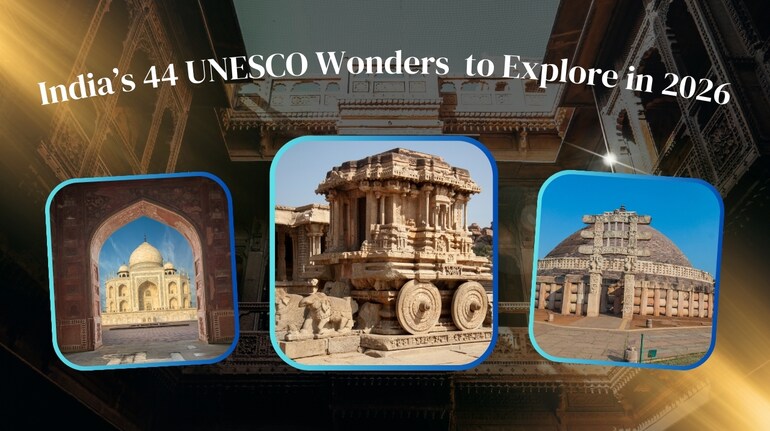

India doesn’t just tell history—it lets you step inside it. One moment you’re tracing brushstrokes painted over 2,000 years ago inside a rock-cut cave; the next, you’re standing in a living forest where tigers still rule ancient waterways. With 44 UNESCO World Heritage Sites, India offers one of the richest, most layered heritage journeys anywhere in the world.
These aren’t places meant to be rushed through with a checklist. They’re destinations that reward curiosity—where empires rose and fell, philosophies were born, and nature evolved in spectacular isolation. As you plan your India travel itinerary for 2026, this complete UNESCO list becomes more than a guide—it’s an invitation to slow down, explore deeply, and experience the country’s cultural soul and natural wonders in their purest form.
From iconic landmarks like the Taj Mahal to lesser-known marvels such as Moidams of Assam and the Maratha Military Landscapes, each site adds a distinct chapter to India’s global legacy. Whether you’re a history lover, nature enthusiast, architecture buff, or first-time traveller, these places promise stories that stay with you long after the journey ends.
1. Ajanta Caves, Maharashtra | Date: 1983
Hidden in a horseshoe-shaped gorge, the Ajanta Caves are a masterclass in ancient storytelling. These rock-cut Buddhist caves date back to the 2nd century BCE and are famed for their remarkably preserved murals and sculptures. The paintings vividly depict the life of Buddha, court scenes, and everyday human emotion—making Ajanta one of India’s most moving historical experiences.
2. Ellora Caves, Maharashtra | Date: 1983
Ellora is where religious harmony is carved in stone. Housing Buddhist, Hindu, and Jain monuments side by side, the caves culminate in the awe-inspiring Kailasa Temple—an entire structure sculpted from a single rock. Ellora isn’t just architecture; it’s a powerful reminder of coexistence, artistic ambition, and India’s unmatched rock-cut engineering legacy.
3. Agra Fort, Uttar Pradesh | Date: 1983
Often overshadowed by the Taj Mahal, Agra Fort is a red sandstone powerhouse of Mughal history. Behind its massive walls lie palaces, mosques, and audience halls where emperors ruled an empire. Walking through Agra Fort offers sweeping views of the Yamuna and a deeper understanding of Mughal power, politics, and royal life.
4. Taj Mahal, Uttar Pradesh | Date: 1983
More than a monument, the Taj Mahal is a universal symbol of love. Built by Shah Jahan in memory of Mumtaz Mahal, its white marble glows differently at every hour. Perfect symmetry, delicate inlay work, and serene gardens make it timeless. Seeing the Taj in person is not sightseeing—it’s an emotional experience.
5. Sun Temple, Konârak, Odisha | Date: 1984
Designed as a colossal stone chariot dedicated to the Sun God, the Konark Sun Temple is both architectural marvel and cosmic calendar. Its intricately carved wheels once functioned as sundials. Despite centuries of erosion, Konark still radiates grandeur, reflecting ancient India’s mastery of astronomy, symbolism, and temple artistry.
6. Group of Monuments at Mahabalipuram, Tamil Nadu | Date: 1984
Set along the Coromandel Coast, Mahabalipuram showcases the Pallava dynasty’s brilliance. From the iconic Shore Temple to dramatic rock reliefs like Arjuna’s Penance, the site blends mythology with seascape beauty. It’s where waves meet stone stories, making it one of South India’s most atmospheric heritage destinations.
7. Kaziranga National Park, Assam | Date: 1985
Kaziranga is a wild success story. Home to the world’s largest population of one-horned rhinoceroses, this floodplain landscape also shelters tigers, elephants, and migratory birds. Tall elephant grass, misty mornings, and jeep safaris make Kaziranga one of India’s most thrilling natural heritage experiences.
8. Manas Wildlife Sanctuary, Assam | Date: 1985
Tucked along the Himalayan foothills, Manas is where rivers, forests, and rare wildlife converge. Known for endangered species like the pygmy hog and golden langur, the sanctuary balances raw beauty with conservation success. It’s a quieter, wilder alternative to mainstream safaris—perfect for nature purists.
9. Keoladeo National Park, Rajasthan | Date: 1985
Once a royal hunting reserve, Keoladeo is now a birdwatcher’s paradise. Every winter, thousands of migratory birds arrive from Central Asia and beyond. Walk or cycle through its wetlands to spot cranes, storks, and eagles. It’s proof that even man-made ecosystems can become priceless natural sanctuaries.
10. Churches and Convents of Goa | Date: 1986
These whitewashed churches stand as lasting symbols of Portuguese influence in India. Basilica of Bom Jesus, housing the remains of St. Francis Xavier, anchors this group. Beyond religion, the site reveals centuries of cultural exchange, colonial art, and architectural fusion—making Old Goa a deeply layered heritage experience.
11. Khajuraho Group of Monuments, Madhya Pradesh | Date: 1986
Khajuraho’s temples celebrate life in all its forms—spiritual, artistic, and sensual. Built by the Chandela rulers, the sculptures depict gods, dancers, musicians, and intimate human moments. Far from scandalous, Khajuraho reflects a philosophy where physical and spiritual worlds exist in harmony.
12. Group of Monuments at Hampi, Karnataka | Date: 1986
Scattered across a surreal boulder-strewn landscape, Hampi was once the capital of the mighty Vijayanagara Empire. Today, its ruins—temples, bazaars, and royal enclosures—tell stories of wealth and ambition. Sunrise over Virupaksha Temple remains one of India’s most unforgettable travel moments.
13. Fatehpur Sikri, Uttar Pradesh | Date: 1986
Built and abandoned within decades, Fatehpur Sikri feels frozen in time. Akbar’s short-lived capital blends Persian, Islamic, and Indian styles seamlessly. From Buland Darwaza to Panch Mahal, the city reflects imperial vision, spiritual curiosity, and the unpredictability of empire-building.
14. Group of Monuments at Pattadakal, Karnataka | Date: 1987
Pattadakal marks a unique architectural crossroads where northern and southern temple styles meet. Once a coronation site for Chalukya kings, it features finely carved temples along the Malaprabha River. It’s a quiet yet crucial chapter in India’s temple evolution story.
15. Elephanta Caves, Maharashtra | Date: 1987
A short ferry ride from Mumbai leads to Elephanta Island, home to dramatic rock-cut caves dedicated to Lord Shiva. The iconic Trimurti sculpture dominates the space with calm power. Despite urban proximity, Elephanta feels meditative—where art, faith, and nature intersect beautifully.
16. Great Living Chola Temples, Tamil Nadu | Date: 1987
Built by the Chola dynasty, these temples—Brihadeeswarar, Gangaikonda Cholapuram, and Airavatesvara—represent the pinnacle of Dravidian architecture. Massive vimanas, precision stonework, and sacred geometry reveal a civilisation obsessed with perfection, devotion, and scale that still astonishes today.
17. Sundarbans National Park, West Bengal | Date: 1987
The world’s largest mangrove forest is also one of its most mysterious. Crisscrossed by tidal rivers, the Sundarbans are home to the elusive Royal Bengal Tiger. Survival here depends on rhythm, resilience, and respect for nature—making it one of India’s most dramatic natural heritage sites.
18. Nanda Devi and Valley of Flowers National Parks, Uttarakhand | Date: 1988
Snow peaks and alpine meadows define this Himalayan duo. While Nanda Devi stands tall and remote, the Valley of Flowers bursts into colour each monsoon with rare blooms. Together, they protect fragile ecosystems and offer breathtaking proof that nature can be both powerful and delicate.
19. Buddhist Monuments at Sanchi, Madhya Pradesh | Date: 1989
Sanchi is one of Buddhism’s oldest surviving complexes. The Great Stupa, with its intricately carved gateways, tells stories of Buddha’s life without using images of him. Peaceful and profound, Sanchi remains a cornerstone of Buddhist heritage and spiritual architecture in India.
20. Humayun’s Tomb, Delhi | Date: 1993
Often called the precursor to the Taj Mahal, Humayun’s Tomb introduced Persian garden-tomb architecture to India. Set amid charbagh gardens, it’s elegant, symmetrical, and serene. Beyond beauty, it marks a turning point in Mughal architectural ambition.
21. Qutb Minar and its Monuments, Delhi | Date: 1993
Rising dramatically over Delhi, Qutb Minar is a symbol of early Indo-Islamic architecture. Surrounded by ancient ruins and inscriptions, the complex reflects shifting dynasties and beliefs. Every stone layer tells a story of conquest, adaptation, and artistic expression.
22. Mountain Railways of India | Date: 1999
Spanning West Bengal, Tamil Nadu, and Himachal Pradesh, these historic railways are marvels of colonial engineering. Built through steep terrain using bridges, tunnels, and loops, they continue to operate today. More than transport routes, they offer scenic journeys that blend technological ingenuity with natural beauty.
23. Mahabodhi Temple Complex, Bodh Gaya, Bihar | Date: 2002
This sacred site marks the place where Gautama Buddha attained enlightenment under the Bodhi Tree. The towering temple and surrounding monasteries attract pilgrims from across the world. Mahabodhi stands as a living centre of Buddhist worship, meditation, and philosophical reflection.
24. Rock Shelters of Bhimbetka, Madhya Pradesh | Date: 2003
Bhimbetka’s rock shelters preserve prehistoric cave paintings dating back over 30,000 years. Depicting hunting scenes, rituals, and daily life, the artwork provides rare insight into early human civilisation. The site bridges archaeology and anthropology, revealing how humans first expressed creativity and community.
25. Chhatrapati Shivaji Terminus, Maharashtra | Date: 2004
A stunning blend of Victorian Gothic and Indian architectural elements, this Mumbai landmark is both a heritage site and a working railway station. Designed during British rule, it symbolises colonial ambition adapted to local culture. Its domes, turrets, and stained glass create a dramatic urban spectacle.
26. Champaner–Pavagadh Archaeological Park, Gujarat | Date: 2004
This lesser-known gem encompasses fortifications, temples, mosques, and stepwells across a historic landscape. Once a flourishing capital, Champaner reflects the fusion of Hindu and Islamic architectural traditions. The site’s layered ruins reveal centuries of cultural coexistence and political change.
27. Red Fort Complex, Delhi | Date: 2007
Built by Shah Jahan, the Red Fort served as the ceremonial heart of Mughal power. Its massive walls enclose palaces, gardens, and halls that once hosted imperial events. Today, it stands as a national symbol, linking India’s royal past with its modern identity.
28. Jantar Mantar, Jaipur, Rajasthan | Date: 2010
This open-air astronomical observatory showcases India’s advanced scientific knowledge in the 18th century. Built by Maharaja Sawai Jai Singh II, its massive instruments measure time, celestial movements, and eclipses with remarkable accuracy. Jantar Mantar is where science meets monumental architecture.
29. Western Ghats | Date: 2012
Stretching across four states, the Western Ghats are older than the Himalayas and among the world’s richest biodiversity hotspots. Dense forests, endemic species, and ancient mountain systems make it ecologically priceless. The region plays a crucial role in regulating climate and supporting millions of livelihoods.
30. Hill Forts of Rajasthan | Date: 2013
These six forts—including Amber, Chittorgarh, and Jaisalmer—demonstrate Rajput military architecture adapted to rugged landscapes. Built atop hills, they combined defence with royal grandeur. The forts tell stories of valour, sacrifice, and strategic brilliance that shaped Rajasthan’s historical identity.
31. Rani-ki-Vav, Patan, Gujarat | Date: 2014
This ornate stepwell is an inverted temple dedicated to water. Lavishly carved with mythological figures, Rani-ki-Vav reflects the importance of water management in arid regions. Buried for centuries, its rediscovery revealed an architectural masterpiece celebrating both engineering and spiritual symbolism.
32. Great Himalayan National Park, Himachal Pradesh | Date: 2014
A pristine Himalayan ecosystem, this park protects alpine meadows, glaciers, and rare wildlife like snow leopards. Its isolation has preserved biodiversity and traditional livelihoods. The park exemplifies conservation through community participation and sustainable living in fragile mountain environments.
33. Nalanda Mahavihara, Bihar | Date: 2016
Once one of the world’s greatest universities, Nalanda attracted scholars from across Asia. Its ruins reveal classrooms, monasteries, and libraries that shaped ancient education systems. Nalanda stands as a powerful reminder that India was a global centre of learning long before modern universities existed.
34. Khangchendzonga National Park, Sikkim | Date: 2016
India’s only mixed UNESCO site, Khangchendzonga blends natural beauty with spiritual significance. Sacred mountains, glaciers, and forests coexist with indigenous traditions. Dominated by Mount Khangchendzonga, the park reflects how nature and culture intertwine in Himalayan belief systems.
35. Architectural Work of Le Corbusier, Chandigarh | Date: 2016
This transnational site recognises Le Corbusier’s contribution to modern architecture, with Chandigarh as a prime example. Clean lines, functional design, and urban planning principles shaped India’s first planned city. The Capitol Complex remains a landmark of 20th-century architectural innovation.
36. Historic City of Ahmedabad, Gujarat | Date: 2017
Ahmedabad’s old city blends Hindu, Islamic, and Jain traditions within tightly knit pols and historic mosques. Wooden houses with intricate carvings coexist with grand monuments. The city reflects centuries of trade, craftsmanship, and community living, making it a vibrant example of urban heritage.
37. Victorian Gothic and Art Deco Ensembles of Mumbai, Maharashtra | Date: 2018
This collection of buildings showcases Mumbai’s transformation into a global port city. Victorian Gothic structures stand alongside elegant Art Deco cinemas and offices. Together, they reflect architectural evolution, cultural exchange, and the city’s cosmopolitan spirit during the late 19th and early 20th centuries.
38. Jaipur City, Rajasthan | Date: 2019
Designed in the 18th century, Jaipur is one of India’s earliest planned cities. Its grid layout, pink façades, and bustling bazaars combine aesthetics with functionality. Jaipur represents a successful blend of royal vision, commerce, and urban planning rooted in traditional Indian principles.
39. Kakatiya Rudreshwara (Ramappa) Temple, Telangana | Date: 2021
Built in the 13th century, this sandstone temple is renowned for its star-shaped platform and lightweight floating bricks. Dedicated to Lord Shiva, Ramappa Temple showcases advanced engineering and intricate carvings. It stands as a masterpiece of Kakatiya dynasty craftsmanship.
40. Dholavira: A Harappan City, Gujarat | Date: 2021
Dholavira offers rare insight into the Indus Valley Civilisation’s urban planning and water management. Located in the Rann of Kutch, its reservoirs, streets, and fortifications reveal advanced engineering adapted to harsh environments. The site reshaped understanding of one of the world’s earliest urban cultures.
41. Santiniketan, West Bengal | Date: 2023
Founded by Rabindranath Tagore, Santiniketan reimagined education through openness, art, and nature. Its campus reflects a philosophy of universal humanism and creative learning. More than a place, Santiniketan is an idea—where culture, education, and freedom of thought converge.
42. Sacred Ensembles of the Hoysalas, Karnataka | Date: 2023
Hoysala temples at Belur, Halebidu, and Somanathapura are celebrated for their intricate stone carvings and star-shaped platforms. Every surface tells a story—from epics to daily life. These temples represent the pinnacle of decorative excellence in medieval South Indian architecture.
43. Moidams – Ahom Dynasty Burial Mounds, Assam | Date: 2024
Often compared to pyramids, the Moidams are royal burial mounds of the Ahom dynasty. Blending Tai-Ahom traditions with local practices, they reflect unique funerary architecture and belief systems. Their recognition highlights Northeast India’s deep, yet often overlooked, cultural heritage.
44. Maratha Military Landscapes of India, Maharashtra | Date: 2025
This serial site includes strategically built hill forts that powered the Maratha Empire’s military success. Designed to blend with rugged terrain, these forts showcase advanced defence planning and governance. Their inscription recognises India’s indigenous military architecture and resistance history.
India’s UNESCO World Heritage Sites are more than protected landmarks—they are living witnesses to human creativity, resilience, faith, and harmony with nature. Exploring these 44 sites in 2026 isn’t just about seeing the past; it’s about understanding how history continues to shape the present. Travel slowly, listen closely, and let India’s timeless heritage leave its mark on you—because some journeys don’t end when the trip does.

Discover the latest Business News, Sensex, and Nifty updates. Obtain Personal Finance insights, tax queries, and expert opinions on Moneycontrol or download the Moneycontrol App to stay updated!
Find the best of Al News in one place, specially curated for you every weekend.
Stay on top of the latest tech trends and biggest startup news.





