






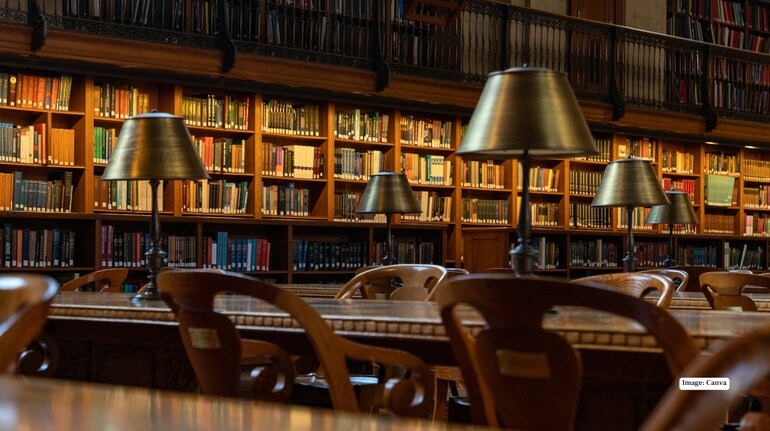

For many journeys, monuments provide the silhouette, but libraries supply the voice. These seven remarkable repositories, all located within UNESCO World Heritage Sites, reveal how different civilisations guarded ideas and shaped learning. They are not just stops for bibliophiles; they are gateways for anyone curious about how a culture thought.
1. Biblioteca Joanina, University of Coimbra – Portugal
High above the Mondego River, Coimbra feels like a city composed in careful paragraphs. The university complex crowns the hill, and within it rests the Joanina Library, built during the golden age of Portuguese baroque. Entering the hall is like walking into an ornate theatre set aside for scholarship—gilded balconies, painted ceilings and deep hues of tropical wood collected from Brazil, once Portugal’s distant colony.
The volumes here chart centuries of inquiry: early medical theories, maritime law shaped by the Age of Discoveries, and theological arguments that travelled between Europe, Africa and Asia. Guides often smile while speaking of the library’s nocturnal guardians—bats that continue an old tradition of protecting paper from insects. Visits are brief and tightly timed, which only heightens the sense of privilege, as if one has been allowed a private audience with the past.
2. Abbey Library of St. Gall – Switzerland
St. Gallen grew from a hermit’s cell into one of medieval Europe’s most disciplined centres of learning. The library hall, completed in the 1700s, glows with rococo elegance, yet its soul is far older. Monks once copied texts here by hand, preserving fragments of classical philosophy while kingdoms rose and fell outside the abbey walls.
Among the treasures are illuminated manuscripts and early writings in Old High German, a reminder that European languages were still finding their feet. The famous monastic blueprint known as the Plan of St Gall shows how an ideal abbey—and an ideal intellectual life—was imagined more than a thousand years ago. Visitors pad across the parquet floor in felt slippers, participating in a small ritual of care that echoes the monastery’s own order.
3. Biblioteca Palafoxiana, Puebla – Mexico
Puebla’s streets smell of talavera ceramics and sweet anise breads, but they also carry the quieter fragrance of paper. In the 17th century, a forward-thinking bishop decided that books should belong to more than elites, founding what became the first public library in the Americas.
The reading room is long and vaulted, its cedar shelves rising like cliffs of knowledge. Early printed works on astronomy and navigation sit beside Indigenous-language texts produced in Mexico’s earliest presses, capturing the hybrid mind of a colonial city connected to global trade routes. A grand antique globe dominates the hall, symbolising the moment when learning crossed oceans. Travellers usually enter through a small museum that explains how Puebla became an intellectual crossroads between Spain and the New World.
4. Strahov Monastery Library, Prague – Czech Republic
Prague is often called a novel disguised as a city, and the Strahov Library provides one of its most dramatic chapters. The complex contains two contrasting halls: one devoted to theology from the baroque period and another celebrating philosophy from the age of early science.
Ceiling frescoes portray the genealogy of ideas—angels discussing doctrine, scholars measuring the heavens, printers setting movable type. The walnut bookcases stretch upward with rolling ladders, proof that this was designed as a working laboratory of thought. Though visitors view the halls from a respectful distance, adjoining galleries display changing selections of maps and scientific instruments, revealing the many ways knowledge served everyday life.
5. Biblioteca Laurenziana, Florence – Italy
Florence’s Renaissance was not only painted on walls; it was debated across desks. The Laurenziana Library, conceived by the Medici family, reflects that confident humanist spirit. Michelangelo designed the approach to the reading room as a journey from compression to clarity—the sculptural entrance gives way to a calm, linear hall flooded with Tuscan light.
The manuscripts trace obsessions of the period: rediscovered Greek dialogues, Latin poetry, early biblical codices annotated by restless scholars. Unlike other European libraries of the time, decoration yields to proportion; the grey pietra serena stone frames the space with intellectual sobriety. To visit today is to understand how Renaissance architecture treated books as citizens of equal importance to statues and palaces.
6. Library of El Escorial, Madrid Region – Spain
El Escorial is a fortress of faith and monarchy, built by a king who believed power should share a roof with learning. The library hall follows the classical restraint of the wider complex—long, barrel-vaulted and luminous.
Philip II gathered manuscripts from across the Iberian world, including Arabic works from Al-Andalus and early scientific treatises that influenced European medicine. Books were arranged along the walls to improve ventilation, showing that preservation was already a science. Frescoes depict the liberal arts like a visual syllabus, reminding travellers that Spain’s imperial ambitions were accompanied by humanist curiosity.
7. Janggyeong Panjeon, Haeinsa Temple – South Korea
Some libraries keep books; Haeinsa keeps the very matrix of scripture. Deep within Gayasan National Park stands the Janggyeong Panjeon, an austere wooden complex that shelters more than 80,000 carved blocks of Buddhist canon.
The architecture behaves like a patient monk: elevated floors, slatted windows and precise orientation tame the wild mood swings of monsoon weather. Thanks to this organic climate engineering, the woodblocks have survived invasions and fires with astonishing freshness. Travellers walk along exterior corridors, viewing structures that resemble giant musical instruments tuned to humidity and wind. The experience shifts attention from ornament to intention—here the building is the librarian.
Reading a Destination Differently
These libraries invite a slower style of travel. They remind us that heritage is not only what dazzles the eye but also what disciplined the mind. Whether you are wandering through Prague after a snowfall or climbing the sunlit steps of Coimbra, pausing inside such repositories changes the rhythm of the trip—you begin to “read” the city around you.

Discover the latest Business News, Sensex, and Nifty updates. Obtain Personal Finance insights, tax queries, and expert opinions on Moneycontrol or download the Moneycontrol App to stay updated!
Find the best of Al News in one place, specially curated for you every weekend.
Stay on top of the latest tech trends and biggest startup news.





