




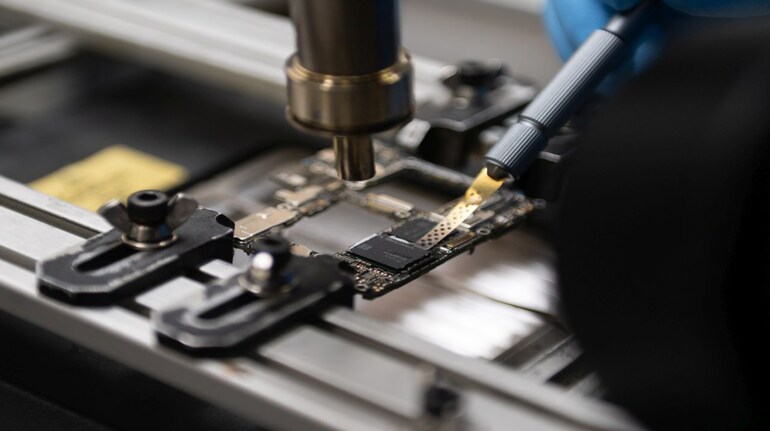
The India Electronics and Semiconductor Association (IESA) plans to present a blueprint to the new government, outlining required incentives and initiatives aimed at advancing the country's semiconductor and electronics sectors over the next five years.
"Over the past five years, Modi's administration has implemented economic reforms fostering growth, particularly in the semiconductor and electronics sectors. We anticipate this trend will continue. We will present a blueprint to the new ministry, emphasizing incentives and initiatives for these sectors over the next five years," Ashok Chandak, President of the IESA said in a statement to Moneycontrol.
The goal of the blueprint, he said, is to enhance local value addition, reduce import dependence, and position India as a global leader in semiconductor and electronics production. Key focus areas include job creation, education, talent development, manufacturing, startup support, global collaborations, and IPR development, supported by tailored government incentive schemes.
In the previous term, which officially ended on June 5 with Prime Minister Modi tendering his resignation, the government had announced a $10- billion (Rs 76,000 crore) semiconductor package which has been allocated to players like the Tata Group, CG Power, Micron for chip plants.
Top officials have indicated over the past few months that a new package is on the anvil, which will focus on supporting end-to-end design and manufacturing of semiconductor chips in the country.
Key players in the electronics manufacturing services (EMS) space of the country don’t expect any big policy change and expect schemes like product-linked incentive schemes to continue.
Rajesh Agarwal, Director of Bhagwati Products Ltd, the manufacturer of smartphones and feature phones, stated that no discontinuity in policies and schemes for the electronics sector is anticipated.. "It should remain good for the industry. We are positive as an industry and the company," he told Moneycontrol.
"The results were slightly surprising, but there will be no impact on manufacturing in the electronics industry… There is a national consensus that the impact of this industry on the economy is huge. We expect PLI schemes to continue to play their part to help various segments within the industry,” a top executive at a leading electronics manufacturing services (EMS) company told Moneycontrol.
The next leg of growth in the electronic manufacturing industry is expected to be driven by component manufacturing as companies ramp up component manufacturing on the back of PLI schemes and have increased their focus on backward integration, analysts at BNP Paribas said in a recent report.
“...we expect the growth of the electronics manufacturing sector to continue across the full supply chain, supported by multiple factors, including the development of domestic semiconductor capabilities and initiatives to increase the domestic sourcing of necessary components,” BNP Paribas said.
Over the past decade, electronic components manufacturing in India grew at 13 percent CAGR, trailing the overall electronic manufacturing industry growth of 19 percent CAGR.
The Indian electronics manufacturing industry witnessed a massive four-fold increase from $25 billion in FY13 to $100 billion in FY23, driven by the aim to reduce dependence on imports of finished goods. This translated to 19 percent CAGR over the past decade, equivalent to 78 percent of the Indian electronics market.
India currently accounts for only 3-4 percent of global electronics manufacturing, despite having a large domestic market. However, favourable government policies and a shift in global sentiments towards India, an alternative to China, will help increase this share further.
India’s electronic manufacturing services (EMS) industry’s total addressable market (TAM) is expected to grow at 27 percent CAGR over FY23-27 to reach $100 billion in total revenue. The rise of domestic EMS players and push on component manufacturing in the country
According to a report by BNP Paribas, the domestic EMS industry’s size is expected to more than double to $55 billion by FY27. “We expect domestic EMS suppliers to capture an increasing share of the total market as they develop their products, capabilities, quality, and relative competitiveness,” the brokerage said.



Discover the latest Business News, Sensex, and Nifty updates. Obtain Personal Finance insights, tax queries, and expert opinions on Moneycontrol or download the Moneycontrol App to stay updated!
Find the best of Al News in one place, specially curated for you every weekend.
Stay on top of the latest tech trends and biggest startup news.