

In 2025, India’s deep tech ecosystem crossed a quiet but consequential threshold. After years of policy push, early-stage capital and scientific ambition, the conversation began to change, from whether frontier technologies could be built in India to whether they could be commercialised, scaled and sustained.
Venture capital investors, founders and policymakers found themselves asking harder questions around revenue visibility, patient capital and global relevance, as deep tech moved from promise to proof.
This year, that promise collided with a harder question: can these companies scale commercially, attract patient capital at later stages, and compete globally before geopolitics, capital constraints or timelines catch up?
The answer is still evolving, but one theme defined 2025 clearly: deep tech is no longer just about scientific ambition. It is about execution, revenue pathways and capital structures built for long gestation cycles.
Government steps in with patient capital
The most consequential development of late 2025 came from the government.
The Rs 1 lakh crore Research, Development and Innovation (RDI) fund, one of India’s most ambitious deep tech interventions, aims to deploy capital over seven years, with Rs 15,000–20,000 crore flowing annually into funds and startups.
“The Rs 1 lakh crore RDI fund will be deployed over a period of seven years, with roughly Rs 15,000–20,000 crore flowing into alternate investment funds and startups each year…We have invited applications for fund managers who will deploy the Rs 1 lakh crore corpus. We expect to finalise names by January, hire by April, and begin deploying by May 2026,” said Abhay Karandikar, Secretary of the Department of Science and Technology (DST), Government of India, in an earlier interaction with Moneycontrol.
Unlike SIDBI’s fund-of-funds model, the RDI programme will combine equity and loans, focus exclusively on deep tech, and tolerate lower returns to crowd in private capital.
Defence, space, semicon, manufacturing find traction
If there was one clear bright spot in 2025, it was defence-linked deep tech.
Several startups secured large domestic defence orders over the past year, signalling that policy push, localisation mandates and geopolitical urgency are beginning to translate into revenue.
Also, read: India’s deep tech push gets $1 bn boost from Indian and US VCs, first bets already in play
Strategic acquisition interest has also emerged earlier than expected in some cases, particularly around counter-drone and surveillance technologies.
Manufacturing-oriented deep tech also gained momentum. With governments offering capex subsidies, land and infrastructure support, build cycles have shortened dramatically.
“Manufacturing is increasingly seen as the closest path to revenue within deep tech,” Iyer said.
At the same time, investors became more cautious about hype. Drones and EVs, in particular, saw heightened scrutiny, with assembling components no longer enough to qualify as deep innovation.
“Apart from AI, the other segments which look promising are Robotic and Automation, followed by Defence and Spacetech,” according to Anil Joshi, Managing Partner, Unicorn India Ventures.
“The focus will include new battery chemistries, electric vehicle motors, photonics, quantum computing, medical devices, gene therapies, biotechnology and more,” said DST Secretary Karandikar.
Early-stage capital flows, but the real gap moves up
At the seed and pre-Series A level, capital is no longer the bottleneck it once was. Grants, angel capital, early-stage VCs and government-backed programmes have flooded the ecosystem, particularly across defence, space and manufacturing-linked technologies.
“The real gap appears at Series B and Series C,” said Manu Iyer, Managing Partner, BlueHill VC, in an interaction with Moneycontrol.
“Deep tech companies often reach Series B eligibility in terms of time and capital consumed, but revenue visibility is still evolving. That makes investors cautious,” he added.
This funding mismatch became more visible in 2025 as dozens of startups graduated from lab validation to early pilots, only to find that traditional growth investors struggled to underwrite the risk.
According to Speciale Invest’s cofounder and Managing Partner, Vishesh Rajaraman, this is structural, not cyclical. “Traditional growth investors often struggle with deep tech because revenues may be unpredictable and profitability unproven even at Series A and beyond,” he said.
He added that, “Deep tech is also geopolitically sensitive, which requires a very different underwriting lens and more local, resilient capital pools.”
That thinking is now shaping a new generation of growth-focused deep tech funds, with cheque sizes in the $5-10 million range, aimed specifically at companies that have mitigated scientific risk but still need time to scale commercially.
Also, read: Deeptech fund Speciale to launch Rs 1,400 crore Growth Fund II, appoints Vijay Jacob as General Partner
Capital steps in to fix deep tech’s scale gap
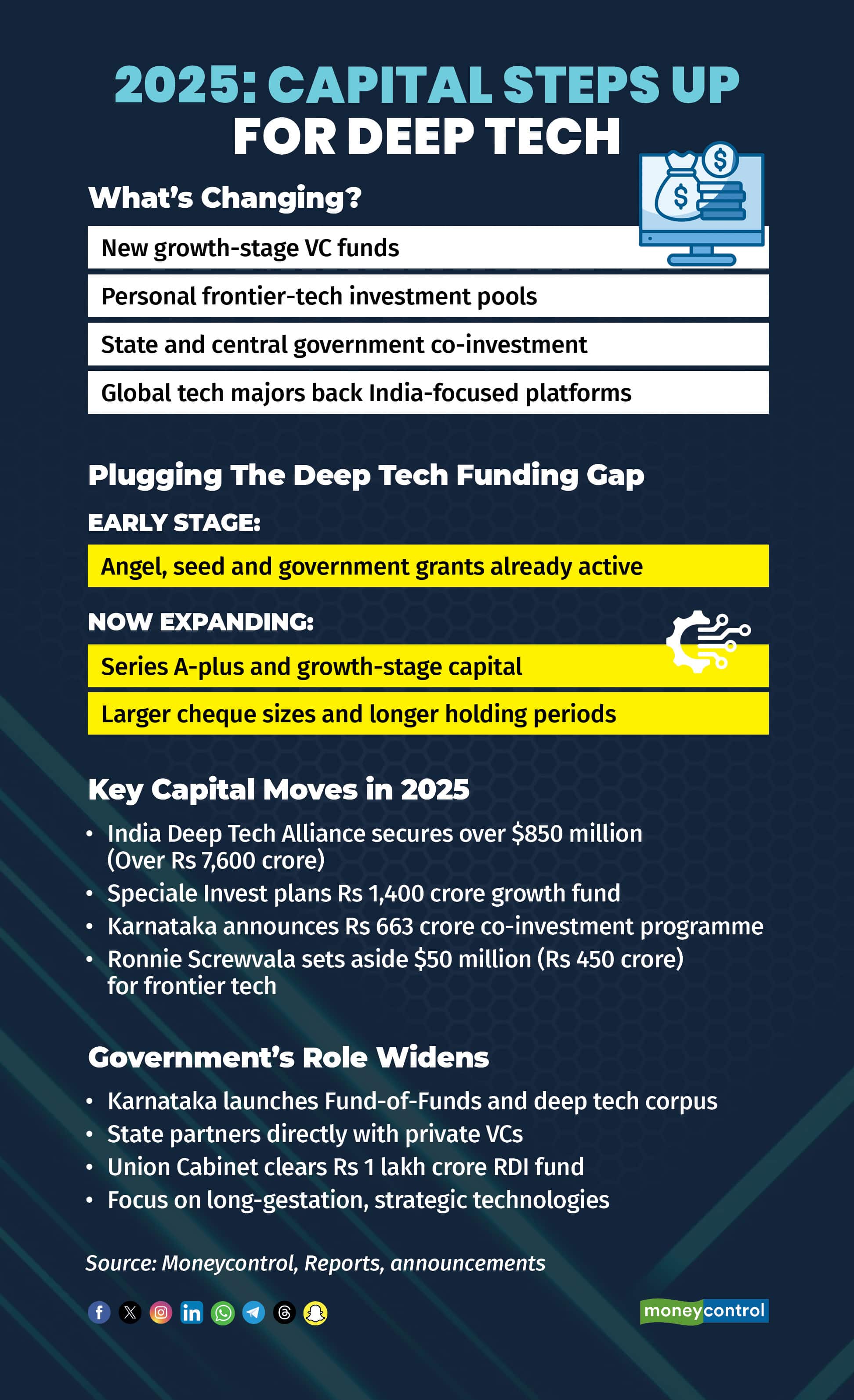
India’s deep tech funding push gathered pace through late 2025 with a sequence of large-ticket capital commitments across platforms, funds and individuals.
The India Deep Tech Alliance secured over $850 million (more than Rs 7,600 crore) in commitments to back startups in areas such as AI, semiconductors and space, signalling growing institutional appetite for frontier technologies. This was followed by Speciale Invest announcing plans for a Rs 1,400 crore growth-stage fund to address the Series B-plus funding gap.
At the state level, Karnataka unveiled a Rs 663 crore co-investment programme with private venture capital firms under its upcoming startup policy. Separately, investor Ronnie Screwvala set aside a $50 million (around Rs 450 crore) personal corpus to back early-stage ventures in AI, deep tech and space-tech.
VCs sharpen focus on deep tech
Indian venture capital firms also stepped up their deep tech focus in 2025, even as funding challenges persisted at later stages.
Funds such as Chiratae Ventures expanded dedicated programmes to back deep tech startups from seed to early growth, while firms including Accel, Blume Ventures, Premji Invest and others committed fresh capital through collaborative platforms and sector-focused initiatives.
Specialist investors like Speciale Invest moved to address the Series A-plus gap by preparing larger growth-stage funds aimed at companies that have cleared early technical risk and are ready to scale commercially.
Together, these moves signal a more structured, long-term VC push into deep tech ahead of 2026.
From technical risk to commercial proof
If the first wave of deep tech investing in India was about whether a team could solve a hard scientific problem, 2025 marked a shift in the questions investors asked.
“At the growth stage, we focus on commercial scaling, revenue traction, go-to-market execution, manufacturing scale-up and global relevance,” said Vijay Jacob, who recently joined Speciale Invest to lead its growth-stage strategy. "The lens changes from ‘can this work’ to ‘how fast and how far can this scale’.”
This shift has implications across sectors. In semiconductors and EVs, revenue visibility is relatively closer, making it easier to attract both late-stage capital and strategic acquirers.
In contrast, moonshot areas such as nuclear technologies, advanced space systems or eVTOL aircraft still face long and uncertain timelines.
That divergence is already shaping exit pathways.
“It is easier to see exits in EVs and semiconductors because there is a clear buyer ecosystem,” Manu Iyer noted. “Several other deep tech areas still lack well-defined exit routes.”
Also, read: Cabinet approves Rs 4,594 crore for four semiconductor projects in Odisha, Punjab and Andhra Pradesh
The lab-to-market valley of death remains
Despite progress, one persistent challenge remains unresolved: commercialising research.
“Lab-to-market is not an automatic path of progression,” R. Raghuttama Rao, CEO of GDC and Fellow at IIT Madras, said in a previous interaction. “Even incentivising with money does not work here. The missing piece is entrepreneurial capability.”
According to Rao, deep tech startups must cross two “valleys of death” — proving technology works beyond controlled environments, and then scaling it for production and adoption. “Scaling is both a technology and a business problem,” he said.
Also, read: Entrepreneurial mindset the missing piece in taking deep tech from lab to market, says IIT Madras
Infosys cofounder and Infosys Science Foundation president K. Dinesh echoed this concern earlier this year, arguing that India must take larger risks and invest more ambitiously if it wants to compete globally.
“Deep tech projects take time and need patience,” he said, adding that failures are inevitable but necessary for outsized rewards.
Also, read: India needs to take bigger bets in deep tech, says Infosys cofounder K. Dinesh
Where VCs are placing their long bets
As the ecosystem matures, investors are also refining what qualifies as deep tech in practice.
For Accel’s Prayank Swaroop, the shift is about committing to hard, multi-year product bets from India that can create globally relevant cybersecurity companies, not smaller outcomes optimised for speed or cost.
Also, read: Venture capital Accel backs Indian cybersecurity startups to chase innovation over pricing power
At Lightspeed, partner Hemant Mohapatra sees the inflexion coming from AI-led infrastructure, where value accrues to companies building foundational systems that power agents, workflows, and enterprise automation.
As these layers stabilise, he argues, commercial scale becomes possible, even if the path remains uneven.
“AI’s output is dreams, but they are much more sharply defined now,” Mohapatra told Moneycontrol earlier, pointing to how improving model reliability is pushing experimentation closer to production.
Also, read: Application-layer AI now accounts for 3X more VC deals than infra in India, says Lightspeed
What 2026 will test
If 2025 was about alignment, between capital, policy and ambition, 2026 will be about outcomes.
Growth-stage funding will determine which companies survive beyond pilots. Revenue, not demos, will dominate boardroom conversations. Global markets, particularly the US and Middle East, will become essential for scale, even as Europe remains difficult terrain.
New frontiers such as quantum computing, quantum security and AI-led drug discovery are beginning to move from theory to early applications, but they will demand patience measured in years, not quarters.
Above all, the ecosystem will be tested on discipline. As one VC put it off record, “Deeptech will reward those who can say no more often than yes, to hype, to premature scaling, and to shortcuts.”
Also, read: India’s Deep-Tech Moment: Building innovation for a $10 trillion future


Discover the latest Business News, Sensex, and Nifty updates. Obtain Personal Finance insights, tax queries, and expert opinions on Moneycontrol or download the Moneycontrol App to stay updated!
Find the best of Al News in one place, specially curated for you every weekend.
Stay on top of the latest tech trends and biggest startup news.