Last week, on December 4, the script flipped.
For once, venture capital investors felt what startup founders often do-the knot of uncertainty, the fear of being just another face in a crowd chasing the same opportunity.
Many, with backpacks still slung on, opted to return as the venue overflowed, with hardly any standing room.
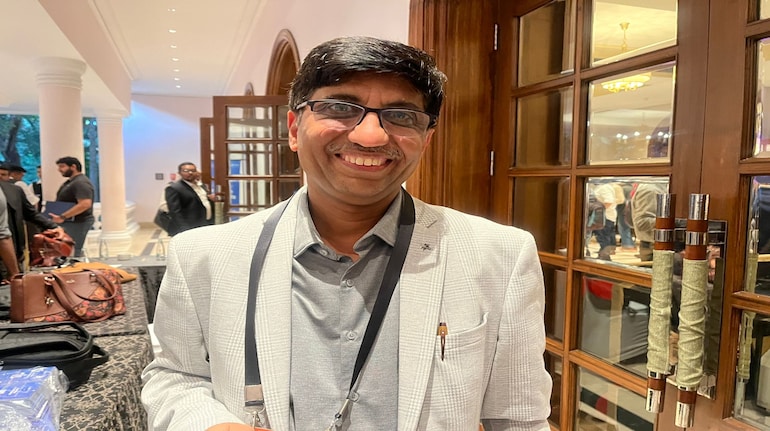
Inside the crammed hall at a prominent hotel in Bengaluru, investors vied with each other for a moment with Abhay Karandikar, Secretary of the Department of Science and Technology (DST), Government of India. Moments earlier the former IIT Kanpur Director had unveiled the broad contours of the Rs 1 lakh crore Research, Development and Innovation (RDI) fund-and VCs wanted answers: how it would be deployed, who would qualify, and whether their next fund could tap into it.
The Rs 1 lakh crore RDI fund will be deployed over a period of seven years, with roughly Rs 15,000-20,000 crore flowing into alternate investment funds (AIFs) and into startups each year, Karandikar told Moneycontrol in an interview. This is one of the Indian Government’s most ambitious moves to grow the deep tech ecosystem, at a time when critical technologies have become important not only from a business but also from a geopolitics perspective.
The work has already begun.
“We have invited the applications for the fund managers who will deploy the Rs 1 lakh crore corpus. We shall finalise fund manager names by January, hire someone by April and begin deploying by May of 2026,” he said.
The RDI fund is the latest initiative from the government and will be different from the Small Industries Development Bank of India (SIDBI) fund of funds (FoFs). While the RDI fund, like SIDBI, will also be an LP (Limited Partners; an investor in funds) in other VC (venture capital) funds, its focus will be different.
“The RDI fund is 10X larger than SIDBI’s latest fund of Rs 10,000 crore. And this fund is meant only for deep tech companies and cutting-edge R&D in some sunrise sectors,” Karandikar said in the interview.
“Also, unlike SIDBI’s fund, the RDI fund will be a combination of both equity and loan. ”
Focus areas would include but not be limited to new battery chemistries, new types of batteries, new motors for electric vehicles, photonics or quantum computers, medical devices, gene therapies, biotechnology and more.
Karandikar admitted the gestation period for deep tech companies is longer than most other investment avenues but the “government is willing to mitigate the risk that is there in the deep tech sector.”
With that in mind, “we are willing to take a lower internal rate of return (IRR)....that I hope that catalyses more private sector investment,” Karandikar said.
While there is no restriction on the amount of money the RDI fund can invest, the total deployment from the RDI fund will not be greater than 50 percent of the entire corpus of a single fund.
The RDI fund is taking shape at a time when VCs and investors are betting big on deep tech, including robotics, to be the next growth frontier in India. More recently, global chipmakers Nvidia Corp. and Qualcomm Ventures joined hands with India-focused VC funds, such as Activate AI, Chiratae Ventures, InfoEdge Ventures, Kalaari Capital, Singularity Holdings VC, and YourNest Venture Capital, to boost the country’s deep tech ecosystem.
The India Deep Tech Alliance (IDTA) coalition of venture capital firms, corporates and investors said it has secured fresh commitments of over Rs 7,500 crore ($850 million), providing a shot in the arm for the sector.
But a fund like the RDI fund is needed because India’s deep tech ecosystem lacks patient capital.
“Along with patient capital being a challenge, another hurdle is the sub-critical funding for companies. If a company wants to develop a quantum computer, they need Rs 1,000 crore, they can't develop a quantum computer for Rs 50 crore,” Karandikar said.
“So, while there are investors who may be willing to give Rs 50 crore, there are no investors who are willing to give Rs 1,000 crore and take that much risk, which is why the RDI fund is needed.”
For the RDI fund to be called a successful project, Karandikar said: “In 15 years if we have 5-10 globally competitive companies we will believe our job is done.”
“Or, if our investments of Rs 1 lakh crore encourage VCs to invest another Rs 10 lakh crore in the deep tech ecosystem, the fund will be a success,” he concluded.



Discover the latest Business News, Sensex, and Nifty updates. Obtain Personal Finance insights, tax queries, and expert opinions on Moneycontrol or download the Moneycontrol App to stay updated!
Find the best of Al News in one place, specially curated for you every weekend.
Stay on top of the latest tech trends and biggest startup news.