
Escalating tensions in West Asia are expected to dampen investor sentiment, particularly toward IPO-bound startups, with late-stage companies also likely to face valuation cuts in private markets, at least nine venture capitalists and investment bankers told Moneycontrol.
Investors around the world are growing cautious as the Middle East-based funds and Sovereign wealth funds (SWFs) are likely to first conserve capital for regional priorities before deploying into other geographies and companies.
This decision will result in IPOs getting pushed out and late-stage companies having to raise money at less-than-desired valuations, the nine people cited above added.
But first:
How important are SWFs from the Middle East for India’s tech ecosystem?
The cautious approach of all nine stakeholders is understandable as investors from the Middle East together account for a sizeable chunk of total investments that flow into Indian new-age companies.
Sovereign wealth funds (SWFs) based in the six Gulf Cooperation Council (GCC) countries have together deployed a total of $9 billion, accounting for 8 percent of the total $112 billion funding secured by the industry, across 30 deals into Indian companies over the last five years, as per data available on Tracxn, a private markets data provider.
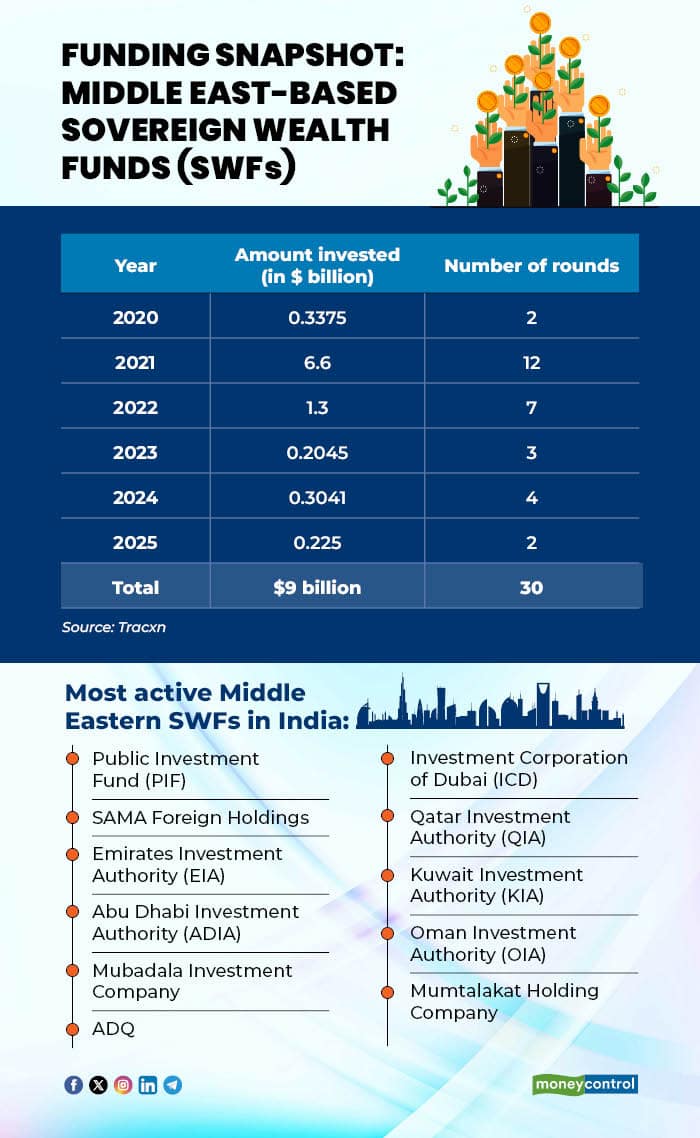 SWFs exposure to Indian new-age companies
What is the immediate impact of the war on India’s startup ecosystem?
While private market companies will take a tad bit longer to feel the pinch, firms preparing to list on the stock exchanges or public listed new-age companies are already feeling the heat.
A large investment banker told Moneycontrol that they have advised all their IPO-bound clients “to hold off (on the IPO work) till there is more clarity on the war front.”
Asked if companies have begun pushing out their IPO timelines, the person said: “All of it is still work in progress. No one has taken a definitive call on delaying their IPO yet, but we are observing.”
Bankers are taking a wait-and-watch approach at a time when at least 20 new-age companies, from PhonePe to Zepto, are all lining up to tap public markets some time this year, as reported by Moneycontrol.
Some of thes IPOs may even get deferred in case markets don’t turn favourable.
“IPOs get delayed because markets tank, multiples compress and for companies that can raise privately to tide this out, they can avoid punitive dilution in public markets,” a large private market investor said.
Is there a second-order impact for publicly listed companies?
As IPO timelines may get altered, there are other risks at play.
Several of the new-age companies – including the likes of Lenskart, Meesho, Amagi, Urban Company, Pine Labs – that went public in the recent 6-8 months were awaiting large block deals, where tens of thousands of shares change hands, but those plans may now need recalibrations.
“Investors were anticipating a $15-20 billion kind of supply through block deals of just new-age companies. Now that supply will not come because there won't be any buyers,” a second large investment banker said.
However, if certain companies become desperate sellers they’ll see significant price corrections.
“When some of this supply is not able to find buyers, there won’t be exits, which will impact the internal rate of return (IRR) for funds which will have to delay their own fundraising and that will result in less capital being deployed. No one is taking this into account yet,” the banker added.
No hurry to deploy capital
Investor sentiment is just as cautious in private markets as it is for public-listed companies.
“New investments, especially from SWFs and the Middle East, are being paused. The ones impacted are shoring up cash for internal measures, the repair bills haven't been tabulated yet so they don’t know how much they’ll need,” a Partner at a large Indian VC fund said.
The large investor cited above echoed those views and said: “Why would SWFs make long dated multi-year commitments when they don’t know just yet if they need $100 million or $5 billion to reconstruct their desalination plants and oil refineries.”
“From an SWF lens, it’s clear: What’s the hurry to deploy capital?”
Valuations to take a knock
As money dries up, private funding rounds are likely to be delayed. However, late-stage companies, which have to raise capital, will see their valuations reduce.
“Any market requires buyers and sellers. So if markets collapse then sellers, or in this case the startups, go away and if prices go up too much, then the buyers, or the VC funds, go away…this mismatch will lead to some impact on late stage pricing,” another Partner at a large global fund said.
Close rounds ASAP
As risk assets become less attractive and SWFs start looking at building buffers for internal reconstruction, investors are advising portfolio companies to do three things on priority: “Close rounds ASAP, reduce cash burn and increase cash runway by a year as everything should get priced in by that time,” a fund manager concluded.
In all, the immediate funding caution and the ripple effects across the IPO market signals a more measured phase for India’s startup ecosystem, where access to capital could become tighter and growth plans more calibrated. Until geopolitical risks ease and large global investors regain visibility on capital deployment, both public listings and late-stage fundraising are likely to be defined by restraint rather than risk-taking.


Discover the latest Business News, Sensex, and Nifty updates. Obtain Personal Finance insights, tax queries, and expert opinions on Moneycontrol or download the Moneycontrol App to stay updated!
Find the best of Al News in one place, specially curated for you every weekend.
Stay on top of the latest tech trends and biggest startup news.