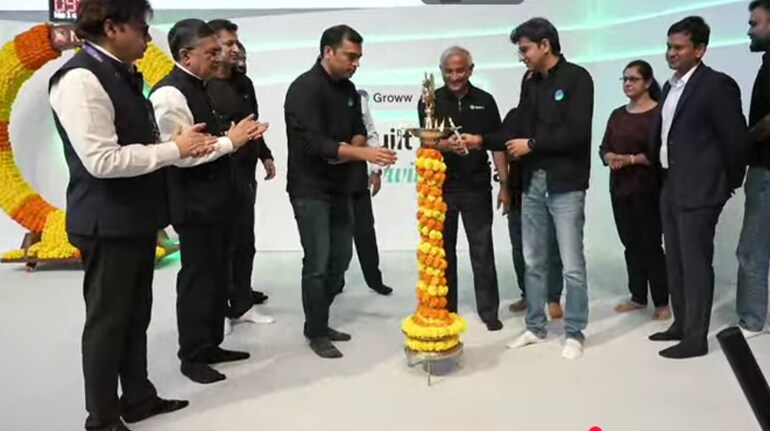
The four founders of Groww first met PeakXV in their Bengaluru office in 2018, leaving an initial impression of being understated and measured.
Seven years later, the team carried the same ethos while going for the IPO. Even though the Bengaluru-based fintech was the most profitable New Economy company of the country, it chose a “conservative valuation” of $7 billion or Rs 62,000 crore.
And it has delivered on listing day, and how!
Groww’s shares closed the market debut with a 31 percent gain compared to the IPO price band and a valuation of Rs 81,000 crore, as against the Rs 62,000 crore valuation it was seeking.
“Over multiple meetings, we began to develop an appreciation for the founders’ engineering, product, and growth skills; their strategic thinking; their quiet ambition; and their brilliant understanding of the customer,” wrote Ashish Agrawal in a blog post on PeakXV website.
PeakXV invested in the series A round in 2018 and also made follow-on investments in the company, and is the single largest shareholder with a 17 percent stake post IPO.
The pricing
Groww announced a price band of Rs 95–Rs 100. On November 12, its shares rose to Rs 134 before closing at Rs 131.
“You give some premium for leadership growth, and then you give a discount because you want to kind of create a win-win kind of situation,” Lalit Keshre, Groww cofounder and CEO told Moneycontrol in a recent interview.
As it turns out, it has been a win-win for the company and its investors on debut.
While some New Economy companies have seen a debate on the IPO pricing, Groww has escaped the conversation, owing to its fair pricing.
Behind the conservative valuation
One of the reasons behind Groww’s understated pricing was the concerns from some regarding the regulatory changes that impacted brokerage firms. Markets
“Investors felt that the company was getting valued fairly, if not conservatively. There were concerns in some quarters regarding the regulations and their impact, as some of its peers saw revenue or profits plummet in the range of 30-40 percent,” said Rishabh Katiyar, principal at Info Edge Ventures.
For most investors, Groww seemed like a company that was valued almost at par with peers and the premium could be attributed to the operational metrics.
Groww had higher EBITDA margins compared with a few peers – 60 percent versus 45 percent – and also had a much higher revenue and customer growth rate.
The Optimism
“There was no technology company premium narrative when investors were looking at Groww. Since Groww had executed well in its core, the hope is that it can continue to execute in the wealth segment,” Katiyar said.
According to industry executives who spoke on condition of anonymity, they would like to see the impact of SEBI regulations for a couple of more quarters before judging the IPO pricing.
“This looks like people are betting on the fintech doing well in the distribution of financial products. Investors seem to believe in the company’s continued growth,” said Madhur Singhal, managing partner and CEO at Praxis Global Alliance, a consulting firm for digital companies.
Wealth-play to lead the next phase of value creation
Groww is betting heavily on wealth management for the millions of customers that the existing bank-led wealth platforms and Motilal Oswal 360One do not cater to. These platforms cater to high-net-worth individuals, while Groww is looking at customers with assets below Rs 5 crore as of now.
According to Katiyar, distribution is the moat in financial services, as shown by the banks which upsell and cross-sell mutual funds, insurance and brokerage services.
Groww started with mutual fund distribution and executed its expansion into the brokerage business to become the largest stockbroker in the country despite being a late mover.
“Investors believe that Groww can continue to execute well in adjacent businesses, as they have already proven previously. Unlike other startups, the adjacencies are within the overall investment realm,” added Katiyar.
Is FOMO playing out?
However, not everyone is convinced that listing pop is because of the company’s performance alone.
“There’s definitely a sense of FOMO driving parts of the Indian stock market today — especially among a segment of investors chasing instant gains. Greed and FOMO together make a potent cocktail — one that can be used to sell almost any valuation to such investors. But a company’s true success can’t be judged on the day or even the month of its listing. Investors need to track performance over several quarters to understand its real value. The listing day is no longer a barometer of a company’s fundamentals or investor expectations," said Srinath Sridharan, author, board member and policy researcher.
Nevertheless, Groww’s IPO has come as a relief to India’s startup ecosystem, which has seen several investors questioning the valuation or the premium, with Lenskart and Boat facing severe criticisms on social media platforms.
Lesson for startup founders
“The lesson for startups is that if you build a world-class product company with laser-focused execution, it creates value for everyone,” said the payment gateway firm Razorpay founder Harshil Mathur.


Discover the latest Business News, Sensex, and Nifty updates. Obtain Personal Finance insights, tax queries, and expert opinions on Moneycontrol or download the Moneycontrol App to stay updated!
Find the best of Al News in one place, specially curated for you every weekend.
Stay on top of the latest tech trends and biggest startup news.