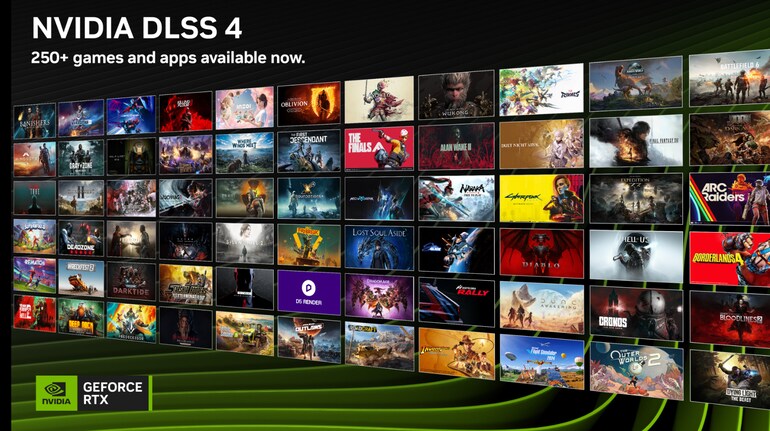

Nvidia DLSS 4.5 is the latest update to the company’s AI-based rendering technology, announced at CES 2026. It builds on DLSS 4, which debuted at CES 2025 and quickly became Nvidia’s fastest-adopted gaming feature, with support across more than 250 games and applications. DLSS 4.5 introduces a second-generation transformer model for Super Resolution and adds Dynamic Multi Frame Generation along with a new 6X Multi Frame Generation mode. Together, these upgrades aim to improve image quality, frame pacing, and performance, especially in demanding ray-traced and path-traced games.
What is Nvidia DLSS 4.5
DLSS, short for Deep Learning Super Sampling, uses AI to reconstruct higher-resolution images from lower-resolution inputs. DLSS 4.5 represents the first major upgrade to Nvidia’s transformer-based Super Resolution architecture. According to Nvidia, the new second-generation transformer model uses five times the compute power of the original model and has been trained on a much larger, higher-fidelity dataset.
DLSS 4.5 also expands frame generation capabilities. While DLSS 4 supported 4X Multi Frame Generation, DLSS 4.5 introduces Dynamic Multi Frame Generation and a fixed 6X mode. At its maximum setting, DLSS 4.5 can generate up to five AI-created frames for every traditionally rendered frame, dynamically scaling performance up to the refresh rate of the user’s display.
DLSS 4.5 Super Resolution explained
The biggest change in DLSS 4.5 is the upgraded Super Resolution model. Nvidia says the new transformer has a deeper understanding of scenes, motion, and lighting. Unlike older techniques that operated in logarithmic space to suppress flickering, DLSS 4.5 trains and infers directly in linear space, which matches the game engine’s native lighting data.
This change allows lighting to be accumulated more accurately, preserving highlights, reflections, and shadow detail. In practical terms, bright neon signs, reflective surfaces, and high-contrast scenes retain more detail and colour, without the muted look sometimes seen in earlier upscaling methods.
DLSS 4.5 Super Resolution improves image quality across all modes, including Quality and Balanced. However, the most noticeable gains are in Performance and Ultra Performance modes, where fewer native pixels are rendered. Nvidia claims that Performance mode can now approach, and in some cases exceed, native image quality, while Ultra Performance becomes a more practical option for 4K gaming.
Reduced ghosting and better temporal stability
One of the common challenges with AI upscaling and temporal techniques is ghosting and instability during fast motion. Nvidia says DLSS 4.5 significantly reduces these artefacts. Fast-moving objects remain clearer, edges are rendered with better precision, and shimmering in motion is reduced.
Examples highlighted by Nvidia include improved edge stability during character movement and reduced trailing artefacts in fast scenes. Overall, the update focuses on maintaining clarity frame-to-frame, rather than only improving still image quality.
Multi Frame Generation and the new 6X mode
DLSS 4.5 expands Nvidia’s Multi Frame Generation technology with a new 6X mode. Earlier versions could generate up to three additional frames per rendered frame. With DLSS 4.5, the system can generate five additional frames, resulting in a maximum 6X frame rate multiplier.
This feature is designed for GeForce RTX 50 Series GPUs and targets high-refresh displays such as 240Hz and 360Hz monitors. Nvidia claims that moving from 4X to 6X Multi Frame Generation can increase 4K frame rates in path-traced titles by up to 35 percent. When combined with Nvidia Reflex, the additional frames are generated with minimal impact on input latency.
The updated frame generation model also improves in-game user interface clarity. By using additional game engine data, static UI elements such as minimaps and HUDs appear sharper and more stable.
Dynamic Multi Frame Generation explained
Dynamic Multi Frame Generation is another key addition in DLSS 4.5. Instead of using a fixed frame multiplier, the system automatically adjusts the number of generated frames in real time. Nvidia compares this to an automatic transmission for the GPU.
The system continuously monitors GPU performance and display refresh rate. In demanding scenes, it increases frame generation to maintain smooth output. When the workload becomes lighter, it reduces the multiplier to avoid unnecessary computation. This approach aims to balance performance, image quality, and responsiveness across a wide range of scenarios and display types.
Supported GPUs and availability
DLSS 4.5 Super Resolution is available to all GeForce RTX GPU owners, including RTX 20, 30, 40, and 50 Series cards. Users can access the feature through the Nvidia app by installing the latest beta update, with a full release scheduled for January 13.
Dynamic Multi Frame Generation and the 6X Multi Frame Generation mode are exclusive to GeForce RTX 50 Series GPUs. Nvidia has confirmed that these features will roll out in spring 2026 through the Nvidia app.
List of supported games
DLSS 4 with Multi Frame Generation is already supported in over 250 games and applications, with DLSS 4.5 compatibility extending across this ecosystem. Nvidia has highlighted several upcoming and recent titles that either launch with or are being upgraded to DLSS 4 and DLSS 4.5 features.
Confirmed titles include 007 First Light, which launches with DLSS 4 and Multi Frame Generation, and PRAGMATA, which is being upgraded with full path tracing and DLSS 4 support on PC. Resident Evil Requiem launches with DLSS 4 and path-traced lighting, while Phantom Blade Zero includes ray tracing and DLSS 4 at launch.
Other titles confirmed with DLSS 4 support include Active Matter, Screamer, and DEFECT. Nvidia also notes that many popular games released in 2025, such as ARC Raiders, Battlefield 6, Clair Obscur: Expedition 33, and Where Winds Meet, already support DLSS 4 with Multi Frame Generation. In addition, DLSS overrides in the Nvidia app allow many existing games to benefit from the DLSS 4.5 Super Resolution model without native updates.
What DLSS 4.5 means for PC gaming
DLSS 4.5 reflects Nvidia’s broader shift toward AI-driven rendering as a core part of modern PC gaming. By combining improved image reconstruction with flexible, dynamic frame generation, the technology aims to make advanced features like path tracing more accessible without requiring constant hardware upgrades.
For players, DLSS 4.5 offers higher frame rates, more stable visuals, and better use of high-refresh displays. For developers, it provides a way to push visual complexity while relying on AI to manage performance. As support continues to expand, DLSS 4.5 is likely to play a central role in how future PC games are built and experienced.


Discover the latest Business News, Sensex, and Nifty updates. Obtain Personal Finance insights, tax queries, and expert opinions on Moneycontrol or download the Moneycontrol App to stay updated!
Find the best of Al News in one place, specially curated for you every weekend.
Stay on top of the latest tech trends and biggest startup news.