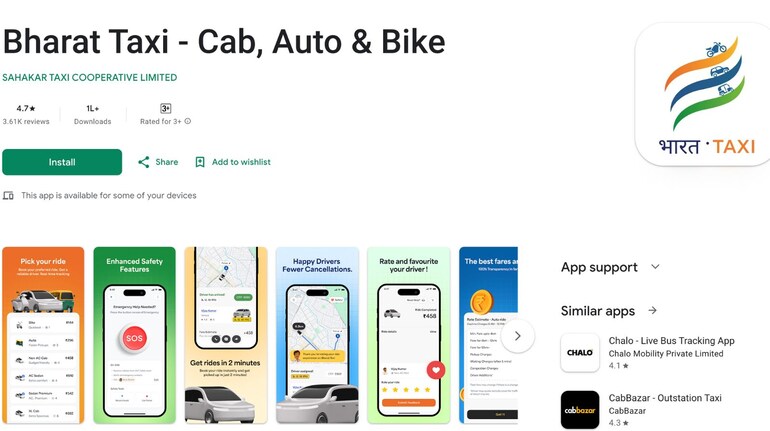

There is a new cab app in town and it’s called Bharat Taxi. The app has now gone live across the NCR region. For commuters in the capital and neighbouring cities, this means one more option when booking rides, a space that has been largely ruled by Uber and Ola for years. Bharat Taxi wants to offer something different, a model where drivers earn more, fares are more stable, and riders don’t get hit with sudden price shocks when demand rises.
The momentum around the app was highlighted by the Ministry of Cooperation, Government of India, from its official X handle. In a recent post, the ministry shared that Bharat Taxi has already crossed four lakh registered customers. Even more interesting is the speed at which the app is adding users. Over the past two days, it has been onboarding around 40,000 to 45,000 users every day. That kind of early traction tells us that people are at least curious enough to download the app and see what it offers. On the app charts, Bharat Taxi is currently ranked ninth on the Google Play Store and thirteenth on Apple’s App Store, while the driver-focused Bharat Taxi partner app is sitting at number 20 on the Play Store. The ministry described this phase as a build-up to a larger nationwide rollout, connecting the initiative with the government’s Atmanirbhar Bharat and Sahkar Se Samriddhi vision, under Union Home and Cooperation Minister Amit Shah.
But the public wants answers to a simpler question: Is Bharat Taxi actually cheaper for everyday rides compared to Uber and Ola?
To find that answer, we decided to put the app through a real-world fare test. The goal wasn’t to hype one app over another, but to simply compare the same trip, at the same time, across all three services. Here’s exactly what we did: we downloaded the Bharat Taxi, Uber, and Ola apps, opened them one by one, and entered the same destination from the same pickup location. The route chosen was from Noida Sector 98 to Select Citywalk Mall in Saket, New Delhi. We took screenshots of the ride options and prices shown in each app to compare what a user would pay in a normal, non-surge moment.
The Fare Test Results
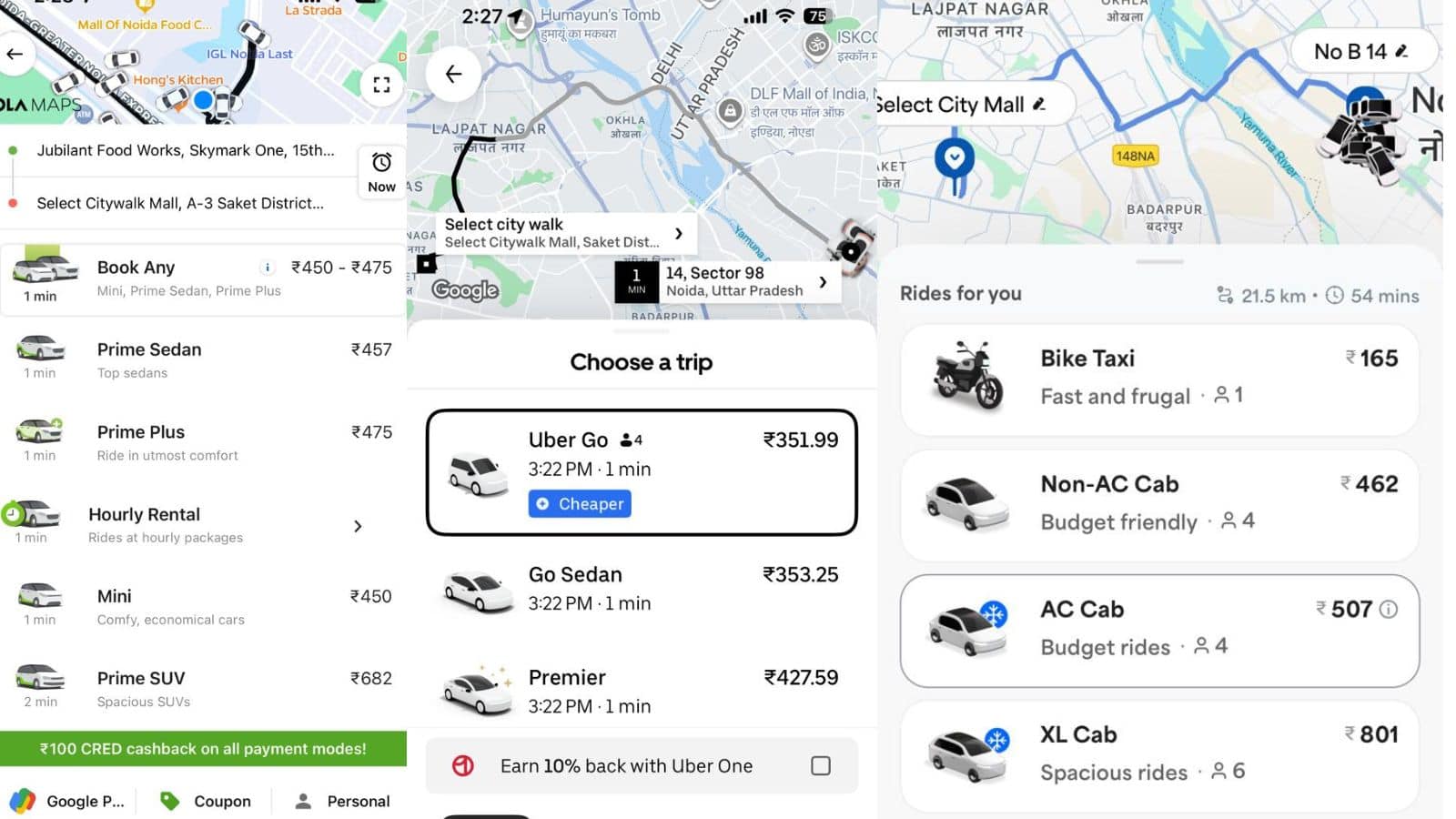
On Bharat Taxi, the options included Bike Taxi for Rs 165, Non-AC Cab for Rs 462, AC Cab for Rs 507, and XL Cab for Rs 801. The Bike Taxi was the lowest price option on the app, but it is also a different ride category compared to cars. For a standard car comparison, the most relevant options were Non-AC Cab at Rs 462 and AC Cab at Rs 507.
 bharat taxi app
On Ola, the prices were: Mini at Rs 450, Prime Sedan at Rs 457, Prime Plus at Rs 475, and Prime SUV at Rs 682. The Mini option on Ola was the cheapest among its car categories, at Rs 450, which is slightly lower than Bharat Taxi’s Non-AC car option.
Then came Uber, which quoted: Uber Go at Rs 351.99, Go Sedan at Rs 353.25, and Premier at Rs 427.59. In this live test for a basic car category, Uber Go turned out to be the cheapest among the three apps, by a noticeable margin. Ola Mini was next in line, and Bharat Taxi’s Non-AC Cab was the highest among the comparable car categories in this snapshot test.
So, if a commuter was booking this ride at this exact moment on this route, Uber was cheaper than Ola, and both were cheaper than Bharat Taxi for similar car options.
Understanding the Pricing Behaviour
Now, a single test isn’t enough to declare one app as always cheaper. Cab fares are shaped by multiple factors including demand, supply, driver availability, commission models, fuel costs, and pricing algorithms. Here’s where the models differ.
Uber and Ola rely on dynamic pricing systems. This means the price you see is not guaranteed to stay the same throughout the day. When ride demand spikes, fares can increase. When demand is low or drivers are nearby, prices dip. This works well for riders when the price dips, like in our test, where Uber Go showed Rs 351.99. It’s great for consumers during non-peak hours, but it can also go the other way when prices climb during busy time slots.
Bharat Taxi promotes fare stability and transparency, with no surge pricing. This means that even if 100 people open the app at the same time during a busy moment, the fare isn’t supposed to spike wildly. The company has been talking about keeping driver commissions low and earnings fair, a key part of the cooperative model. This approach is built to protect passengers from unpredictable fare jumps. But this also means that Bharat Taxi’s fares may not always look the lowest when compared during non-surge moments. It is built for consistency, not always for the lowest possible number at a given second.
Other Factors That Matter
Let’s talk about what commuters actually care about beyond price. Most people booking a cab look for the full experience. They want a car that arrives quickly, a driver who doesn’t cancel at the last minute, and an app that works smoothly. They want options for luggage space, AC during summers, and reasonable wait times.
Uber and Ola have the advantage of time. They have been operating for years, building driver networks, refining their apps, and collecting data that helps them place cars closer to riders. Their maps, arrival predictions, and pricing models are now deeply tuned to commuter behaviour. Riders also trust these apps because they have used them for years, faced issues, solved complaints, and learned how the platforms work.
Bharat Taxi is new in NCR. It is onboarding customers fast, but driver availability in the region is still scaling up. The government’s official support and promotion gives it visibility, but real-world reliability will only be judged as more drivers join and more rides are completed. Cooperative model or not, riders will stay if the app can deliver availability and timely pickups as consistently as the competition.
Delhi-NCR now has more choice. One app wins on price in one test, another might win on comfort or size, and the third might win on stability during busy hours. For now, on our tested route at this tested moment, Uber came out cheaper. But as Bharat Taxi scales its driver network in NCR, and more pricing data emerges over regular rides and peak hours, commuters will have a clearer picture.
In a market where a Rs 10 to Rs 100 difference can influence daily decisions, having more apps means more transparency, more comparisons, and ultimately, better deals for riders over time.



Discover the latest Business News, Sensex, and Nifty updates. Obtain Personal Finance insights, tax queries, and expert opinions on Moneycontrol or download the Moneycontrol App to stay updated!
Find the best of Al News in one place, specially curated for you every weekend.
Stay on top of the latest tech trends and biggest startup news.