






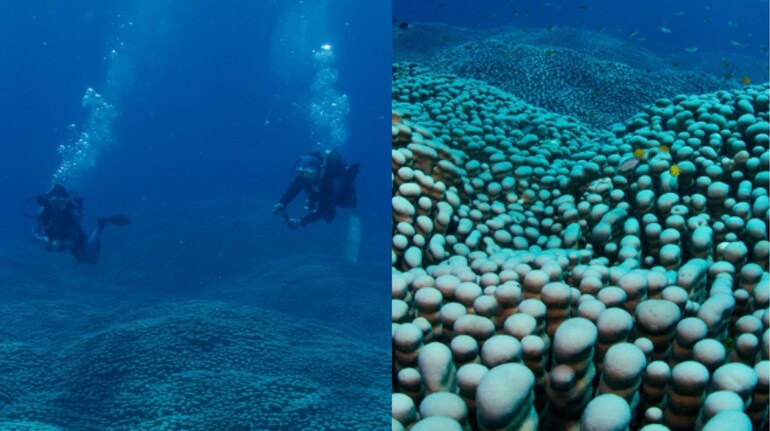

A routine dive has led to an extraordinary marine discovery. A mother and daughter participating in a citizen science project have identified what experts now believe could be the largest documented coral colony in the world.
The massive structure was spotted by Jan Pope and her daughter Sophie Kalkowski‑Pope while surveying a remote section of the Great Barrier Reef. Their find has since been reviewed by marine scientists and confirmed as an exceptionally large single coral colony which is potentially the biggest ever recorded.
Discovery made during the Great Reef Census
The discovery occurred during the Great Reef Census. This is a collaborative initiative that invites volunteer divers to document reef health. While exploring an under-surveyed area, the pair (mother-daughter duo) encountered an enormous coral structure stretching across a vast section of seabed.
Initially unaware of its significance, they captured photographs and video footage before submitting the material to reef researchers for analysis. Subsequent measurements revealed that the formation dwarfs previously documented coral colonies in the region.
How Did Scientists Determine It Is the World’s Largest?
The divers submitted photographs and video recordings of the coral. Marine researchers conducted a detailed spatial analysis on this found something interesting.
The measurements revealed that the coral colony stretches approximately 34 metres (112 feet) in length and around 32 metres (105 feet) in width.
These dimensions exceed previously documented single coral colonies, distinguishing it from clusters of separate coral heads. Scientists confirmed it is one continuous living colony.
How Deep Did the Divers Go?
The mother–daughter team encountered the coral at a depth of roughly 12 to 15 metres (about 40 to 50 feet) below the surface. This relatively accessible depth makes the discovery even more remarkable, as the reef system has been extensively studied for decades.
Despite its prominence in one of the most researched marine environments in the world, the colony had remained undocumented until now.
What Is This Coral Made Of?
Though often mistaken for underwater plants, corals are in fact marine animals. This giant structure is composed of millions of tiny, genetically identical organisms known as polyps.
Each polyp secretes a hard calcium carbonate skeleton over centuries or even millennia. These skeletons accumulate to form vast reef structures.
What Makes This Coral So Remarkable?
Several factors make the colony exceptional. These factors include scale, survival and age of the colony. It appears healthy despite environmental pressures affecting much of the reef.
Scientists believe such a large, intact coral colony provides valuable insight into reef resilience, genetic survival strategies and long-term ocean conditions.
A Timely Discovery Amid Climate Concerns
The Great Barrier Reef has suffered repeated coral bleaching events linked to rising sea temperatures driven by climate change. Large portions of the reef have experienced stress over the past decade. Against this backdrop, the discovery offers cautious optimism.
The existence of a thriving mega-colony suggests that certain coral systems may possess natural resilience or favourable micro-conditions that protect them from extreme warming.
Discover the latest Business News, Sensex, and Nifty updates. Obtain Personal Finance insights, tax queries, and expert opinions on Moneycontrol or download the Moneycontrol App to stay updated!
Find the best of Al News in one place, specially curated for you every weekend.
Stay on top of the latest tech trends and biggest startup news.





