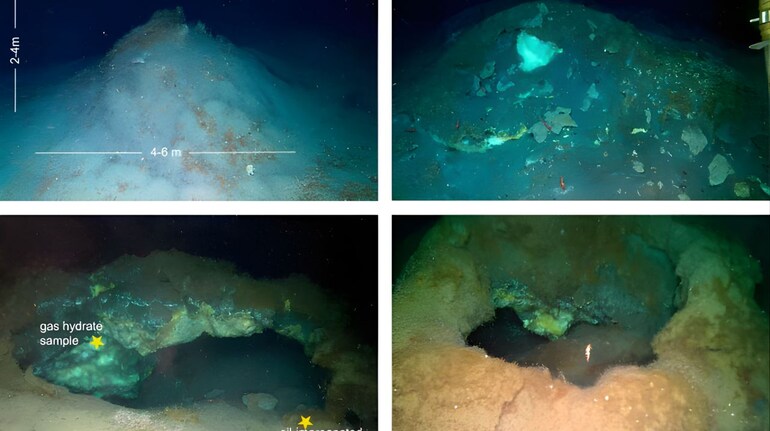

Scientists have found a secret world beneath the Arctic Ocean. It lies 3.6 kilometres below the Greenland Sea surface. Here, methane mounds rise from the tectonically active seabed. These mounds are icy structures trapping methane under extreme pressure.
Tectonic cracks allow methane to seep slowly from deep below. The formations are among the deepest gas hydrates ever recorded. Researchers say this discovery could reshape understanding of Arctic ecosystems.
A Frozen Methane Hiding Below the Waves
These icy mounds trap methane gas under extreme pressure. They are among the deepest gas hydrates ever recorded on Earth. The formation occurs along the Molloy Ridge, a hidden underwater ridge.
Tectonic activity creates cracks, letting methane escape from the crust. When methane meets near-freezing water, it forms stable gas hydrates. These formations may hide massive amounts of stored greenhouse gas.
Wildlife Thriving in Total Darkness
What makes this discovery remarkable is the thriving wildlife. Tube worms, crustaceans, and microbial mats inhabit the mounds. They survive entirely through chemosynthesis, not sunlight or photosynthesis.
These extreme organisms convert methane and chemicals into usable energy. This ecosystem exists in total darkness under crushing pressures. It shows life can adapt to unimaginable environments on Earth.
Why Methane Mounds Could Change Climate?
Methane is a potent greenhouse gas that warms our planet. Understanding deep-sea methane helps scientists model climate change impacts. These mounds may reveal how methane is stored and released naturally.
The find also highlights extreme life as a model for research. It shows how biology and geology intersect in hidden oceans. Robotic submarines and imaging technology made this discovery possible.
How This Discovery Is Shaping Science?
The Arctic methane mounds challenge what we know about life extremes. Life can thrive without sunlight, pressure, or warmth for survival. Chemosynthesis ecosystems offer insights into alternative energy pathways for life.
Deep-sea methane storage informs climate models and greenhouse gas predictions. Geologists study these formations to understand tectonic activity under oceans. Biologists gain new understanding of evolution in extreme environments.
What Scientists Plan Next?
Researchers aim to map more Arctic methane mounds worldwide. Robotic submarines will explore deeper, previously unreachable ocean floors. They plan to study microbes and organisms thriving around hydrates.
Experiments will test methane release rates under changing ocean conditions. Scientists hope findings may inform astrobiology and alien-life research. Future studies will guide conservation of fragile deep-sea ecosystems.
Discover the latest Business News, Sensex, and Nifty updates. Obtain Personal Finance insights, tax queries, and expert opinions on Moneycontrol or download the Moneycontrol App to stay updated!
Find the best of Al News in one place, specially curated for you every weekend.
Stay on top of the latest tech trends and biggest startup news.