
co-presented by
ASSOCIATE SPONSORS
co-presented by


ASSOCIATE SPONSORS




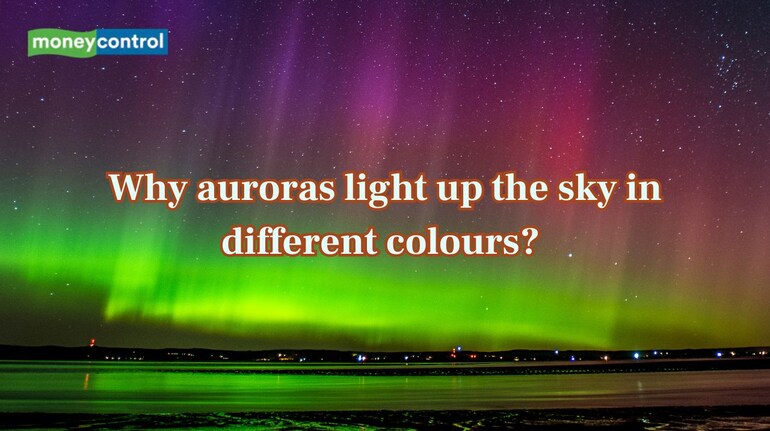

Auroras are nature’s most mesmerizing sky displays visible near poles. They appear as dancing, glowing curtains in green, red, blue and purple. The science behind aurora colors is fascinating and tied to physics. Charged particles from the Sun collide with Earth’s magnetic field. Each color depends on which gas is hit and altitude involved. Stronger solar storms and unusual atmospheric conditions intensify the visual spectacle.
How do Auroras form?
Auroras form when solar wind particles, mostly electrons and protons, reach Earth and interact with its magnetic field. The magnetic field directs these particles towards the poles, where they collide with oxygen and nitrogen molecules in the upper atmosphere.
These collisions excite the atoms, forcing them to release energy as light. The result is auroras dancing across polar skies, curving along magnetic field lines and creating waves, arcs, and curtains.
Different Colours of Auroras
The colour of an aurora depends on which gas is struck, and the altitude at which the collision occurs. Here are some prominent colours of auroras that light up the night sky.
1. Red Auroras: They are formed at the highest altitudes, above 150 miles (240 km). Caused by oxygen atoms excited by high-energy particles. Rare and visible only during intense solar activity.
2. Green Auroras: This most common colour is seen at lower altitudes, up to 150 miles. Produced by oxygen where it is more abundant. Creates the familiar emerald glow often photographed by travellers.
3. Blue and Purple Auroras: They are formed below 60 miles (100 km), dominated by nitrogen. High-energy collisions with nitrogen atoms produce vivid blue and violet tones. Most visible during strong solar storms, adding depth to the sky.
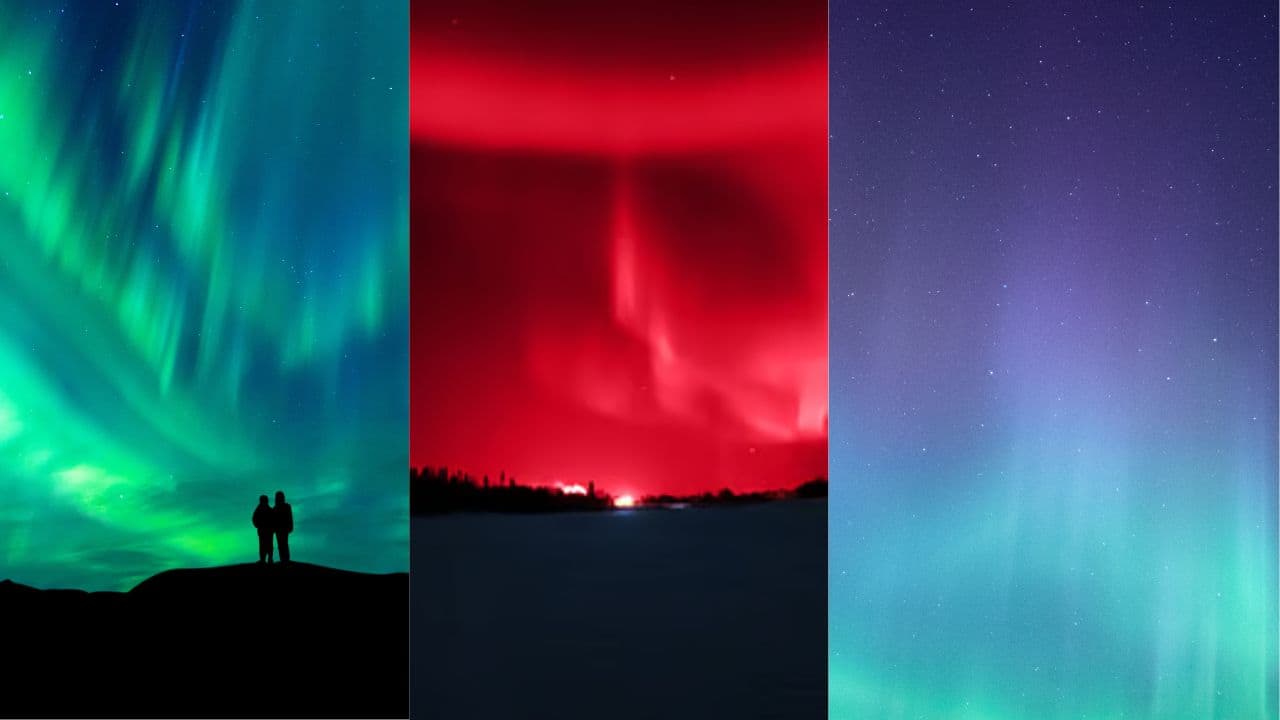 Aurora in Green, Red, blue and purple colours (Image: Canva)
How Solar Storms Affect Aurora Intensity?
Solar storms, or coronal mass ejections, intensify auroral displays. High-energy particles reach Earth faster and in greater numbers. This produces brighter, faster-moving auroras that extend further from the poles. Occasionally, auroras become visible at lower latitudes, with extraordinary displays stretching as far as Europe, the United States and Asia.
Why Auroras form in Colours?
Auroras are not just white flashes of light in the sky. Their colours depend on the type of gas particles in the atmosphere. Oxygen emits green and red light when struck by charged particles. Nitrogen produces blue and purple auroras near Earth’s surface.
The exact colour also depends on particle energy and collision speed. Auroras are coloured because different gases emit different wavelengths of light when excited by energetic particles.
Auroras on Other Planets
Auroras are not unique to Earth. Jupiter, Saturn, Uranus and Neptune all host auroral activity. On Jupiter, auroras are extremely bright and permanent, powered by interactions with its moons and strong magnetic field. Saturn’s auroras vary seasonally, while Uranus and Neptune’s are more irregular and unpredictable, shaped by unique magnetic geometries.
How Satellites and Scientists Study Auroras?
Scientists use satellites equipped with cameras and magnetometers to monitor auroras from space, measuring particle flow and energy. Ground-based observatories photograph auroras and record intensity fluctuations. Data from instruments like NASA’s Polar, THEMIS and ESA’s Swarm missions allow researchers to model auroral formation accurately.
Discover the latest Business News, Sensex, and Nifty updates. Obtain Personal Finance insights, tax queries, and expert opinions on Moneycontrol or download the Moneycontrol App to stay updated!
Find the best of Al News in one place, specially curated for you every weekend.
Stay on top of the latest tech trends and biggest startup news.