






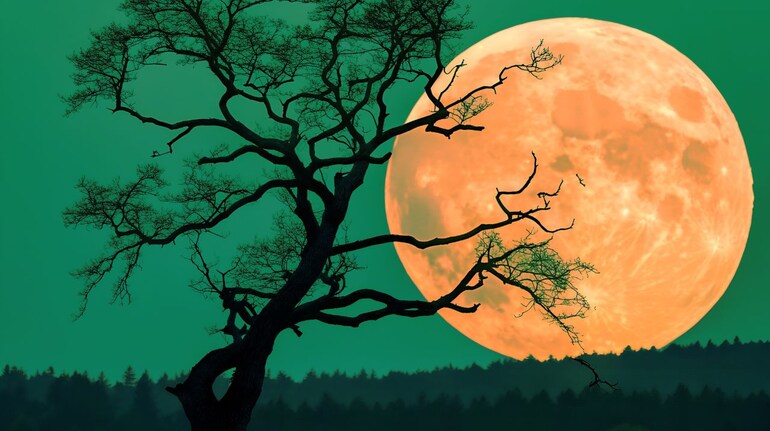

A total lunar eclipse will be visible across India and worldwide on 3 March 2026, and astronomers say the Moon may glow navy blue and deep crimson rather than the usual dusty red.
Skywatchers often expect a copper coloured Moon. This year the display may look different. Scientists say the event marks 2026’s first lunar eclipse. Observers could witness rare colour contrasts overhead. The spectacle depends on precise cosmic alignment.
Why the Moon Turns Red During Eclipse
A lunar eclipse occurs when Earth intervenes. The planet moves directly between Sun and Moon. Direct sunlight becomes blocked by Earth. The atmosphere bends remaining sunlight inwards. This bending effect is called Rayleigh scattering. The same process colours daytime skies blue. It also produces red sunrises and sunsets.
During totality, the Moon enters Earth’s umbra. Only longer red wavelengths reach lunar surfaces. That creates the familiar Blood Moon glow. The red shade depends on atmospheric conditions. Dust and particles influence final colour tones.
What Makes the 2026 Lunar Eclipse Different
Astronomers expect a different visual outcome. The Moon will skim the umbra’s upper edge. Light will pass through higher stratospheric layers. These layers contain less dust contamination. The altered path changes transmitted wavelengths significantly.
Scientists say ozone plays a decisive role. The effect involves Chappuis absorption bands. They are named after James Chappuis. Ozone molecules absorb yellow and red light. This filtering allows blue hues to dominate. A navy or turquoise fringe may appear. The boundary of Earth’s shadow glows differently.
Ozone, Satellite Data and 72-Hour Window
Researchers have tested this colour mechanism. They used satellite observations and ray tracing models. Spectroscopy confirmed ozone’s distinct light signature. Without ozone, the Moon appears largely red.
The eclipse offers a 72-hour study window. During this time, scientists assess ozone density. The Moon reflects valuable atmospheric information. Measuring stratospheric clarity from Earth proves difficult. This celestial mirror aids atmospheric monitoring.
Experts say such alignments remain uncommon. The event links sky spectacle with science. Observers may simply enjoy unusual colours. Researchers will analyse atmospheric health carefully. The March eclipse blends beauty with data.
Discover the latest Business News, Sensex, and Nifty updates. Obtain Personal Finance insights, tax queries, and expert opinions on Moneycontrol or download the Moneycontrol App to stay updated!
Find the best of Al News in one place, specially curated for you every weekend.
Stay on top of the latest tech trends and biggest startup news.





