






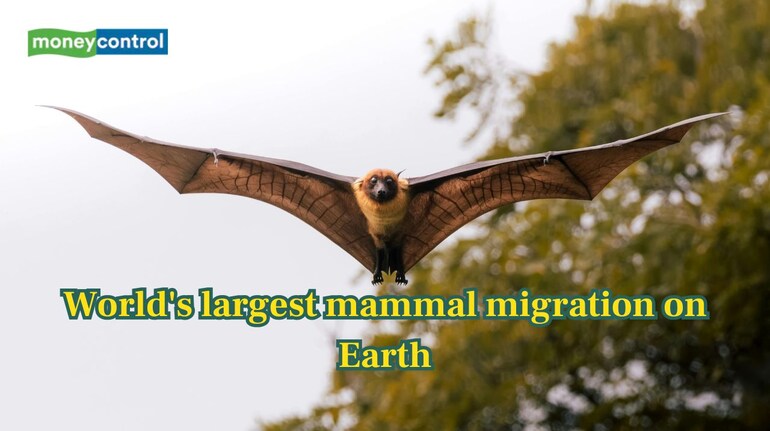

Every year, something incredible happens in Kasanka National Park, Zambia. From October onwards, hundreds of thousands of straw‑coloured fruit bats (Eidolon helvum) descend on a small patch of swamp forest. They form one of the largest mammal migrations on the planet.
These bats, with wingspans approaching 80 cm, transform the forest into a living cloud. By day, they roost tightly in the trees, hanging like golden umbrellas. By night, they take off in massive swirling flocks, flying tens of kilometres to feast on fruit and nectar.
What Happens During this Migration?
The journey is a daily rhythm of survival and spectacle. In daytime, these bats roost safely in the swamp forest. They are often packed shoulder to shoulder. At nighttime, these bats forage flights up to 100 km, consuming up to their own bodyweight in fruit each night. This annual migration is not just a visual marvel, but it is an ecological event that shapes forests across Africa.
Where these Bats gather?
The straw coloured bats gathered at Kasanka National Park, Zambia. This is relatively a small swamp forest that becomes the focal point of this migration. It is a protected haven that allows the bats to gather safely during the wet season. The park’s unique location and abundance of fruiting trees make it an ideal pit stop in the bats’ annual journey across sub‑Saharan Africa.
Why These Bats Are Ecologically Crucial?
Straw‑coloured fruit bats are nature’s gardeners. Every fruit they eat can turn into seeds spread across vast areas, regenerating forests. They also pollinate tropical trees and crops such as mangoes and cashews.
Without them, many forests would struggle to recover, threatening biodiversity and local livelihoods. Scientists consider this migration essential for forest health, showing how a single species can influence entire ecosystems.
Why Kasanka Is a Unique Stopover for these bats?
What makes Kasanka unique is its perfect combination of habitat, food availability and safety. Kasanka offers a compact, resource-rich environment, allowing such an enormous number of bats to gather in one area without excessive competition for space or nourishment. Location within the migration corridor is crucial.
Positioned strategically in the bats’ wet-season range, it acts as a natural pit stop. This place enables them to refuel before continuing long foraging trips or onward migrations.
Discover the latest Business News, Sensex, and Nifty updates. Obtain Personal Finance insights, tax queries, and expert opinions on Moneycontrol or download the Moneycontrol App to stay updated!
Find the best of Al News in one place, specially curated for you every weekend.
Stay on top of the latest tech trends and biggest startup news.





