






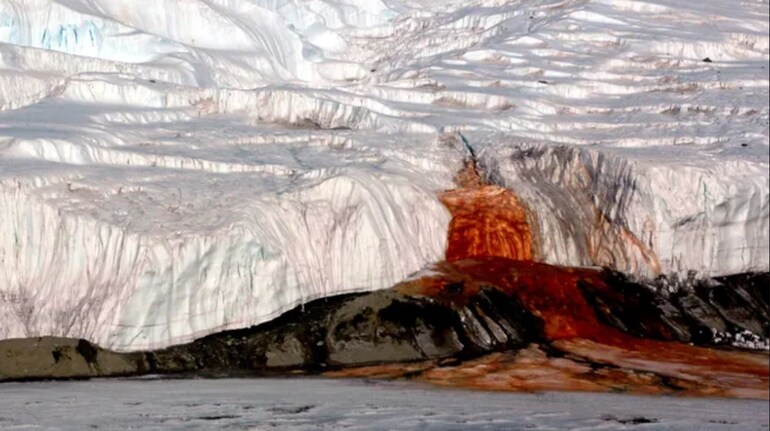

A century after explorers first reported a strange crimson waterfall in Antarctica, scientists say they have finally clarified why Blood Falls pours red from the frozen Taylor Glacier, offering new insight into extreme life on Earth and possibly beyond.
Blood Falls and the Mystery of Red Water
Antarctica is known for endless white ice. Sunlight is limited across much of year. Yet one site breaks that frozen image. Blood Falls spills red liquid over ice. The stream flows from Taylor Glacier. It lies within the McMurdo Dry Valleys. First recorded in 1911, it puzzled explorers. Early theories blamed red algae or sediments. The colour looked eerie against pale surroundings. For decades, the true cause remained unclear.
Scientists later found salty brine beneath glacier. This water remains liquid despite freezing air. High salt content lowers its freezing point. The brine is rich in dissolved iron. When it reaches surface, it meets oxygen. The reaction turns clear liquid deep red. A report by Futura Sciences explained process. The effect resembles rust forming instantly in air.
Iron Nanospheres Identified in 2023 Study
In 2023, researchers refined that explanation further. Ken Livi led a team at Johns Hopkins. They used high resolution electron microscopy. Their findings appeared in Frontiers in Astronomy and Space Sciences. The team discovered amorphous iron nanospheres. These particles lack ordered crystal structure. Earlier X ray studies had missed them. Once exposed to oxygen, they oxidise quickly. This rapid oxidation creates the vivid colour. The study was highlighted by JHU Hub. Scientists described particles as hidden rust sources.
Microbial Life Beneath Taylor Glacier
Beneath the glacier lies an unusual ecosystem. The water is hypersaline and oxygen poor. Microbes survive without sunlight or warmth. They gain energy using iron and sulfur. This process is known as chemosynthesis. Some researchers believe ecosystem is ancient. It may have remained isolated millions of years. Polar Tours has noted its resilience. The discovery reshapes thinking about habitable zones.
Blood Falls also interests space agencies. Conditions resemble icy environments on Mars. Similar brines may exist beneath Martian surface. NASA studies the site as planetary analogue. Europa, a moon of Jupiter, holds icy oceans. Scientists suggest comparable microbes could survive there. National Geographic has reported on these links. Advances in imaging have clarified interactions below ice. Rocks, brine and microbes form complex system. Blood Falls now stands as scientific landmark. It shows life persists in harshest places.
Discover the latest Business News, Sensex, and Nifty updates. Obtain Personal Finance insights, tax queries, and expert opinions on Moneycontrol or download the Moneycontrol App to stay updated!
Find the best of Al News in one place, specially curated for you every weekend.
Stay on top of the latest tech trends and biggest startup news.





