






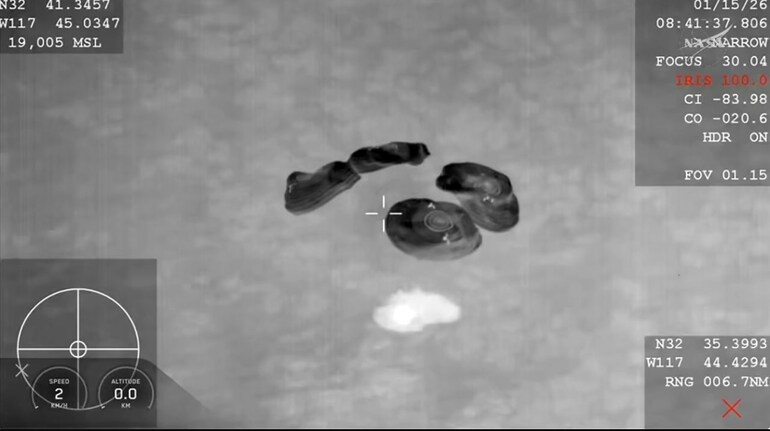

Four International Space Station crew members safely returned to Earth on 15 January 2026 after an unscheduled mission ending linked to the first medical evacuation in the orbiting laboratory’s history, according to NASA footage released Thursday.
The SpaceX capsule carrying the astronauts splashed down in the Pacific Ocean off California near San Diego at 12.41 a.m. local time, ending a mission that began in early August and was originally planned to conclude mid February.
ISS Medical Evacuation and Pacific Splashdown
NASA live infrared video showed the capsule descending steadily through darkness before parachutes deployed, slowing the spacecraft to roughly 15 miles per hour before touching the water. The capsule landed smoothly, marking a rare Pacific recovery for an International Space Station mission.
The returning crew included American astronauts Mike Fincke and Zena Cardman, Russian cosmonaut Oleg Platonov, and Japanese astronaut Kimiya Yui. Fincke served as the Crew 11 pilot during the mission, while Cardman supported scientific research operations. Platonov represented Roscosmos mission integration, and Yui contributed to Japanese space agency research activities aboard the station.
Within an hour, SpaceX recovery teams secured the capsule and lifted it onto a retrieval vessel. The astronauts exited wearing their white and black pressure suits, smiling and giving thumbs up gestures. It was not visually clear which crew member required medical attention.
Welcome home, Crew-11! At 3:41am ET (0841 UTC), the @SpaceX Dragon spacecraft splashed down off the coast of San Diego, California. pic.twitter.com/8LFpdKwizc— NASA (@NASA) January 15, 2026
NASA Crew Health and Medical Decision
After months in microgravity, the astronauts were unable to support their own weight. Each was assisted onto gurneys and moved to an onboard medical station for routine checks. NASA said the crew would then be transported to a nearby hospital for further examinations.
NASA officials declined to identify the ailing astronaut or disclose the medical condition, citing privacy rules. Rob Navias, a NASA spokesperson, said the affected crew member remained stable throughout the return process.
Fincke wrote on social media that all astronauts were safe and receiving proper care. He said the decision allowed full diagnostic evaluations on Earth, describing it as necessary despite emotional difficulty.
James Polk, NASA’s chief health and medical officer, said lingering medical uncertainty prompted the early return. He described the decision as precautionary rather than reactive.
ISS Mission Context and What Comes Next
The Crew 11 team arrived at the station in August 2025 and worked aboard the ISS for nearly 24 weeks. American astronaut Chris Williams and Russian cosmonauts Sergey Kud Sverchkov and Sergei Mikaev remain onboard after arriving in November aboard a Soyuz spacecraft.
The ISS has remained continuously occupied since 2000 and represents ongoing cooperation between NASA, Roscosmos, Japan, Europe, and other partners. Orbiting about 400 kilometres above Earth, the station supports research for future Moon and Mars missions.
Senior NASA official Amit Kshatriya said the crew had trained extensively for medical emergencies and handled the situation professionally. The ISS is scheduled for retirement after 2030, when it will be safely guided to burn up over the Pacific region known as Point Nemo.
Discover the latest Business News, Sensex, and Nifty updates. Obtain Personal Finance insights, tax queries, and expert opinions on Moneycontrol or download the Moneycontrol App to stay updated!
Find the best of Al News in one place, specially curated for you every weekend.
Stay on top of the latest tech trends and biggest startup news.





