






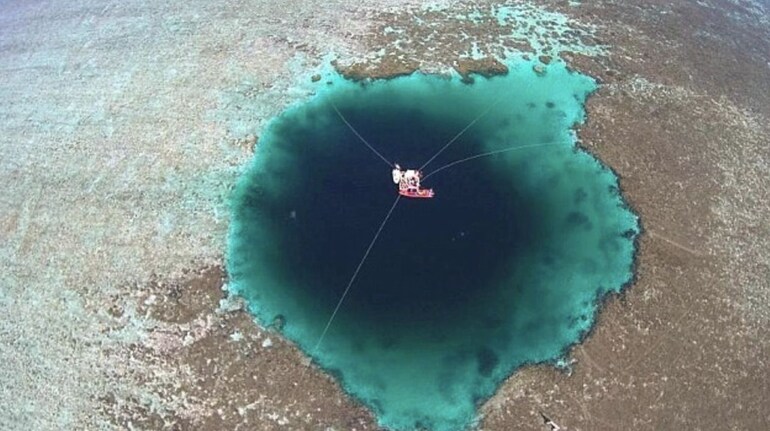

Deep inside the South China Sea lies a giant underwater hole. Scientists call it the "Dragon Hole". It drops nearly 1,000 feet into the ocean floor. Sunlight cannot reach its deepest layers. Water inside rarely mixes with surrounding seas. This creates a closed and isolated environment. Few humans have ever explored its depths.
A Mysterious Sinkhole Beneath the Sea
Deep in the South China Sea lies a vast underwater sinkhole. Known as the Dragon Hole, it plunges nearly 1,000 feet below the surface. It is one of the deepest blue holes on Earth. Steep walls and little water mixing make it unique. The oxygen disappears far below the surface. Yet life still thrives in this extreme place.
Exploration by Chinese Marine Scientists
Researchers from the First Institute of Oceanography led the expedition. They collected water samples from deep inside the sinkhole. Their goal was to study microbes in this isolated environment. Robotic instruments helped reach extreme underwater zones. Scientists wanted to study hidden microbial life. They expected difficult conditions and limited organisms. What they found surprised everyone.
Discovery of 1,700 Unknown Viruses
Laboratory tests revealed nearly 1,700 different viruses. Most were never recorded before. Many did not match any known virus databases. These viruses live mainly in deeper layers. Most infect bacteria and tiny microbes. They help control microbial populations. They form a unique underground viral ecosystem.
Marine Life in Oxygen-Free Waters
Below certain depths, oxygen almost disappears completely. Fish and plants cannot survive here. Sunlight never reaches these dark zones. Only specialised microbes can live in such conditions. They use chemical energy instead of sunlight. Viruses interact closely with these microbes.
Depth of China's deep-sea "Dragon Hole"
The Dragon Hole is nearly 300 metres deep. This is taller than many skyscrapers. It is deeper than most underwater caves. Water pressure increases sharply with depth. Temperatures drop in lower layers. Light disappears after the first few metres. Only specialised equipment can reach the bottom.
These Viruses are not Dangerous
Most of these viruses are harmless to people. They mainly infect bacteria and tiny microbes. They cannot survive inside the human body. Scientists found no evidence of human infection. These viruses remain trapped deep underwater.
What Happens Next in Research?
Chinese scientists plan more expeditions to the Dragon Hole. They will use advanced submarines and robotic sampling tools. Additional water and sediment samples will be collected carefully. Laboratories will analyse viral DNA and microbial communities. They hope to identify more unknown viruses and microbes. The team also plans to compare Dragon Hole with other blue holes.
Discover the latest Business News, Sensex, and Nifty updates. Obtain Personal Finance insights, tax queries, and expert opinions on Moneycontrol or download the Moneycontrol App to stay updated!
Find the best of Al News in one place, specially curated for you every weekend.
Stay on top of the latest tech trends and biggest startup news.





