






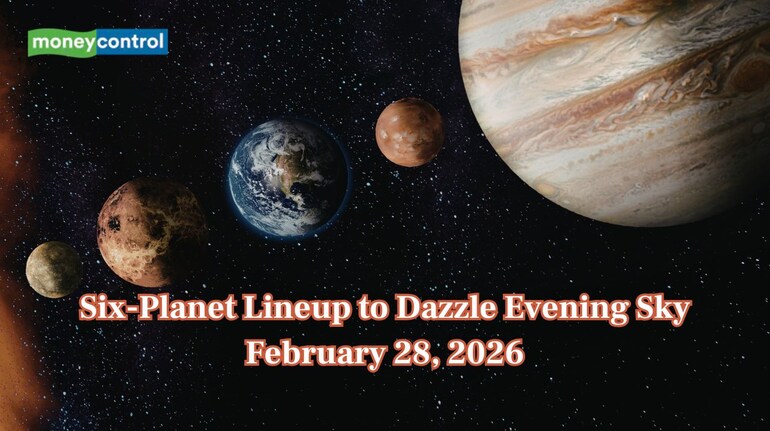

On February 28th, the evening sky will host a rare sight. Six planets will appear in a near-straight line after sunset. Observers will see Mercury, Venus, Jupiter, Saturn, Uranus and Neptune. This planetary parade occurs roughly an hour after the Sun sets. The alignment is visible in the southwestern sky from most regions. Skywatchers are preparing to capture images of this celestial show. Though not extremely rare, the lineup is visually striking and memorable.
What Are the Six Planets?
Mercury, the smallest and closest planet, shines just after sunset. Venus, the brightest, dominates the early evening southwestern sky. Jupiter glows steadily, easily spotted without any special equipment. Saturn appears pale yellow, its rings invisible to the naked eye. Uranus is faint, visible with binoculars or small telescopes. Neptune, the farthest, is subtle and challenging to spot clearly. Together, these six form a celestial parade above Earth’s horizon.
When and Where to See Them?
The event occurs on February 28th, 2026. Planets will be visible roughly 1 hour after the Sun sets. Look toward the southwestern horizon for the clearest view. Open spaces without tall buildings offer the best observation points. Binoculars or small telescopes help reveal faint outer planets.
Cloudy skies may obscure the lineup, so plan accordingly. The event will happen around 6:30 PM – 7:30 PM EST. This is when the sky has grown dark enough and the planets appear above the southwestern horizon.
How Rare Is This Event?
Seeing six planets in one evening is unusual but not unique. Naked-eye visibility of Mercury, Venus, Jupiter, and Saturn is common. Outer planets Uranus and Neptune rarely appear without optical aid. These events occur perhaps once every few years globally.
Timing and local horizon conditions determine whether you can see them. Historically, similar alignments have inspired astronomers and skywatchers alike. This particular parade will be a treat for millions worldwide.
Why This Alignment Happens?
Planets orbit the Sun at different speeds and distances. From Earth, they sometimes appear in a straight line together. The alignment is an optical illusion caused by our perspective. They are never perfectly straight, but close enough to notice.
Gravity keeps planets moving steadily, maintaining predictable orbital paths. Astronomers can calculate alignments decades or centuries in advance. Such events provide rare opportunities for observation and study.
How to See This Event?
No special equipment is needed for Mercury, Venus, Jupiter and Saturn. Binoculars improve Uranus visibility. Telescopes may reveal Neptune’s faint glow. Wait until after the Sun has fully set for safety. Long-exposure photography captures multiple planets in a single frame beautifully.
Discover the latest Business News, Sensex, and Nifty updates. Obtain Personal Finance insights, tax queries, and expert opinions on Moneycontrol or download the Moneycontrol App to stay updated!
Find the best of Al News in one place, specially curated for you every weekend.
Stay on top of the latest tech trends and biggest startup news.





