






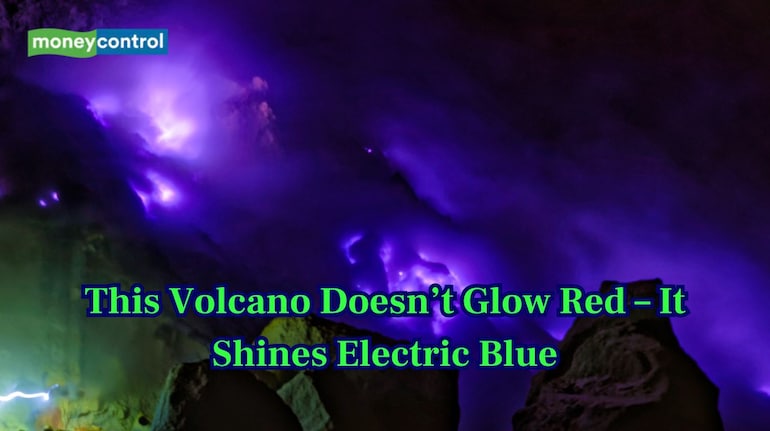

At night, the volcano looks unreal. Its lava shines bright electric blue. A volcano glowing electric blue against the darkness. The sight comes from Indonesia’s Kawah Ijen volcano. Images show rivers of blue fire flowing down volcanic slopes. Many believe the lava itself has changed colour. Science, however, tells a far more fascinating story.
What’s Really Glowing in the Dark?
The molten rock is not blue. It remains the usual red-hot colour. The blue glow comes from burning sulphur gas. Toxic gases escape through cracks in the crater. When they meet oxygen, they ignite. The flames burn at extremely high temperatures. This produces an intense blue light. At night, the effect looks magical. It appears like glowing blue rivers. But it is fire, not lava.
Why Only a Few Volcanoes Show This?
Kawah Ijen contains large sulphur deposits. The gas is released in high concentrations. Most volcanoes do not have this chemistry. This is the reason why blue flames are rare. This makes the site scientifically special. The flames can reach several metres high. They flow downhill like liquid fire. Photographers often capture the spectacle. But the beauty hides serious danger.
The lava from Indonesia's Kawah Ijen volcano has an electric blue appearancepic.twitter.com/2hktnirVdT — Science girl (@sciencegirl) October 18, 2025
Where this Phenomenon Appears?
The spectacle occurs at Indonesia’s Kawah Ijen volcano. Located on Java island, it is among Earth’s most unusual volcanoes. The blue glow is visible only after sunset. During daylight, nothing appears out of the ordinary. At night, the crater transforms dramatically.
Why Scientists Study the Blue Flames?
Volcanic gases reveal underground activity. They help predict eruptions and chemical changes. Sulphur behaviour shows pressure build-up. It also reveals magma movement patterns. Studying Kawah Ijen improves volcanic safety. It helps protect nearby communities. It also improves global volcano monitoring systems. The glowing flames are not just beautiful. They are scientific warning signals.
Nature’s Illusion That Tricks the Eye
At night, human eyes see colour differently. The blue flames dominate the landscape. Red lava becomes harder to notice. This creates the illusion of blue lava. Social media spreads the myth quickly. But geology tells the real story. It is burning gas, not glowing rock. Still, the spectacle remains breathtaking. Few natural sights look so otherworldly.
Discover the latest Business News, Sensex, and Nifty updates. Obtain Personal Finance insights, tax queries, and expert opinions on Moneycontrol or download the Moneycontrol App to stay updated!
Find the best of Al News in one place, specially curated for you every weekend.
Stay on top of the latest tech trends and biggest startup news.





